
Frequently Asked Questions About Room Thermostats and Controllers
A room thermostat is one of those heating system components people talk about least, yet it has a surprisingly large influence on how satisfied you are with your heating and how big your energy bills are. While most households carefully choose and compare the output, efficiency and price of the boiler or heat pump itself, the thermostat is often bought "along with it" without much thought — or the original unit, decades old, that came with the boiler, simply stays in place.
In practice, the same handful of questions keep coming up when choosing and installing a thermostat: what's the difference between a wired and a wireless design, is an original controller straight from the boiler manufacturer worth it, how does weather-compensated control work, what is HDO in relation to electric heating, or how do you set a different temperature in individual rooms without having to manually adjust radiator valve heads. This article works through all these topics in turn, explains the principles without unnecessary technical jargon, and uses specific products to show what the individual solutions look like in practice.
If you're dealing with a heating system renovation, replacing an old boiler with a new one, or just want to lower consumption without touching the heating system, the following sections and the closing FAQ should cover most of the questions we commonly encounter when choosing a room thermostat.
What a room thermostat is and why every heating system needs one
The basic principle of how a room thermostat works.
A room thermostat is a device that measures the temperature in a room and, according to the set value, switches the heat source — boiler, heat pump or electric heating unit — on or off (or smoothly modulates its output). The principle is simple at first glance: the thermostat compares the measured temperature with the one you set, and when the room is cooler, it instructs the heat source to heat. As soon as the desired temperature is reached, heating is stopped or reduced.
Without a thermostat, the boiler would heat continuously at full output regardless of the actual room temperature. In practice this means overheating — the house is needlessly warm, windows have to be aired even in winter, and gas, electricity or other fuel consumption rises without bringing any real extra comfort. A thermostat is therefore one of the cheapest investments in a heating system, one that pays for itself very quickly — it's not a cosmetic extra, but a control element that decides whether the boiler works efficiently or needlessly runs idle.
It's also important that a thermostat isn't tied only to gas boilers. The same measuring and temperature-control principle also works with heat pumps and with electric heating units (convectors, electric boilers, storage furnaces). The difference is in how the thermostat communicates with the heat source — more on that in the section on original and universal controllers below. Anyone wanting a more comprehensive overview before buying can also read the separate guide How to choose a room thermostat, which covers choosing by boiler type, household size and budget.
Wired and wireless thermostat connections — the main differences.
Wired or wireless thermostat — which to choose
The first decision almost everyone faces when choosing a thermostat is the choice between a wired (cabled) and a wireless design. Both types basically do the same thing — measure the temperature and instruct the boiler to heat — they only differ in how they send the signal.
A wired thermostat connects to the boiler's controller with a two-core wire. The advantage is high reliability and the fact that it doesn't need batteries — as long as it's connected, it works. The disadvantage is that it requires running a cable from where the thermostat is to hang (usually the living room, the spot that best represents the average temperature of the flat or house) all the way to the boiler. In a new build or a complete renovation, where the electrical wiring is being redone from scratch anyway, this isn't a problem — the cable is simply planned along with the rest of the wiring. In a flat or house that's already inhabited and has no pre-prepared cable route, it's more complicated — it means either cutting a channel into the wall and subsequent repairs, or running the cable on the surface, which isn't always an aesthetically acceptable solution.
A wireless thermostat communicates with the receiver at the boiler via a radio signal, usually on a frequency of 868 MHz. Thanks to this, installation is substantially faster and without any breaking into walls — you just need to fix the thermostat's transmitting unit to the wall (or simply set it on a table or shelf) and pair it with the receiver at the boiler. This convenience comes with two trade-offs: the transmitter needs batteries, which need to be replaced occasionally, and in densely built-up spaces (flats in panel buildings, with many other wireless devices in range) the signal can be more sensitive to interference than with a wired connection.
In practice this means: if you're renovating from scratch or building a new house, a wired solution is easier to run at this stage and removes the future worry about batteries. If you're just replacing the thermostat in a flat or house where you're not planning to break into walls, a wireless thermostat is practically the only sensible choice. A specific example of a wireless solution is the programmable thermostat Avansa 2007 TX, which consists of a transmitter and a receiver and requires no cabling between the temperature-measuring location and the boiler:
 |
Avansa 2007 TX Wireless programmable thermostat — the transmitter and receiver communicate via a radio signal, so there's no need to run a cable from the thermostat to the boiler. Suitable especially when replacing a thermostat in a flat or house without a prepared cable route. Price: €56.31 View product → |
You'll find a more detailed comparison of both solutions, including recommendations for specific situations, in the separate article Wired vs. wireless thermostat.
Manual, programmable or WiFi thermostat — which type is best for you
Besides the method of connection (wired/wireless), thermostats also differ in how much intelligence they have "inside" — that is, how sophisticatedly they can control temperature over the course of a day and week.
The simplest type is a manual (mechanical) thermostat. It has only a rotary dial, with which you set a single target temperature, and the thermostat tries to maintain it continuously — regardless of whether it's day or night, whether you're home or at work. It's the cheapest option, but has one fundamental weakness: it can't lower the temperature on its own when it isn't needed, for example at night, when you're under a blanket anyway, or during the day, when the whole household is at work or school. A typical representative of this category is the thermostat Avansa TH1 — simple, reliable and cheap, suitable for example as a basic replacement for a broken original thermostat where no further automation is planned.
A programmable (weekly) thermostat solves exactly this weakness. It lets you set different temperatures for different times of day and different days of the week — for example a lower temperature during the night and when the flat is empty, and a higher one shortly before the family wakes up or returns home. The typical saving compared to a manual setting is noticeable especially from the temperature drop during the night and absence, since these hours make up a large part of the day during which a higher temperature brings no real extra comfort. This category includes, for example, the thermostat Euroster Q7 with a display and a weekly program:
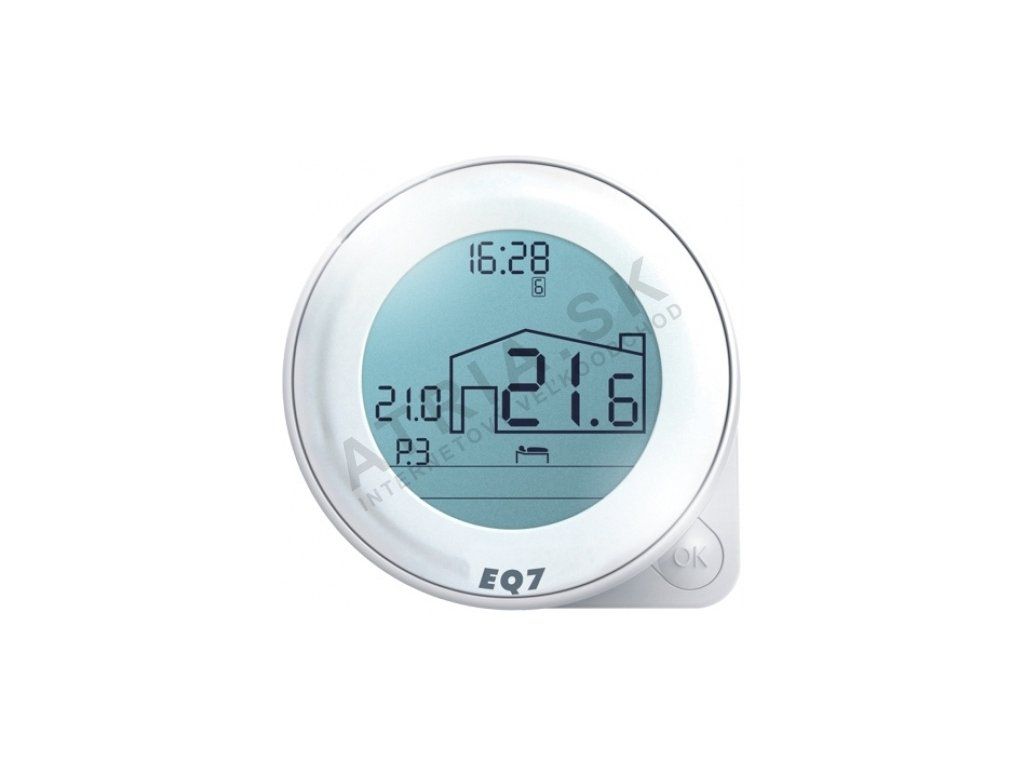 |
Euroster Q7 Programmable weekly thermostat with a display — lets you set different temperatures for individual days of the week and time periods, so heating happens exactly when needed, not continuously at one temperature. Price: €74.29 View product → |
The highest category is the WiFi (smart) thermostat, which adds remote control and monitoring via a mobile app from anywhere on top of programming — not just at home, but for example also from work, on holiday, or on the way home, when you want the flat to be warm exactly when you arrive. Specific WiFi solutions tied to a boiler brand are discussed in the next section. You'll also find a complete comparison of all three levels in the article Manual vs. programmable vs. WiFi thermostat.
The price difference between common thermostats and original WiFi controllers from the boiler manufacturer.
Original controller from the boiler manufacturer or universal thermostat
This is probably the most frequent question we deal with directly in sales: does it make sense to pay extra for an original controller from the boiler manufacturer, or is a universal thermostat of a different brand completely enough?
An original controller from the boiler manufacturer — for example Bosch Easycontrol, Protherm MiGo or Vaillant eRELAX — communicates with the boiler over a digital bus, for example the eBUS or OpenTherm protocol. Thanks to this two-way digital communication it can not only switch heating on and off, but smoothly modulate the boiler's output exactly according to current need, display error messages directly from the boiler (so an invisible fault doesn't just show up as cold radiators, but as a specific message right in the app), and in many cases also control the compensation curve, discussed in the next section.
A universal thermostat — for example of the brand Avansa, Euroster or Salus — works more simply: it just closes and opens an electrical circuit (contact), which the boiler evaluates simply as a "heat" or "don't heat" signal. This is not smooth output modulation according to precise need, but a binary on/off command. The advantage is a lower price and the fact that a universal thermostat works with almost any boiler, heat pump or electric heating unit regardless of brand. An original controller, on the other hand, offers smoother control and more features, but generally only works for the specific boiler brand it was made for.
In practice this means a simple rule: if you're replacing or adding a controller to a specific modern boiler that supports eBUS or OpenTherm, an original WiFi controller from the manufacturer will bring you noticeably more — smoother control, diagnostics and possibly weather compensation all in one package. If you need a cheaper, universal solution, or the boiler doesn't support this kind of communication, a universal thermostat will fulfil its basic function just as reliably. Two examples of original WiFi controllers we offer:
 |
Bosch Easycontrol CT 200 Original WiFi/smart room controller for Bosch and Junkers boilers — communicates with the boiler over a digital bus, control and monitoring via mobile app from anywhere. Price: €356.68 View product → |
 |
Protherm MiGo Original WiFi controller for Protherm boilers — control and monitoring via mobile app, smooth communication directly with the boiler's control unit. Price: €222.48 View product → |
If you're not sure which category is right for your specific boiler, we recommend also reading the more detailed comparison in the article Original boiler controller vs. universal thermostat.
How weather-compensated control works and whether it's worth it for you
Weather-compensated control is a topic often mentioned alongside the room thermostat, but it actually addresses a different problem. While the room thermostat reacts to the temperature measured inside the room, weather-compensated control doesn't control heating only according to room temperature, but primarily according to the outdoor temperature measured by a separate outdoor sensor.
The principle is as follows: according to a pre-set compensation curve, the boiler calculates on its own what temperature it should heat the heating water to (i.e. the water flowing into the radiators or underfloor heating), so that the house has a stable, even temperature regardless of whether it's freezing outside or the weather is milder. When the outdoor temperature drops, the boiler automatically raises the heating water temperature. When it gets warmer outside, the heating water temperature drops — without you having to manually adjust anything.
The best result — both the most precise and the most economical — comes from combining both systems, so-called cascade control: the compensation curve sets the basic heating water temperature according to the weather outside, and the room thermostat fine-tunes this further according to the actual temperature right in the living space. Thanks to this, the heating system can adapt not only to changes in the weather, but also to small influences the compensation curve alone doesn't pick up — for example sunlight through windows, heat from cooking in the kitchen, or the fact that there happen to be more people in the room.
This is exactly why original WiFi controllers from boiler manufacturers (mentioned in the previous section) often have weather-compensation support built directly into the app — they can communicate with the boiler's control unit in enough detail to set the curve too, not just a simple heat/don't-heat command. You'll find a detailed guide to setting the compensation curve in the article How weather-compensated control works.
HDO and a room thermostat — how they work together with electric heating
This topic doesn't concern gas boilers, but mainly households with electric heating — electric boilers, storage systems or direct electric heating units. HDO (ripple control) is a signal from the electricity distributor that switches between a high and a low, i.e. night, tariff.
A thermostat with an HDO input can recognise when the cheaper (low) tariff is active and adjust its behaviour accordingly. A typical setup works so that outside the active HDO signal (i.e. during the more expensive high tariff) a lower comfort-temperature threshold is set, to save energy, while during active HDO, when electricity is cheaper, the comfort threshold is raised and the heating system can "charge" more heat — for example into storage mass or into a tank — at a more favourable price.
Important note: not every thermostat on the market has an HDO input. If you have or are planning an electric boiler with a dual-tariff rate, this is one of the first things to check when choosing a thermostat — a thermostat without an HDO input simply can't tell which tariff is currently active, and won't be able to make use of the price difference between the high and low bands. You'll find a complete explanation, including practical recommendations, in the article Ripple control (HDO) and a room thermostat — how they work together.
Zone control — different temperature in every room
While a classic room thermostat handles control of a single temperature for the whole house or flat (or for one circuit), zone control goes a step further. It divides the house into several independent circuits — zones — each of which has its own thermostat and its own control valve, a so-called actuator, located on the manifold or directly on the radiator.
The result is that you can have, for example, 22 °C in the living room and 18 °C in the bedroom at the same time, without having to manually adjust radiator valve heads every time the weather or time of day changes. Each zone lives its own life according to the thermostat set for that particular room.
Zone control is most often and most naturally combined with underfloor heating, where typically each room has its own loop of pipework and its own thermostat controlling an actuator directly on the manifold. It's precisely with underfloor heating, where the system's inertia is greater than with radiators and where individual rooms (bathroom, bedroom, living room) often differ most in required temperature, that zone control brings the greatest real comfort and savings. We discuss it in more detail in the article Zone heating control.
Real-life examples
Three typical real-life situations and the recommended thermostat solution.
A family house with the original gas boiler and a manual thermostat. A family house that's empty during the day on working days — children at school, parents at work — where the original manual thermostat, from when the boiler was replaced, is set to a single constant temperature of 21 °C, continuously, 24 hours a day. In practice this means the house is needlessly heated to the full comfort temperature even while no one's in it, and likewise at night, when a lower temperature of 17–18 °C would be more pleasant for sleeping and more economical. The solution in this situation is replacing the manual thermostat with a programmable or directly a WiFi thermostat, which lets you set a lower temperature during the day (while the house is empty) and at night, and a higher one shortly before the family wakes up in the morning or returns home in the evening. If the boiler in the house is more modern and supports eBUS or OpenTherm communication, instead of a universal programmable thermostat it's worth considering an original WiFi controller from the boiler manufacturer — this also brings smooth output modulation and an overview of any faults directly in the app.A flat in a panel building with one radiator circuit and different room temperature requirements. A flat in a panel building heated from a central source, where the whole flat is on one shared circuit and a single thermostat located in the living room. The problem arises when the flat's occupants want a cooler temperature in the bedroom for sleeping, while in the living room, where they spend their evenings, they like a warmer environment — but one central thermostat in the living room can only control one shared temperature for the whole flat, so the difference between rooms can only be handled by manually turning radiator valve heads up and down, which in practice quickly gets tiresome and usually isn't kept up consistently. The solution is zone control — a separate thermostat and control head for the bedroom, a separate one for the living room — thanks to which each room maintains exactly the temperature its occupants prefer, without needing to manually adjust anything day to day.
Bathroom and kitchen renovation with underfloor heating added. A flat or house where, during a bathroom and kitchen renovation, electric or water-based underfloor heating was added alongside the original radiators in the other rooms. By the nature of their use, the bathroom and kitchen have completely different heat and timing requirements than, say, a bedroom or living room — the bathroom needs heat mainly in the morning and evening when showering, the kitchen needs less since cooking itself brings heat too. In such a combined system (radiators plus underfloor heating in other rooms), it makes sense to deploy separate thermostats for the underfloor circuits with their own program, independent of the rest of the house, ensuring the bathroom isn't heated at full output all day just because the bedroom requires it.
Frequently asked questions
Is it really worth buying a thermostat, when the boiler works fine without one?
Yes. Without a thermostat, the boiler heats continuously at full output regardless of the actual room temperature, which leads to overheating and needlessly high consumption. A thermostat is one of the cheapest and fastest-paying-back investments in the whole heating system.
Should I choose a wired or a wireless thermostat?
A wired thermostat is reliable and doesn't need batteries, but requires running a cable to the boiler, which is easiest to handle in a new build or a complete renovation. A wireless thermostat installs quickly and without breaking into walls, communicates via a radio signal (usually 868 MHz), but needs batteries and can be more sensitive to interference in densely built-up spaces.
What's the difference between a manual, programmable and WiFi thermostat?
A manual thermostat has only a rotary dial for a single target temperature and cannot lower the temperature on its own at night or while away. A programmable (weekly) thermostat lets you set different temperatures for different times of day and days of the week. A WiFi/smart thermostat adds remote control and status monitoring via a mobile app from anywhere on top of programming.
Is it worth paying extra for an original controller from the boiler manufacturer?
An original controller (for example Bosch Easycontrol, Protherm MiGo, Vaillant eRELAX) communicates with the boiler over the digital bus eBUS or OpenTherm, thanks to which it can smoothly modulate the boiler's output, display error messages directly from the boiler, and sometimes also control the compensation curve. A universal thermostat only closes and opens a circuit, and the boiler evaluates that as a simple heat/don't-heat signal. An original controller only works for the given boiler brand; a universal thermostat is cheaper and works with almost any boiler.
What is weather-compensated control and do I need it alongside a room thermostat?
Weather-compensated control adjusts the heating water temperature according to the outdoor temperature measured by an outdoor sensor, not according to the room temperature. Combining weather-compensated control with a room thermostat (cascade control) gives the most precise and most economical result, since they complement each other — one reacts to the weather outside, the other to the actual temperature inside.
What does HDO mean for a thermostat, and does it apply to me?
HDO is a signal from the electricity distributor that switches between a high and a low (night) tariff, and it mainly concerns electric boilers and storage systems. A thermostat with an HDO input can recognise the active cheaper tariff and adjust heating behaviour accordingly. If you have an electric boiler with a dual-tariff rate, check when choosing whether the thermostat has an HDO input — not every model does.
Can I have a different temperature in every room without manually adjusting the radiators?
Yes, that's exactly what zone control is for. The house is divided into several independent zones, each with its own thermostat and its own control head on the manifold or radiator. It's commonly combined with underfloor heating, where typically each room has its own loop and its own thermostat controlling an actuator on the manifold.
Does a universal thermostat work with a heat pump or an electric heating unit too, or only with a gas boiler?
A thermostat generally measures temperature and instructs the heat source — whether a boiler, heat pump or electric heating unit — to switch on or off. Since a universal thermostat works via a simple switching contact, it can work together with almost any type of heat source. An original controller from the manufacturer, by contrast, is always tied only to the specific brand and type of boiler it was made for.
Related topics
- How to choose a room thermostat
- Wired vs. wireless thermostat
- Manual vs. programmable vs. WiFi thermostat
- Original boiler controller vs. universal thermostat
- How weather-compensated control works
- Ripple control (HDO) and a room thermostat — how they work together
- Zone heating control
- Installing and wiring a room thermostat
- Thermostat service and common faults
Have a question about choosing a room thermostat?
Can't decide, or dealing with a specific situation in your household? Write to us — we're happy to help.