
Zone Heating Control
Imagine a house where the living room has a pleasant 22 °C, the bedroom has a cooler 18 °C ideal for sleeping, and the hallway or storage room has just enough heat to keep the pipes from freezing — all at the same time, without you having to run from radiator to radiator manually adjusting valve heads. That's exactly what zone heating control makes possible. Instead of a single thermostat deciding on heat for the whole house at once, zone control divides the space into several independent circuits, each with its own thermostat and its own control element.
In practice this means significantly higher comfort (each room has exactly the temperature it needs) and generally also lower energy consumption, since heating doesn't happen needlessly where it isn't needed — for example in a room nobody uses during the day, or in a bedroom where a lower temperature is even desirable. Zone control can be set up with classic radiators as well as with underfloor heating; only the technical implementation of the individual zones differs.
In this article we'll explain how zone control works, what the difference is between a wired and a wireless solution, which types of thermostats are suitable for zones, how it can be combined with weather-compensated control and the HDO tariff, and we'll show, using real-life examples, what such a system looks like in an actual family house and in a flat.
What zone heating control is and how it works
Before we look at zones, it's worth recalling the basics — what a room thermostat actually does. A room thermostat measures the temperature in a room and, according to the set value, switches the heat source — boiler, heat pump or electric heating unit — on or off (or modulates its output). Without a thermostat, the boiler would heat continuously at full output regardless of the actual room temperature, which leads to overheating and needlessly high consumption. This exact switching on/off is the basic building block that zone control is also based on — except that instead of one thermostat for the whole house, there are several, each responsible for its part of the house.
Zone control divides the house into several independent circuits (zones), each of which has its own thermostat and its own control valve (actuator) on the manifold or radiator. This makes it possible to have 22 °C in the living room and 18 °C in the bedroom at the same time, without having to manually adjust radiator valve heads. Each zone thus works as a separate small heating system with its own decision-making — the thermostat in a given room doesn't care what's happening elsewhere in the house, it only takes care of "its own" temperature.
This is how control of a single zone works — the thermostat decides on opening and closing the valve based on the measured temperature.
Technically, a zone is usually implemented in one of two ways. With radiator heating, it's a motorised actuator on the radiator valve, controlled by the corresponding room thermostat — when the room temperature drops below the set value, the actuator opens the valve and hot water flows into the radiator; once the required temperature is reached, the valve closes back again. With underfloor heating, instead of an actuator on the radiator, an actuator directly on the manifold is controlled, specifically on the circuit belonging to that room. The principle is the same; only the point of intervention changes.
It's important that individual zones may or may not be connected to the boiler's central control. In simpler systems, each thermostat just opens and closes its own valve, and the boiler runs according to its own internal logic (for example according to one "main" space or according to a compensation curve). In more elaborate systems, zone thermostats also communicate with the boiler's controller, so the boiler knows how many zones are currently "requesting" heat and adjusts its output accordingly — this is more efficient, but more technically demanding to set up.
Wired vs. wireless zone control
The main difference between a wired and a wireless zone solution lies in the method of installation and maintenance.
When building zone control, one of the first decisions is whether to connect zones with cables or use wireless communication. Exactly the same applies here as with a single room thermostat: a wired (cabled) thermostat connects to the boiler's controller (or in this case to the actuator on the manifold or radiator) with a two-core wire — it's reliable, without batteries, but requires running a cable from the thermostat to the boiler, or to the manifold, which is problematic when renovating a flat without a pre-prepared route.
With zone control this problem multiplies with the number of zones — if a house has, say, five zones, that potentially means five separate cable routes running from each room all the way to the distribution board or manifold. That's why a wired solution is most often deployed in new builds or complete renovations, where walls are being broken into and new wiring laid anyway — in that case, adding a cable for the thermostat is a marginal cost.
A wireless thermostat communicates with the receiver at the boiler (or at the manifold) via a radio signal, usually on a frequency of 868 MHz — installation is faster and without breaking into walls, but requires batteries in the transmitter, and in densely built-up spaces it can be more sensitive to interference. With zone control, exactly this feature — no breaking into walls — is the main reason a wireless solution has become the standard for retrofitting zones into an already-inhabited flat or house. You just need to mount the thermostat on the wall in the given room, the actuator on the corresponding valve or circuit at the manifold, and pair them via radio signal — without a single cut into the plaster.
The disadvantage remains the need for regular battery replacement in the transmitters (typically once every one to two years, depending on the thermostat type) and a theoretical sensitivity to interference in an environment with many other wireless devices. In apartment buildings with thicker reinforced-concrete walls, it's also necessary to check the signal range between the thermostat in the flat and the receiver, which may be, for example, in another room or near the riser.
When choosing between a wired and a wireless solution for zone control, it's worth looking at the more detailed comparison too: Wired vs. wireless thermostat.
Types of thermostats suitable for individual zones
Comparison of indicative prices for the three types of thermostats mentioned in the article.
Not every zone in a house needs an equally "smart" thermostat. An ordinary hallway or storage room is fine with the simplest solution, while a living room or bedroom, where you spend most of your time, will benefit from a programmable or smart thermostat. Thermostats break down by feature level as follows:
A manual (mechanical) thermostat has only a rotary dial for setting a single target temperature — it's the cheapest, but cannot lower the temperature on its own at night or during the day when you're not at home. For a zone where you want a constant temperature all the time (for example a utility room or hallway), this is a fully adequate and economical solution. A typical example of this category is the Avansa TH1 thermostat.

Avansa TH1
Simple manual (mechanical) room thermostat with a rotary dial. Ideal for zones where it's enough to maintain a single constant temperature without programming — hallways, utility rooms, storage rooms.
Price: €10.61
View productA programmable (weekly) thermostat lets you set different temperatures for different times of day and days of the week — the typical saving compared to a manual setting is noticeable especially from the temperature drop during the night and absence. This is precisely the type of thermostat most often installed in the "main" zones of a house — living room, bedroom, children's room — where it makes sense to distinguish day and night temperatures, or a working-day and weekend regime. A wireless programmable thermostat, such as the Avansa 2007 TX, is a practical choice for retrofitting zoning into a flat or house precisely because both transmitter and receiver are installed without any need for cabling.

Avansa 2007 TX
Wireless programmable thermostat, transmitter and receiver without the need for cabling. Suitable for retrofitting a zone into a living room, bedroom or children's room without breaking into walls.
Price: €56.31
View productThe next step up is a programmable thermostat with its own display, which offers clearer setting of the weekly program and often more precise temperature control too. An example is the Euroster Q7 — a thermostat with a display showing the current and set temperature, letting you easily switch between days of the week. For zones with higher demands on precision (for example a room where you work from home and need a stable temperature at precisely defined hours), this category is a sensible compromise between price and control comfort.
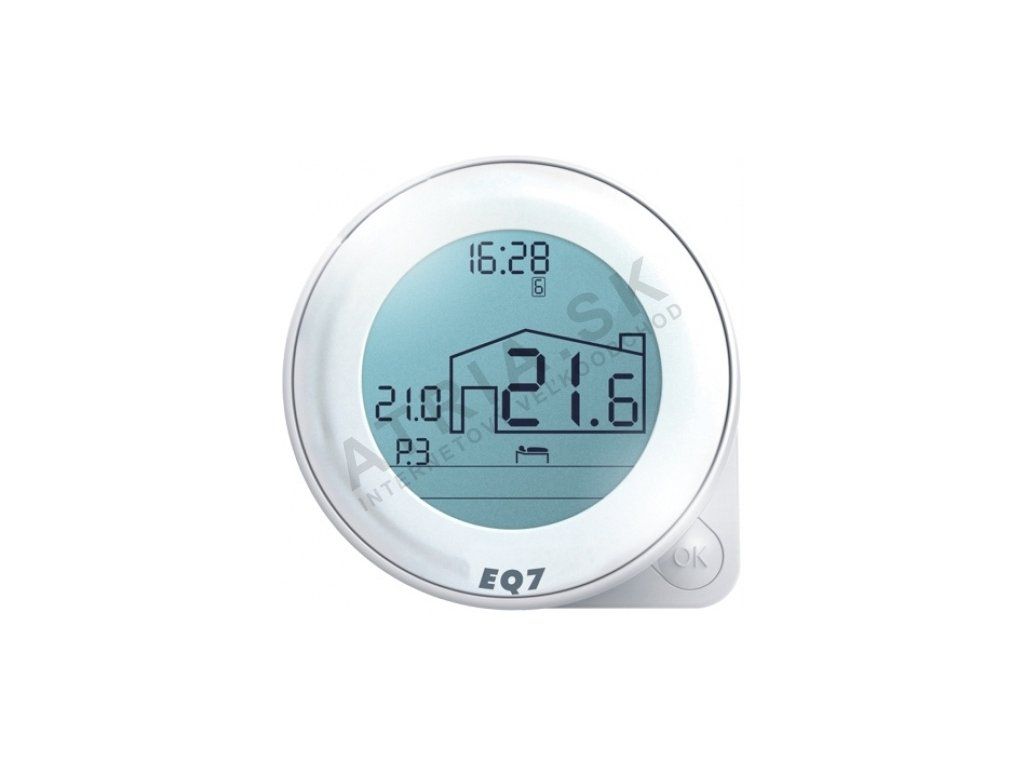
Euroster Q7
Programmable weekly thermostat with a display. Clear setting of several temperature levels throughout the day, suitable for zones with higher demands on control precision.
Price: €74.29
View productA WiFi/smart thermostat adds remote control and monitoring via a mobile app from anywhere on top of programming. With zone control this is useful especially when you want to have an overview and the ability to intervene in several zones at once — for example lowering the temperature in the children's room from bed in the morning, or checking remotely during a holiday whether some zone isn't heating needlessly. You'll find a more detailed comparison of all three categories in the article Manual vs. programmable vs. WiFi thermostat, which also explains how to combine the types across different zones of the same house — you don't have to have the same category of thermostat in every room.
Original controller from the boiler manufacturer vs. universal thermostat in a zone system
When building zone control, you also need to address how the individual zones will communicate with the heat source — that is, with the boiler. There are essentially two approaches here. An original controller from the boiler manufacturer (for example Bosch Easycontrol, Protherm MiGo, Vaillant eRELAX) communicates with the boiler over a digital bus, for example eBUS or OpenTherm — it can smoothly modulate the boiler's output according to current need, display the boiler's error messages, and sometimes also control the compensation curve.
A universal thermostat (for example Avansa, Euroster, Salus) works more simply — it only opens/closes a circuit (contact), which the boiler evaluates as a "heat/don't heat" signal. A universal thermostat is cheaper and works with almost any boiler, while an original controller offers smoother control and more features, but only for the given boiler brand.
With zone control, these two approaches can also be combined. A common, field-proven model is as follows: one "main" zone (most often the living room or the room with the greatest heat loss) communicates with the boiler via the manufacturer's original controller, which controls the boiler's overall output, while the other zones (bedrooms, children's rooms, hallways) have universal thermostats that just open and close their own actuators on the manifold or radiators. The boiler thus still gets information about the current heat demand from the main zone and modulates its output accordingly, while individual rooms independently regulate the flow into their own circuit.
If you have a Bosch or Junkers boiler, the original WiFi controller Bosch Easycontrol CT 200 lets you control heating via a mobile app and also displays status and error messages directly from the boiler — which is handy especially for remote diagnostics, when you're away from home and need to find out why the boiler isn't heating.

Bosch Easycontrol CT 200
Original WiFi/smart room controller for Bosch/Junkers boilers, controlled via mobile app. Suitable as the main zone communicating directly with the boiler over the bus.
Price: €356.68
View productSimilarly, if you heat with a Protherm boiler, the same role of main zone can be filled by the original WiFi controller Protherm MiGo, which also communicates directly with the boiler and offers control via a phone app.

Protherm MiGo
Original WiFi controller for Protherm boilers, controlled via mobile app. Suitable as the main zone communicating directly with the boiler, with other zones handled by universal thermostats.
Price: €222.48
View productWhich approach is more suitable for your house, and what to watch out for when combining an original and a universal controller in one system, is discussed in detail in the article Original boiler controller vs. universal thermostat.
Zone control and weather compensation — the most economical combination
Zone control addresses the distribution of heat within the space of the house, but there's one more dimension of control that works with time and outdoor conditions — weather-compensated control. Weather-compensated control doesn't control heating only according to room temperature, but mainly according to the outdoor temperature measured by an outdoor sensor — according to a pre-set compensation curve, the boiler calculates on its own what temperature it should heat the heating water to, so the house has a stable temperature regardless of whether it's freezing outside or the weather is milder.
Combining weather-compensated control with a room thermostat (so-called cascade control) gives the most precise and most economical result. In the context of zone control this means that, thanks to the compensation curve, the boiler prepares the heating water at the "right" temperature already based on the weather outside, and the individual zone thermostats then just finely adjust whether this water flows into a given room or not. The result is a system that doesn't need large swings in boiler output — it runs more smoothly and efficiently — while each room still has exactly the temperature you've set for it.
Without weather-compensated control, in a zone system it can happen that the boiler runs at one fixed heating water temperature regardless of outdoor conditions, and the zones then simply open and close their valves more or less often. It works, but it's not as smooth and efficient as when the heating water temperature adjusts automatically to the weather. That's exactly why, with larger houses with multiple zones, it's recommended to consider weather-compensated control as an addition to the zone system, not as a replacement.
You can read exactly how the compensation curve works, how it's set, and when it's worth investing in an outdoor sensor, in the article How weather-compensated control works.
Zone control and HDO with electric boilers
If the heat source is an electric boiler or a storage system, one more factor comes into play — electricity tariffing. HDO (ripple control) is a signal from the electricity distributor that switches between a high and a low (night) tariff — it mainly concerns electric boilers and storage systems. A thermostat with an HDO input can recognise when the cheaper tariff is active and adjust its behaviour accordingly — for example a lower comfort threshold outside HDO to save energy, and a higher one during HDO, when electricity is cheaper.
With zone control combined with HDO, a typical approach is to set a slightly lower target temperature in all zones outside the HDO band (for example during the day, when the high tariff applies) and a higher temperature during HDO (typically at night and a few hours during the day, depending on the distributor). Thanks to zone control, this can also be graded according to which room is currently in use — a children's room can have higher comfort even outside HDO, while a hallway or storage room can "save" during the more expensive tariff without anyone noticing.
Not every thermostat has an HDO input — this needs to be checked when choosing, if you have an electric boiler with a dual-tariff rate. With a zone system this applies especially strictly — if you plan to use HDO logic across several zones, every thermostat that needs to react to it must have access to the HDO signal (usually brought in via a separate wire from the electricity meter or distribution board), or the central unit needs to be able to distribute the HDO state to the individual zones. This topic is covered in detail in the article Ripple control (HDO) and a room thermostat — how they work together.
Zone control combined with underfloor heating
Zone control is commonly combined with underfloor heating, where typically each room has its own loop and its own thermostat controlling an actuator on the manifold. In fact, underfloor heating is the environment where zone control makes the most sense — since each room already has its own separate loop (or several loops) connected to a shared manifold for structural reasons anyway, all you need to do is add a thermostat and an actuator to this existing infrastructure, and the zone is complete without further building work.
The thermal inertia of underfloor heating is higher than with radiators — the floor heats up and cools down more slowly. This also has a consequence for zone control: temperature settings shouldn't be too aggressive (for example a sharp night-time drop of several degrees expecting an equally fast reheat in the morning), because the floor reacts to a change with a delay on the order of hours, not minutes. With underfloor heating, therefore, milder temperature differences between day and night are recommended for zone control, along with programmable or smart thermostats that know in advance when a zone's "warm-up" needs to start so the required temperature is reached exactly when you need it.
The combination of zone control with underfloor heating is also where the advantage of an original controller with a compensation curve shows up most often — the floor, after all, "wants" a more stable, smoothly regulated heating water temperature, rather than sudden switching on and off at full output.
Installation and technical aspects of zone control
When implementing zone control, the first step is deciding how many zones the house actually needs. It's not necessary (or even economically sensible) to have a separate zone for absolutely every room — common practice is to group rooms with similar temperature requirements and usage patterns into one zone (for example bedrooms into one zone, common living areas into another, utility and storage spaces into a third).
The next step is choosing between a wired and a wireless solution for each zone (more in the section above), and deciding which zone will be the "main" one from the point of view of communicating with the boiler, if the manufacturer's original controller is to be used. Actuators on the manifold are usually powered from a central unit located directly at the manifold, which collects signals from the individual zone thermostats (wired or wireless) and opens or closes the corresponding circuits accordingly. With radiator heating, motorised actuator heads are mounted directly onto the existing radiator valve, which in most cases can be done afterwards without needing to change the pipework.
The exact wiring procedure, the recommended placement of the thermostat in a room (away from direct sunlight, away from draughts from doors or windows, at a reasonable height), and common installation mistakes that distort the measured temperature, are described in the article Installing and wiring a room thermostat. If a problem appears in the system's operation — for example a zone that "doesn't respond", or a thermostat showing an incorrect temperature — you'll find an overview of the most common faults and their solutions in the article Thermostat service and common faults.
Real-life examples
A family house with radiator heating and a Bosch boiler.
An example of a real division of a family house into three separate heating zones.
A flat in a panel building with underfloor heating in the bathroom and radiators in the other rooms. A three-room flat, after renovation, had electric underfloor heating added in the bathroom (for a pleasant feeling underfoot), while the rest of the flat stayed on the original radiators connected to the building's central heating, with its own HDO tariff for the flat's electrical connection. Since it wasn't possible to run new cables in the flat without disturbing already-finished floors and walls, an exclusively wireless solution was chosen. The bathroom got its own thermostat with an HDO input, set to maintain a slightly higher floor temperature during the cheaper night tariff (making use of cheaper electricity), and a slightly lower one outside the HDO band, since the floor's thermal inertia naturally evened out the difference. The living room and bedrooms each got their own programmable thermostat with a wireless actuator on the radiator valve, with a different day and night program for the bedroom (lower temperature for sleeping) compared to the living room (constant comfortable temperature during the day and evening). The whole installation was carried out without a single intervention into the already-finished surfaces, since all the components communicated by radio.
FAQ — frequently asked questions about zone heating control
How many zones does an ordinary family house need?
There's no universal number — it depends on the layout and on how much temperature requirements differ between rooms. Common practice is to group rooms with a similar usage pattern (bedrooms, common living areas, utility spaces) into several zones instead of one zone per room — three to five zones will cover the needs of most family houses.
Can zone control be retrofitted into a flat where the renovation is already finished?
Yes, that's exactly what wireless thermostats and wireless actuators are for — they communicate via a radio signal (usually 868 MHz), so there's no need to break into walls or run new cables. The only things that need to be resolved are power availability for the actuator at the manifold or radiator, and the signal range between the thermostat and the receiver.
Does zone control require using the boiler manufacturer's original controller?
No. A common and functional combination is one main zone with an original controller (communicating with the boiler over a bus such as eBUS or OpenTherm), while the other zones work with cheaper universal thermostats that just switch their own actuator.
Is zone control worth it in a small flat too, or only in a large house?
Zone control makes the most sense where there are real differences between rooms in required temperature or usage time — this applies to smaller flats too, for example if a flat has a bedroom you want cooler at night and a living room where you spend your evenings. In very small flats with one main living room, the benefit may be smaller.
How does zone control relate to weather-compensated control?
These are two different, mutually complementary mechanisms. Weather-compensated control adjusts the heating water temperature to the outdoor weather (according to a curve set on the outdoor sensor), while zone control decides which rooms this water actually flows into. Together (so-called cascade control) they give the most precise and most energy-economical result.
Does zone control work with an electric boiler on a dual-tariff rate (HDO) too?
Yes, as long as the chosen thermostats have an HDO input — in that case they can recognise when the cheaper night tariff is active and adjust the behaviour of individual zones accordingly. Not every thermostat has this feature, so the HDO input needs to be checked already when choosing.
Can zone control be used with underfloor heating too?
Yes, underfloor heating is actually a natural environment for zones — each room usually already has its own loop connected to a shared manifold, so all you need to do is add a thermostat and an actuator to that manifold circuit. You just need to allow for the floor's higher thermal inertia and set milder temperature differences between day and night.
What happens if one of the zone thermostats stops working or its battery runs out?
The given zone stays in the default state set on the actuator or valve head (usually partially open), while the other zones keep working independently without any limitation. With wireless solutions it's therefore advisable to regularly check the battery status in the transmitters, so a failure doesn't happen at the least convenient moment (for example during a freezing weekend). You'll find common causes of failures and how to fix them in the article on thermostat service and faults.
Related topics
- How to choose a room thermostat
- Wired vs. wireless thermostat
- Manual vs. programmable vs. WiFi thermostat
- Original boiler controller vs. universal thermostat
- How weather-compensated control works
- Ripple control (HDO) and a room thermostat — how they work together
- Installing and wiring a room thermostat
- Thermostat service and common faults
- Frequently asked questions about room thermostats and controllers
Have a question about choosing a room thermostat?
Can't decide, or dealing with a specific situation in your household? Write to us — we're happy to help.