
Wired vs. Wireless Thermostat
A room thermostat is one of the cheapest and, at the same time, one of the most effective investments you can make in a heating system. While the boiler or heat pump itself can cost thousands of euros, a small device on the wall costing a few dozen euros decides whether the house is heated efficiently, or whether you'll be paying for heat that nobody needs. Despite this, when choosing a thermostat people often focus on just one question - wired or wireless? - even though that's only one of several dimensions that decide which type of control actually suits a particular household.
In this article we go through the difference between a wired and a wireless thermostat in detail - where a cable is worth it and where a wireless solution is the obvious choice. We'll also show how this relates to the other concepts you'll come across when choosing a thermostat: manual vs. programmable vs. WiFi thermostat, an original control unit from the boiler manufacturer versus a universal thermostat, weather-compensated control, HDO and zone control. The goal is that after reading this you'll be able to say exactly what thermostat you need for your specific boiler and your specific house or flat.
The article also includes specific products with prices, two real-world examples, and answers to the most frequent questions we get from customers on this topic.
What is a room thermostat and why do you need one
A room thermostat measures the temperature in the room and, according to the set value, switches on or off (or modulates the output of) the heat source - the boiler, heat pump or electric heating element. It sounds simple, but without this one function the boiler would keep heating continuously at full output regardless of the actual temperature in the room. The result would be overheating - the flat would be too warm, you'd have to open windows even in freezing weather, and your gas or electricity bill would climb without any extra benefit.
The thermostat is therefore not an "add-on" to the boiler, but its brain in the sense that it decides when heating should even happen. The boiler by itself can only heat water to a set outlet temperature, but it has no idea how many degrees it currently is in your living room - someone has to tell it that. That's exactly the job of the room thermostat, whether it's the simplest mechanical model with a rotary dial or a smart control operated from a phone on the other side of the world.
Choosing the right thermostat has a direct impact on fuel consumption, on comfort in the household, and even on the lifespan of the boiler itself - unnecessary frequent switching on and off (so-called cycling) puts more strain on the boiler than smooth output modulation based on actual demand. That's exactly why it's worth paying the same attention to choosing a thermostat as to choosing the boiler itself.
Wired vs. wireless thermostat - what the real difference is
The choice between a wired and a wireless thermostat mainly depends on whether you have a cable route ready.
This is the question almost every customer faces when replacing or installing a new thermostat, and the answer isn't universal - it depends on the condition of your flat or house and whether or not you have a cable route ready from the thermostat location to the boiler.
A wired (cabled) thermostat connects to the boiler's control unit via a two-core wire. It's the oldest and most reliable solution - no batteries that could run out right in the middle of winter, no radio signal that could be interfered with, simply a direct electrical contact between the thermostat and the boiler. The downside is obvious: you need to run a cable from where you want the thermostat (usually the living room, in the middle of the flat's layout) all the way to the boiler, which is often located in the kitchen, hallway or boiler room. If you're only planning a build or renovating down to the bare walls, this isn't a problem - the cable is simply worked into the new wiring under the plaster. In a panel-building flat that already has finished plastering, paintwork and flooring, however, it would mean demolishing partitions and cutting channels just for one thin wire.
A wireless thermostat solves exactly this problem - it communicates with a receiver placed near the boiler via a radio signal, usually in the 868 MHz frequency band (common for home automation in Europe). Installation is faster and involves no demolition at all - the transmitter (the thermostat itself) is simply mounted on the wall or placed on a shelf, and the receiver is connected right at the boiler, in the spot where the cable from a wired thermostat would otherwise go. The price for this convenience is the need for batteries in the transmitter (typically lasting one to two years depending on type and intensity of use) and a theoretical sensitivity to interference in more densely built-up areas where many other wireless devices operate at the same time - in practice, however, with quality branded thermostats this is only a marginal issue, not a common operational complication.
In short: if you're renovating down to the bare walls or building new and can plan the cable route in advance, a wired thermostat is the cheaper and more reliable solution without any compromises. If you're replacing or adding a thermostat in a flat or house where the interior finish is already done and running a cable would mean unnecessary building work, a wireless thermostat is clearly the more practical choice, even though it's usually somewhat more expensive and you need to plan for battery replacement. A more detailed guide on how to pick a specific model according to your boiler and layout can be found in the article How to choose a room thermostat.

Avansa 2007 TX - a wireless programmable thermostat, transmitter + receiver with no cabling required. Ideal for a flat where you don't want to demolish anything for the sake of one cable.
Price: €56.31 - view product
Thermostat types by function: manual, programmable, WiFi
Besides the wired/wireless question, there's a second, equally important dimension to consider - what features the thermostat offers. Here thermostats are roughly divided into three categories according to how much intelligence and convenience they bring compared to basic on/off switching of the heating.
A manual (mechanical) thermostat has just a dial for setting a single target temperature. It's the simplest and cheapest solution - no menu, no display, you just turn the dial to the required value and the thermostat maintains that temperature until you manually adjust it again. The downside is that it can't lower the temperature by itself at night while you're asleep under a duvet and a lower room temperature is both more pleasant and more economical, nor during the day when you're at work and the flat is empty. If you want a different temperature at a different time, you have to go to the thermostat and adjust it manually - which in practice hardly anyone does regularly, so a manual thermostat effectively runs at one constant temperature 24 hours a day.
A programmable (weekly) thermostat solves this shortcoming - it lets you set different temperatures for different times of day and different days of the week. Typically you'd set, for example, 21 °C in the morning before leaving for work, a drop to 17-18 °C during the day when nobody's home, a comfortable temperature again in the evening, and a slight drop for the night. This "set and forget" model brings a noticeable saving precisely because the heating automatically responds to whether the house is actually occupied or not - without you having to remember to turn the dial every time you leave or go to bed.
A WiFi (smart) thermostat adds remote control and monitoring via a mobile app from anywhere with an internet connection, on top of programming. Coming back from a holiday early and want the flat warm when you arrive? Turn the heating on from your phone while still on the way home. Heading off for an unexpectedly longer stay away from home? Lower the temperature remotely, without having to ask anyone to go and adjust the thermostat for you. WiFi thermostats also often display consumption history, and some types (especially original solutions from boiler manufacturers) can even display error messages directly from the boiler.
| Product | Type | Price |
|---|---|---|
 Avansa TH1 Avansa TH1 |
manual (mechanical), wired | €10.61 |
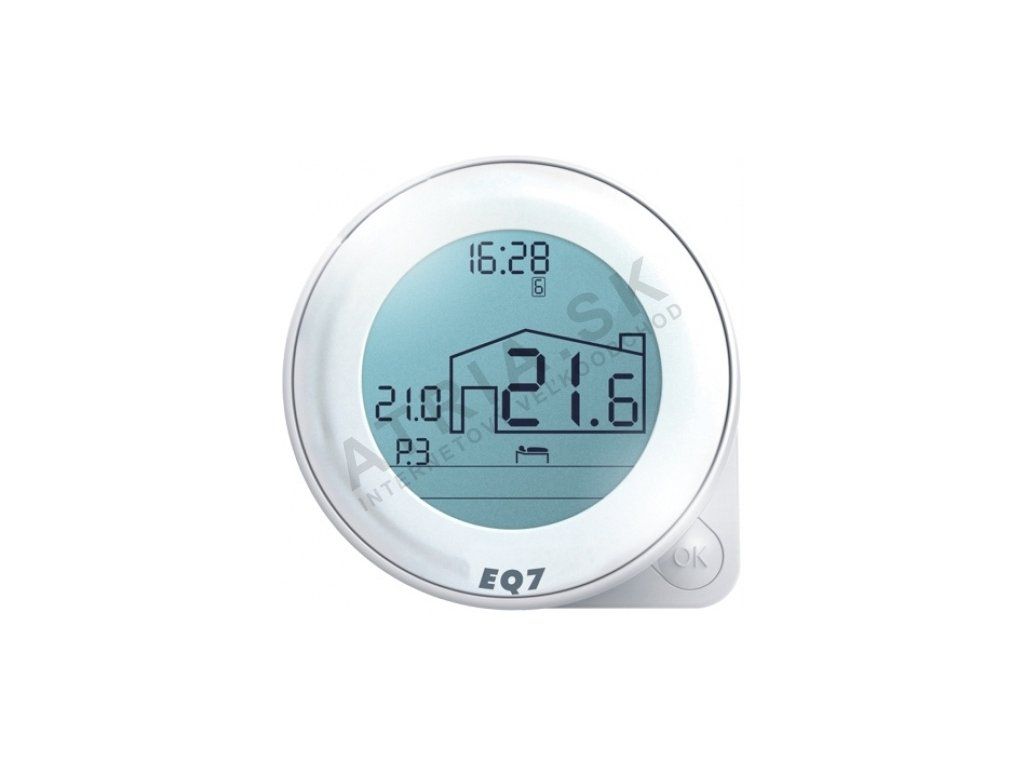 Euroster Q7 Euroster Q7 |
programmable weekly, with display | €74.29 |
As you can see, the price difference between a manual and a programmable thermostat is only around €60-70, yet the difference in comfort and potential savings over the whole heating season is significant - especially in households that are empty for most of the working week. You'll find a detailed comparison of all three levels in a separate article, Manual vs. programmable vs. WiFi thermostat.
Original control unit from the boiler manufacturer vs. universal thermostat
Original control units from boiler manufacturers are noticeably more expensive than universal thermostats.
The third important dimension of choice, which is often overlooked, is whether to go for an original control unit directly from your boiler's manufacturer, or a universal thermostat that works with almost any boiler on the market.
The original control unit from the boiler manufacturer - for example Bosch Easycontrol, Protherm MiGo or Vaillant eRELAX - communicates with the boiler over a digital bus such as eBUS or OpenTherm. Thanks to this it can smoothly modulate the boiler's output exactly according to current demand (not just switch on/off at full power), display boiler error messages directly on the thermostat's screen, and in some cases even manage the weather compensation curve (more on that in the next section). It's the most sophisticated solution, but it only works with a boiler of the brand it was developed for - you can't connect a Bosch control unit to a Vaillant boiler and vice versa.
A universal thermostat - for example Avansa, Euroster or Salus - works more simply: it just opens or closes an electrical circuit (a contact), which the boiler interprets as a simple "heat" or "don't heat" signal. It doesn't communicate with the boiler over any bus, doesn't see its internal parameters or error messages, but in return it works with almost any boiler on the market regardless of brand. It's a universal, reliable, and usually considerably cheaper solution.
The summary of the difference is therefore simple: a universal thermostat is cheaper and works with almost any boiler, while an original control unit from the manufacturer offers smoother output control and more features, but only for a boiler of that specific brand. If you're planning to replace your boiler with a different brand in the future, a universal thermostat will stay with you and keep working - an original control unit would have to be replaced together with the boiler.

Bosch Easycontrol CT 200 - an original WiFi/smart room control unit for Bosch/Junkers boilers, controlled via a mobile app, with smooth boiler output modulation.
Price: €356.68 - view product

Protherm MiGo - an original WiFi control unit for Protherm boilers, controlled via a mobile app.
Price: €222.48 - view product
If you're not sure what brand of boiler you have at home and whether an original control unit is even available for it, we go through this in detail in the article Original boiler control unit vs. universal thermostat.
Weather-compensated control - heating according to the weather outside
So far we've been talking about thermostats that measure the temperature inside the room. There is, however, another, more sophisticated approach to heating control - weather-compensated (equithermal) control. This doesn't control heating only according to room temperature, but primarily according to the outdoor temperature measured by an outdoor sensor mounted on the facade of the house, usually on the north side, where it isn't hit by direct sunlight.
The principle works as follows: according to a pre-set weather compensation curve, the boiler calculates by itself the temperature it should heat the heating water to, so that the temperature in the house stays stable regardless of whether it's -15 °C outside or milder weather around 5 °C. The colder it is outside, the higher the water temperature the boiler will prepare, and vice versa. Thanks to this the boiler doesn't react "with a delay" to a change in the weather (the way an ordinary room thermostat would, only registering a drop in room temperature after the house has actually cooled down), but reacts preventively, before the outdoor cooling even shows up indoors.
The most precise and most economical result comes from combining weather-compensated control with a room thermostat - so-called cascade control. The weather compensation curve handles the basic setting of the heating water temperature according to the weather, while the room thermostat then fine-tunes small deviations caused, for example, by sunlight coming through the windows, heat from cooking in the kitchen, or the number of people in the room. This combination is common especially with more modern condensing boilers, where weather-compensated control is already built into the control electronics and all you need to do is connect an outdoor sensor and a room thermostat.
If you're considering this type of control, we recommend reading the detailed article How weather-compensated control works, where the principle and the specific curve setup are explained in more detail.
HDO and the thermostat - how to make use of cheaper electricity
If you have an electric boiler or a storage heating system at home, you've probably heard of HDO - ripple control (off-peak signalling). This is a signal from the electricity distributor that switches between a high (daytime) and a low (night-time) tariff according to a pre-agreed schedule. The goal is to encourage households to shift their consumption to times when the grid load is lower - typically at night.
A thermostat with an HDO input can recognise when the cheaper tariff is active and automatically adjust its behaviour accordingly. In practice this works, for example, so that outside HDO (during the more expensive daytime tariff) the thermostat maintains a lower comfort temperature threshold to save energy, while during HDO (when electricity is cheaper) it allows the boiler or storage heaters to charge more heat and maintain a higher temperature. The result is that most of the consumption shifts precisely into the cheaper band without you having to watch the clock and switch manually.
It's important to realise that not every thermostat has an HDO input - it's a feature you need to explicitly check when choosing one if you have an electric boiler on a dual-tariff rate. For ordinary gas condensing boilers, HDO is usually not relevant, since it doesn't concern gas consumption, only electric heat sources. You'll find more on this topic, including specific recommended models with an HDO input, in the article HDO and the room thermostat - how they work together.
Zone control of heating
So far we've been talking about a single thermostat controlling the whole house or flat as one unit. In larger houses, or where different rooms have significantly different temperature requirements, it's worth considering zone control.
Zone control divides the house into several independent circuits (zones), each of which has its own thermostat and its own control valve (actuator) on a manifold or directly on the radiator. Thanks to this you can have, for example, 22 °C in the living room, where you spend most of the evening, and 18 °C in the bedroom, where a lower temperature is more pleasant for sleeping while also saving energy - at the same time, without having to walk around the house manually adjusting radiator valves every time something changes.
This approach is commonly combined with underfloor heating, where each room typically has its own heating loop and its own thermostat controlling an actuator (valve) on the manifold. When the thermostat in a given room determines that the temperature has been reached, it closes the actuator only for that loop, while other rooms continue heating according to their own settings. Zone control is therefore not just about comfort, but above all about precision - every room gets exactly as much heat as it needs, nothing more. You'll find a detailed guide on designing and installing zone control in the article Zone control of heating.
How the thermostat is mounted and wired
Regardless of whether you choose a wired or a wireless model, the installation itself has several common principles that affect how accurately the thermostat measures the actual room temperature. A thermostat should never be placed near a heat source (radiator, fireplace, direct sunlight through a window) or near a source of cold (front door, draught from a window) - in both cases the measured value wouldn't correspond to the actual average room temperature and the heating would be controlled by a distorted reading.
The recommended installation height is approximately 1.2 - 1.5 metres above the floor, on an internal partition (not on an external wall, which can be colder), in a room that best represents average living conditions in the house - most often the living room. With a wired thermostat, installation also needs to allow for a flush-mounted box and cable routing, work that either requires advance planning during a renovation or an experienced electrician if the cable is run afterwards along the surface (in trunking). With a wireless thermostat, installation is a matter of a few minutes - the transmitter is mounted on the wall (or simply placed on a shelf, since it doesn't need an electrical connection, only batteries), the receiver is connected to the boiler's terminal block exactly where the wires from a wired model would otherwise go, and the devices are paired according to the instructions, usually by pressing a button on both units.
You'll find a complete step-by-step procedure, including a wiring diagram for the terminal block of common boiler types, in the article Installing and wiring a room thermostat.
Which type of thermostat is right for you?
The four-step process for choosing a thermostat, following the recommendations from the article.
If we were to sum up the whole selection process into one simple procedure, we recommend following these steps:
1. First, settle the wired vs. wireless question. If you have a ready or easily accessible cable route (new build, planned rewiring), choose a wired thermostat - it's cheaper and free of any battery worries. If a cable would mean demolition or cutting into finished surfaces, choose a wireless model.
2. Then choose the feature level. If you're at home all the time and don't need to change the temperature during the day, a manual thermostat is enough. If the house is empty during the day (work, school) or you want a different temperature at night, choose a programmable thermostat. If you want to keep the heating under control even when you're away from home (holiday, travelling for work, a cottage), go for a WiFi/smart model.
3. Consider whether an original control unit is worth it. If you have a boiler of a brand for which the manufacturer offers its own WiFi control unit (Bosch, Protherm, Vaillant and similar), and you want to make use of smooth output modulation and error messages displayed directly on the thermostat's screen, an original control unit is worth the higher price. If you want a universal solution that will survive even a future replacement of the boiler with a different brand, choose a universal thermostat.
4. Don't forget special needs. An electric boiler on a dual-tariff rate? Check for an HDO input. Underfloor heating, or several rooms with different temperature requirements? Consider zone control instead of a single central thermostat.
Real-world examples
Example 1: A family house after a complete rewiring. A family house with an original gas boiler without any control was undergoing a complete renovation including new wiring. Since channels for new cabling were being cut anyway, it was natural to also plan the cable route to the thermostat already at the first-fix stage - all it took was adding one two-core wire from the future thermostat location in the living room all the way to the boiler in the utility room. The result was a wired programmable thermostat that needs no batteries and whose signal can't be interfered with. Since the house has several rooms with different requirements (a child's room, a bedroom, a living room with a fireplace that provides heat even without the heating running), the owners later decided to also add zone control on the underfloor heating manifold in the bedroom and the child's room, while the living room and hallway stayed on a shared circuit controlled by the main thermostat.
Example 2: A flat in a panel building with a finished renovation. A flat in a panel building had an old, purely mechanical thermostat with a rotary dial that maintained a single constant temperature regardless of the time of day. The flat had been completely renovated a year earlier - new flooring, plastering, paintwork - so any cutting for a new cable to the thermostat was out of the question. The solution was a wireless programmable thermostat, whose transmitter was simply mounted on the living-room wall in exactly the spot where the old mechanical thermostat had been (with no building work needed at all), and whose receiver was connected directly to the boiler's terminal block in the kitchen unit where the boiler was mounted. Thanks to the programmable profiles, the temperature automatically dropped during the day while the occupants were at work, and rose again an hour before their usual time of returning home - without them having to adjust anything manually.
Frequently asked questions about choosing a wired or wireless thermostat
Is a wireless thermostat less reliable than a wired one?
With quality branded models, the difference in reliability in normal household operation is minimal. A wired thermostat has the advantage of needing no batteries and its signal can't be interfered with, since it's a direct electrical connection. A wireless thermostat is, in the vast majority of cases, just as reliable, only requiring the occasional battery change, and in extremely densely built-up areas with many other wireless devices it could theoretically be more sensitive to interference - in practice this tends to be a marginal issue rather than a common problem.
How long do the batteries in a wireless thermostat last?
Mostly one to two years, depending on the specific model, how often it communicates with the receiver, and the type of batteries used. Modern thermostats usually give advance warning of an approaching battery drain, so there's no risk of suddenly being left without heating control.
Can I replace a wired thermostat with a wireless one without an electrician's help?
For a simple thermostat-for-thermostat swap (same type of connection - two wires into the boiler's terminal block), this is usually manageable yourself if you follow basic safety rules (the boiler disconnected from the mains before working on it). For more complex wiring, or if you're not sure about your boiler's type, we recommend calling in a service technician.
Does a universal thermostat work with all boilers?
Practically yes - a universal thermostat communicates with the boiler using just a simple contact (opening/closing the circuit), which almost every boiler on the market can interpret regardless of brand. The exceptions might be very specific or older control units, where it's worth checking compatibility directly against the terminal block type in the boiler's manual.
Is an original control unit from the boiler manufacturer worth it, or is a universal thermostat enough?
It depends on what you expect from the control. If it's enough that the boiler heats or doesn't heat depending on whether the set temperature has been reached, a universal thermostat is a cheaper and equally functional solution. If you want to make use of smooth boiler output modulation, error messages displayed directly on the thermostat, and possibly control of the weather compensation curve, an original control unit from the manufacturer offers more, but only works with a boiler of that specific brand.
Do I need a WiFi thermostat if I spend most of my time at home?
Not necessarily. A WiFi thermostat brings an advantage mainly when you need to change settings remotely - for example when going on holiday or coming back outside your usual schedule. If you're regularly at home following a settled daily routine, a programmable (weekly) thermostat without WiFi is entirely sufficient, and it's usually cheaper.
What is HDO and do I need a thermostat with an HDO input?
HDO (ripple control) is a signal from the electricity distributor that switches between a high and a low (night-time) tariff. You mainly need a thermostat with an HDO input if you have an electric boiler or storage heating on a dual-tariff rate - in that case it can automatically adjust the heating's behaviour to the cheaper and more expensive bands. With an ordinary gas boiler, this feature is usually not used.
Zone control is easier to retrofit where a circuit manifold is already available.
Can zone control be retrofitted into an already finished house?Yes, provided you have a heating circuit manifold (typically with underfloor heating) or radiators with thermostatic valves that electronic actuators can be fitted to. With classic radiators without a manifold it's more complex and requires installing separate electronic valve heads on each radiator, communicating with the room thermostats in that room.
How do I find out if my boiler supports the original WiFi control unit of its brand?
The most reliable way is to check the boiler's technical documentation or verify the type of communication bus (eBUS, OpenTherm) directly in the manual. In most cases our sales advisors can also help if you give them the exact model designation of your boiler.
Related topics
- How to choose a room thermostat
- Manual vs. programmable vs. WiFi thermostat
- Original boiler control unit vs. universal thermostat
- How weather-compensated control works
- HDO and the room thermostat - how they work together
- Zone control of heating
- Installing and wiring a room thermostat
- Servicing and common thermostat faults
- Frequently asked questions about room thermostats and controls
Have a question about choosing a room thermostat?
Can't decide, or dealing with a specific situation in your household? Write to us – we're happy to help.