
Thermostat Service and Common Faults
A room thermostat is one of those devices most households don't think about until it starts causing problems. It works quietly, for years, unnoticed — and that's exactly why its fault is often discovered only when the flat is unusually cold, or conversely the boiler runs endlessly and the energy bill grows disproportionately. Servicing a thermostat, however, is usually not a complicated task requiring a technician — the vast majority of common faults can be solved by the owner themselves in a few minutes, if they know where to look for the cause.
In this article we'll look at the most common faults across all types of room thermostats — from the simplest manual dial to a WiFi controller linked to the boiler over a digital bus. We'll explain why wired and wireless thermostats fail for completely different reasons, why a universal thermostat sometimes doesn't "understand" the boiler as well as an original controller, and what to do when zone control or the compensation curve doesn't work as expected.
If you're not sure what type of thermostat you actually have, or which one you should choose when replacing it, we recommend first reading the article How to choose a room thermostat — this text, by contrast, follows on mainly for situations where you already have a thermostat at home and something isn't right with it.
Why check the thermostat at all — and what happens when it fails
A room thermostat measures the temperature in a room and, according to the set value, switches the heat source — boiler, heat pump or electric heating unit — on and off (or, with more modern types, smoothly modulates its output). It sounds simple, but this simple function is exactly what decides whether the house heats efficiently or needlessly wastes energy.
A thermostat fault shows up either as overheating or as cold in the house.
Without a working thermostat, or with a thermostat measuring incorrectly, the boiler would heat continuously at full output regardless of the actual room temperature. The result is overheating — the flat is unpleasantly warm, windows have to be opened even in frost, and gas or electricity consumption grows disproportionately. This is exactly the most common "silent" symptom of a thermostat fault: not a complete heating failure, but inconspicuous overheating that the owner doesn't notice for months, until a high bill arrives.
The opposite scenario — the thermostat constantly reports that it's warm enough, even though the room is cold — is less common but far more noticeable, since it shows up immediately as a cold flat or house. Both situations have in common that the cause is usually not the boiler, but the controller giving it incorrect or no instructions.
Most common faults in wired (cabled) thermostats
A wired thermostat connects to the boiler's controller with a two-core wire. This design is a major advantage from a reliability point of view — the thermostat doesn't need batteries, there's no radio signal that could drop out, and that's why wired thermostats generally fail less often, and differently, than wireless ones.
When a wired thermostat stops behaving as expected, the most common cause is a mechanical problem in the wiring or terminal block itself, not a fault in the thermostat's electronics:
- A loose connection at the terminal block — the wires at both the thermostat and the boiler are connected with screw terminals. After years, especially if the house "works" (thermal expansion of walls, vibrations), the connection can loosen. The thermostat then either doesn't communicate with the boiler at all, or communicates intermittently — the boiler heats in an unpredictable, jerky fashion.
- A broken or damaged cable — especially where it's routed under a floor, near rodents (cottages, family houses with a basement), or during later building work, when the cable gets accidentally drilled through or cut.
- Incorrect polarity or swapped terminals — when replacing an old thermostat with a new one, wires that look the same but lead to a different terminal are sometimes mixed up. The result can be a thermostat that "does nothing" even though it's physically functional.
- A faulty or dirty contact inside the thermostat — older mechanical thermostats have an internal contact that opens and closes. After many years of operation it can get dirty or worn, which shows up as unreliable switching.
The advantage of a wired solution for diagnostics is that it's relatively easy to check with a multimeter whether there actually is or isn't a signal at the terminals when the thermostat "requests heat". If the problem is confirmed to be in the wiring, it's generally simpler and cheaper to replace the whole thermostat with a new one than to look for the break in the wall. You'll find a comparison of both solutions in the article Wired vs. wireless thermostat.

Avansa TH1
Simple manual (mechanical) room thermostat with a rotary dial — a typical example of a wired solution with no electronics, no batteries, and therefore no risk of "dead batteries" as a cause of failure.
Price: €10.61
View productMost common faults in wireless thermostats
A wireless thermostat communicates with the receiver at the boiler via a radio signal, usually on a frequency of 868 MHz. Installation is faster and without breaking into walls, which is the main reason for its popularity in flat renovations where no cable route is pre-prepared. This convenience, however, comes at a cost — a wireless solution brings two entirely new categories of fault that don't occur at all with a wired thermostat.
1. Dead or weakening batteries in the transmitter. This is by far the most common cause of wireless thermostat "faults" that servicing encounters. The batteries in the transmitter lose capacity gradually — the thermostat therefore doesn't stop working outright at first, but starts communicating unreliably: the display flickers, the receiver at the boiler occasionally misses the signal, heating starts with a delay. Many owners mistake this gradual decline for a more serious fault, though it's enough to replace the batteries.
2. Signal interference. In densely built-up spaces — apartment blocks, terraced houses, but also households with a lot of their own home electronics (WiFi routers, other wireless devices on the same band) — a wireless thermostat can be more sensitive to interference than in an isolated family house. This shows up similarly to weak batteries: intermittent communication, delayed reactions, occasional complete dropouts of the connection between transmitter and receiver.
The recommended procedure for solving a wireless thermostat fault.
When solving a wireless thermostat fault, we therefore recommend proceeding in this order: first replace the batteries (the cheapest and most common cause), then check the distance and obstacles between transmitter and receiver (thick walls, metal structures, large appliances), and only when that doesn't help, address possible interference from another device or consider switching to a wired solution, if that's realistic in the given household. You'll find a detailed installation and wiring guide in the article Installing and wiring a room thermostat.

Avansa 2007 TX
Wireless programmable thermostat — transmitter and receiver without the need for cabling. With a communication fault, the first step is always checking the batteries in the transmitter and the distance/obstacles relative to the receiver at the boiler.
Price: €56.31
View productFaults by thermostat type — manual, programmable, WiFi
Besides the method of connection (wired/wireless), thermostats also differ in their level of "intelligence", and this is exactly what determines what most commonly breaks on them.
A manual (mechanical) thermostat has only a rotary dial for setting a single target temperature. It's the cheapest, but cannot lower the temperature on its own at night or during the day when you're not at home. This is precisely why we almost never encounter a "software" fault with a manual thermostat — there's simply nothing to break at the program level. The only thing that can break is the mechanical contact inside (described above), or an incorrectly set value that someone in the household accidentally turned.
A programmable (weekly) thermostat lets you set different temperatures for different times of day and days of the week. The typical saving compared to a manual setting is noticeable especially from the temperature drop during the night and while away from the flat. This very advantage is also the most common source of an "apparent fault" — the thermostat works completely correctly, it just has an incorrectly set program. A typical case: the thermostat is still running a program left over from a previous period (for example from summer, when the household was away longer, or from a time when someone worked from home and now no longer does), and the owner wonders why it's cold in the evening even though "the thermostat is set to 22 degrees" — just in a different time window than the one currently active.
A WiFi/smart thermostat adds remote control and monitoring via a mobile app from anywhere on top of programming. This category also brings a third group of possible failure causes — besides batteries/signal and an incorrect program, there's also loss of connection to the home WiFi network (for example after a router password change, replacing the router, or an internet outage). If the mobile app reports the thermostat as "offline", this generally doesn't affect the heating itself — the thermostat usually keeps working locally according to its last setting, just without the ability to change it remotely, until the WiFi connection is restored.
When choosing between these three levels, it's worth considering how much comfort and complexity a given household will actually make use of — a detailed comparison is in the article Manual vs. programmable vs. WiFi thermostat.
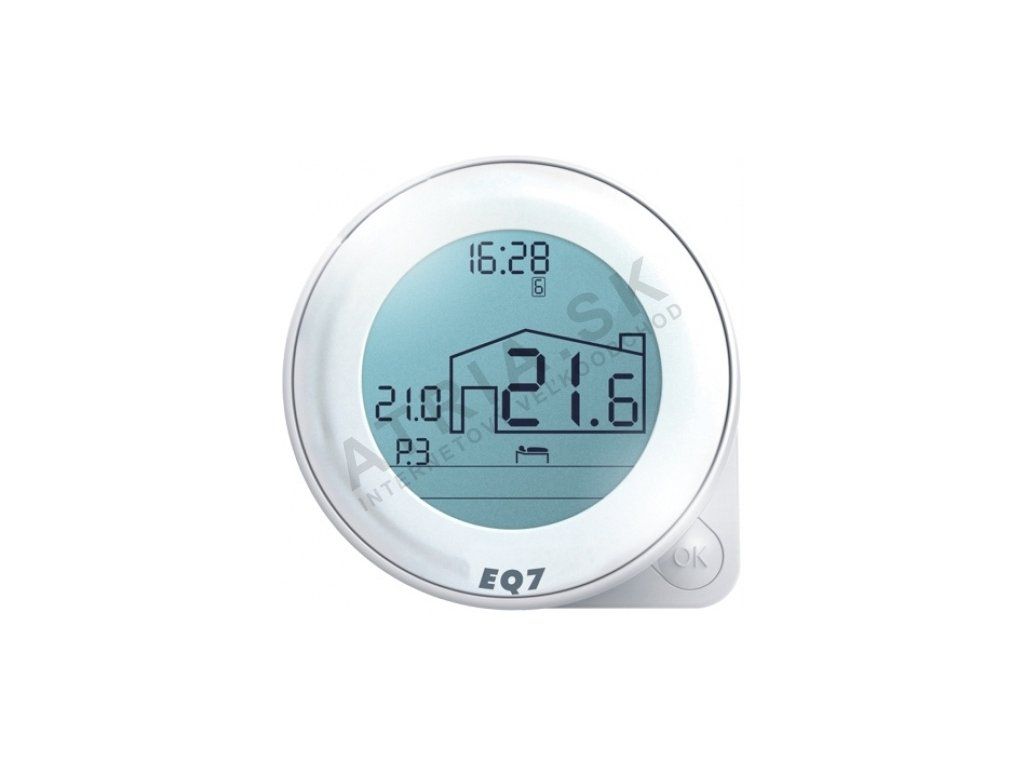
Euroster Q7
Programmable weekly thermostat with a display. With an "unexplained" cold evening, or conversely an overheated night, the first step is always checking the currently active weekly program, not suspecting a fault.
Price: €74.29
View productOriginal controller from the boiler manufacturer vs. universal thermostat — where compatibility faults arise
The price of a thermostat rises with its level of technical intelligence and connection to the boiler.
This is a topic that probably causes the most misunderstandings in thermostat servicing, since it involves two technically different principles of communicating with the boiler.
An original controller from the boiler manufacturer — for example Bosch Easycontrol, Protherm MiGo or Vaillant eRELAX — communicates with the boiler over a digital bus, such as eBUS or OpenTherm. Thanks to this it can smoothly modulate the boiler's output according to current need, display the boiler's error messages directly on its display, and sometimes also control the compensation curve. When such a controller "reports a fault", it's often actually just passing on an error message from the boiler itself — in that case, the problem isn't in the thermostat, and the boiler's fault code needs to be looked up in its own documentation instead.
A universal thermostat — for example Avansa, Euroster or Salus — works more simply: it only closes or opens a circuit (contact), which the boiler evaluates as a "heat" or "don't heat" signal. It's cheaper and works with almost any boiler regardless of brand, but it doesn't offer smooth output modulation or display the boiler's error messages.
The most common "compatibility fault" that servicing encounters arises precisely from confusing these two principles — for example when someone tries to connect a universal switching thermostat to terminals intended for digital communication, or expects features from a simple contact thermostat that only an original controller can provide (for example smooth output control or displaying the boiler's error code). The result isn't a "fault" in the true sense, but a mismatched expectation — both the boiler and the thermostat work correctly, they just can't do together what only a different type of wiring was meant to do.
When replacing a thermostat with a different type, we therefore always recommend first checking how the original controller communicates with the specific boiler, and whether the boiler is even equipped with a bus for the original controller of that brand. More in the article Original boiler controller vs. universal thermostat.

Bosch Easycontrol CT 200
Original WiFi/smart room controller for Bosch/Junkers boilers with control via mobile app. Since it communicates directly with the boiler over a digital bus, it can also display the boiler's own error messages on its display.
Price: €356.68
View product
Protherm MiGo
Original WiFi controller for Protherm boilers with control via mobile app — the same digital-communication principle with the boiler as the Bosch Easycontrol, just for a different boiler brand.
Price: €222.48
View productFaults and incorrect setup of weather-compensated control
Weather-compensated control doesn't control heating only according to room temperature, but mainly according to the outdoor temperature measured by an outdoor sensor. According to a pre-set compensation curve, the boiler calculates on its own what temperature it should heat the heating water to, so the house has a stable temperature regardless of whether it's freezing outside or the weather is milder.
When it seems that "weather compensation isn't working", the cause is almost always one of these two things, not an electronics fault:
- An incorrectly placed outdoor sensor — if the sensor is exposed to direct sunlight, close to a window with heat escaping from the house, or conversely in a sheltered corner with no air circulation, it measures a different temperature than the actual outdoor temperature. The boiler then calculates the wrong heating water temperature from the curve — the house is either undercooled or overheated, even though both the thermostat and the sensor "work" in terms of measurement.
- An unsuitably set compensation curve — the curve is set during installation according to the type of house (insulation, radiator size, ceiling height), and if it remains set, for example, from the house's original, less insulated state even after the facade is subsequently insulated, the boiler will systematically heat the water to a needlessly high temperature.
Combining weather-compensated control with a room thermostat, so-called cascade control, gives the most precise and most economical result — the room thermostat can fine-tune small deviations that the compensation curve alone (working only with outdoor temperature) doesn't account for, for example solar heat gains through windows or heat from household appliances. If your household uses only one of these two systems, the service intervention sometimes simply consists of recommending adding the other one, not looking for a fault. You'll find a detailed explanation of the principle in the article How weather-compensated control works.
HDO and a room thermostat — when the controller "doesn't know" about the cheaper tariff
HDO (ripple control) is a signal from the electricity distributor that switches between a high and a low (night) tariff. It mainly concerns electric boilers and storage systems, where the difference between tariffs is noticeable on the electricity bill.
A thermostat with an HDO input can recognise when the cheaper tariff is active and adjust its behaviour accordingly — for example setting a lower comfort-temperature threshold outside HDO (to save during the high tariff) and a higher one during HDO, when electricity is cheaper. The common "problem" that servicing encounters in this area isn't a fault in the technical sense, but a mismatched expectation: not every thermostat has an HDO input available at all. If a household with an electric boiler and a dual-tariff rate buys a thermostat without this feature and expects it to react to tariff switching, they'll be disappointed — the thermostat simply has no way to pick up this signal; it's not a device defect.
When choosing or replacing a thermostat for an electric boiler with HDO, this feature therefore needs to be checked in advance, before buying, not afterwards, once it turns out the expected saving on the night tariff isn't materialising. More on this topic in the article Ripple control (HDO) and a room thermostat — how they work together.
Zone control — when one room fails, not the whole system
Zone control divides the house into several independent circuits (zones), each of which has its own thermostat and its own control valve (actuator) on the manifold or radiator. This makes it possible to have, for example, 22 °C in the living room and 18 °C in the bedroom at the same time, without having to manually adjust radiator valve heads. Zone control is commonly combined with underfloor heating, where typically each room has its own loop and its own thermostat controlling an actuator on the manifold.
This very architecture — several independent thermostats controlling several independent actuators — brings a specific type of fault: the problem usually shows up in just one zone, not the whole house. When only one room is cold while the other zones work without problems, the cause is almost always not the central boiler or the main controller, but the specific thermostat or specific actuator belonging to that zone — for example dead batteries in that room's thermostat, or a mechanically stuck actuator on the manifold left in the closed position.
When diagnosing a zone system, we therefore always recommend proceeding zone by zone — checking whether the thermostat of a specific room is requesting heat at all, and then whether the corresponding actuator on the manifold responds to this request by opening. This quickly separates whether it's a problem with the thermostat, the communication, or the mechanics at the manifold. A complete explanation of the principle is in the article Zone heating control.
Real-life examples
Two real-life cases from service practice and their solutions.
A family house with an electric boiler and a dual-tariff rate. After renovating the boiler room, the household had a new universal thermostat installed, since it was cheaper and had a nice display. After a month of operation, the owner noticed that the electricity bill hadn't dropped as much as expected after switching to a dual-tariff rate with HDO. On inspection, it turned out the purchased thermostat model simply didn't have an HDO input — the controller therefore maintained the same target temperature regardless of whether the cheap or expensive tariff was currently active, so the boiler kept heating just as intensively during the more expensive band as during the cheap one. The solution was replacing it with a thermostat with an HDO input, which can distinguish between both tariffs and shift the comfort temperature accordingly.A flat in a panel building with a wireless programmable thermostat. In a flat with underfloor heating in one room and radiators in the others, the thermostat in the living room started working unreliably — the display occasionally flickered and heating started with a significant delay compared to the set program, while the thermostats in the other rooms worked without problems. Since this was a panel-building flat with several neighbouring households and their own home electronics, the first suspicion was signal interference. After replacing the batteries in the transmitter — which had never been done since installation several years earlier — the problem was completely resolved. The cause therefore wasn't neighbouring wireless devices, but simply gradually weakening batteries, whose decline showed up exactly like an unreliable signal.
FAQ — frequently asked questions about thermostat service and faults
How often do batteries in a wireless thermostat need replacing?
The exact interval depends on the specific model and intensity of use, but it's worth preventively checking or replacing the batteries before the start of the heating season, to avoid unreliable communication exactly when heating is most needed.
The thermostat shows the correct temperature, but the boiler isn't heating at all — where's the problem?
If the thermostat measures the temperature correctly but the boiler doesn't respond, the cause is most often a broken or loose connection between the thermostat and the boiler (with a wired type), or a signal dropout between transmitter and receiver (with a wireless type). Also check whether the thermostat is actually "requesting heat" according to the currently set program.
Can I simply connect a universal thermostat to any boiler?
A universal thermostat works on the principle of simple contact switching, so it's compatible with most boilers that have an input for a room thermostat. However, it doesn't work as a replacement for an original controller communicating over a digital bus (eBUS, OpenTherm) — the two technologies aren't interchangeable without losing features.
Why is it unpleasantly warm in the house even though the thermostat is set low?
The most common cause is a different time program being active than the owner assumes (for example a forgotten program from a previous period), or an incorrectly set compensation curve, because of which the boiler heats the water to a higher temperature than is needed in the current weather.
Can you tell whether it's a thermostat fault or a boiler fault?
With an original controller communicating directly with the boiler, the boiler's error messages are usually displayed directly on the thermostat's display — in that case it's a boiler fault, not a controller fault. With a universal thermostat that just closes a contact, you need to separately check whether the thermostat is sending a heating signal at all, and separately whether the boiler responds to that signal.
Why does heating work differently in one room than in the others with zone control?
With zone control, each room has its own thermostat and its own actuator on the manifold. If the problem affects only one zone, the cause is almost always local — the thermostat or actuator of that specific room, not the central boiler or the other zones.
Does it make sense to combine weather-compensated control with a room thermostat?
Yes, this combination (cascade control) gives a more precise and more economical result than the compensation curve working alone, since the room thermostat can fine-tune deviations caused, for example, by sunlight or heat from appliances, which the outdoor sensor alone doesn't pick up.
When there's a fault, is it worth replacing the thermostat right away, or can it usually be repaired?
Most common faults (dead batteries, a loose connection, an incorrect program, an unsuitably placed sensor) can be solved without replacing the thermostat. Replacement makes sense especially when the problem is in wiring inside the wall that's hard to trace, and it's cheaper to replace a wired thermostat with a wireless one, or when a household wants to move from a simple manual type to a programmable or WiFi type for missing features, not because of an actual fault.
How do I find out if my thermostat supports HDO?
The information should be stated in the technical specification of the specific model. If you're not sure whether your current thermostat has an HDO input, or when buying a new thermostat for an electric boiler with a dual-tariff rate, we recommend checking this feature in advance — not every model, even in the same price category, offers it.
Related topics
- How to choose a room thermostat
- Wired vs. wireless thermostat
- Manual vs. programmable vs. WiFi thermostat
- Original boiler controller vs. universal thermostat
- How weather-compensated control works
- Ripple control (HDO) and a room thermostat — how they work together
- Zone heating control
- Installing and wiring a room thermostat
- Frequently asked questions about room thermostats and controllers
Have a question about choosing a room thermostat?
Can't decide, or dealing with a specific situation in your household? Write to us — we're happy to help.