
How to Choose a Room Thermostat
How to Choose a Room Thermostat
A room thermostat is one of the cheapest investments you can make in a heating system, one that typically pays for itself within a single heating season – and yet it is one of the most frequently underestimated components of the whole setup. While most households pay plenty of attention to choosing a boiler, heat pump or radiators, the thermostat is often bought in a hurry, "just to have one", without any real consideration of whether it actually suits the type of home, the heating method and the household's habits.
The differences between individual thermostat types are anything but cosmetic. A manual thermostat with a single dial, a programmable weekly thermostat and a WiFi/smart control unit each solve fundamentally different needs – and for boilers that support the manufacturer's own digital control (for example Bosch, Protherm or Vaillant), there is also the question of whether to go for a universal thermostat or a control unit made directly by the boiler manufacturer. On top of that comes the question of wired versus wireless connection, weather-compensated (outdoor-temperature) control, HDO (off-peak) wiring for electric heating, and finally zone control, when you want a different temperature in every room.
In this article we go through all of these decision criteria step by step, explaining for each one who it suits and who it doesn't, and adding specific products with prices so you get an idea of what sums of money we're talking about in each category. At the end you'll find a section with frequently asked questions and links to more detailed articles that go even deeper into individual aspects of choosing a thermostat.
What is a room thermostat and why do you actually need one
A room thermostat is a device that measures the current temperature in the room where it is installed, and based on the difference between this measured temperature and the temperature you have set as the target, it switches the heat source on or off (or, with more modern controls, smoothly modulates its output) – meaning the boiler, heat pump or electric heating element.
Without a thermostat, or if the thermostat is out of operation, most boilers keep heating continuously at full or almost full output regardless of the actual temperature in the living room. The typical result is a combination of two unpleasant effects at once: rooms are overheated beyond the comfort level (in practice households deal with this by opening windows while the heating is running, which is the worst possible combination from an energy point of view), and at the same time fuel or electricity consumption rises, since the heat source runs longer and more intensively than is actually needed at that moment.
A thermostat is therefore not just a matter of comfort – it is a basic control element that links what the boiler is physically capable of producing with what the household actually needs at any given moment. That's exactly why it's worth paying the same amount of attention to choosing a thermostat as to choosing the heat source itself.
Thermostat types by control method – manual, programmable and WiFi/smart
The three basic thermostat types by degree of automation and remote control.
Thermostats are first divided by how much automation and remote control they offer. This choice has a direct impact on how much you actually save and how much convenience you gain, so it's worth starting here.
A manual (mechanical) thermostat has just one dial that you use to set a single target temperature. It's the simplest and cheapest solution on the market, but it can't lower the temperature by itself at night while you're asleep under a duvet, or during the day when you're away at work. If you want a different temperature at a different time, you have to turn the dial manually – and in practice, in the vast majority of households, that simply doesn't happen regularly.

A simple manual (mechanical) room thermostat with a rotary dial – ideal if you just want basic control without any programming.
Price: €10.61
View productA programmable (weekly) thermostat takes things a step further – it lets you set different target temperatures for different times of day and different days of the week. Typically you'd programme a lower temperature during the night and during working hours, when the house is empty, and a higher one just before the household wakes up or comes home. The savings compared to setting a single constant temperature manually are felt especially thanks to this regular drop during the night and while away – these are the most common "wasted" hours of heating to full room temperature that a household with a manual thermostat isn't even aware of.
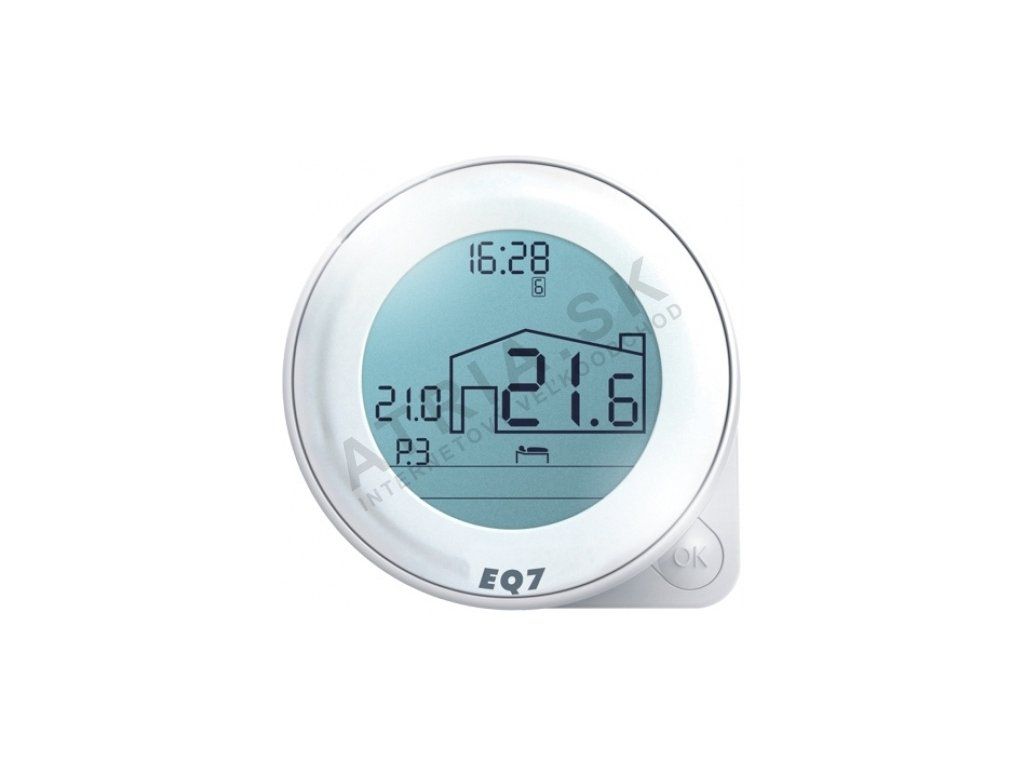
A programmable weekly thermostat with a clear display – its own temperature schedule for every day of the week.
Price: €74.29
View productA WiFi/smart thermostat adds remote control and monitoring of the heating status via a mobile app from anywhere with an internet connection, on top of everything a programmable thermostat offers. That's especially useful when your plans change irregularly – for example when you come back from a holiday a day early and want the house to be warm without having to change your pre-programmed schedule, or when you simply want to check remotely that the heating at home is actually running the way it should.
You'll find a more detailed comparison of all three types in a separate article, Manual vs. programmable vs. WiFi thermostat, where we also cover when investing in a higher category actually pays off and when it's unnecessary.
Wired or wireless thermostat? It mainly depends on the state of your home
The second important decision has nothing to do with the thermostat's functions, but with how it communicates with the boiler. Here you choose between a wired (cabled) and a wireless solution, and the choice should be based primarily on the condition of your electrical wiring and cable runs.
A wired thermostat connects to the boiler's control unit via a two-core wire. It's a reliable, battery-free solution that has nothing to "run flat" and can't lose signal. Its downside is that it requires running a cable from the place where the thermostat is mounted (usually the living room or another representative room) all the way to the boiler. In a new build, where the wiring is planned in advance, this isn't a problem. In the renovation of a flat or house where a cable route wasn't prepared in advance, it can become an issue – it means either demolition and new plastering, or running the cable along the surface, which isn't always an aesthetically acceptable solution.
A wireless thermostat communicates with a receiver placed near the boiler via a radio signal, usually in the 868 MHz frequency band. Thanks to this, installation is considerably faster and involves no demolition at all – you simply mount the transmitter (the thermostat itself) on the wall in the room and connect the receiver near the boiler to the control unit. The price for this convenience is batteries in the transmitter, which need to be replaced from time to time, and slightly higher sensitivity to radio interference in densely built-up areas such as apartment blocks with lots of other wireless devices nearby (WiFi routers, remote controls, other wireless sensors).
An example of a wireless solution is the programmable thermostat Avansa 2007 TX, which includes both a transmitter and a receiver in one package, so installation requires no cabling at all between the room and the boiler.
Which solution suits you better therefore depends mainly on whether you're renovating an existing house without a prepared cable route, or building a new one – in the latter case it's worth planning a wired solution in advance, since it's the most reliable option in the long run. You'll find a detailed comparison of both approaches with further examples in the article Wired vs. wireless thermostat.
Original control unit from the boiler manufacturer, or a universal thermostat?
If you have a boiler at home from a brand that offers its own digital room control – typically Bosch/Junkers with Easycontrol, Protherm with MiGo, or Vaillant with eRELAX – you face another decision: go for this original control unit, or for a cheaper universal thermostat from a different brand, for example Avansa, Euroster or Salus.
The price range from a simple manual thermostat to an original WiFi boiler control unit.
The difference between them isn't just in price, but primarily in how they communicate with the boiler. The original control unit from the boiler manufacturer communicates with the boiler over a digital bus – most often the eBUS or OpenTherm standard. Thanks to this two-way digital communication, the control unit can smoothly modulate the boiler's output exactly according to current demand (instead of a simple on/off switch to full power), display any boiler error messages directly on its screen, and in more advanced models even work together with the boiler's weather compensation curve.

Original WiFi/smart room control for Bosch and Junkers boilers, controlled via a mobile app, with smooth output modulation over the eBUS bus.
Price: €356.68
View product
Original WiFi control unit for Protherm boilers, controlled via a mobile app, with smooth cooperation with the boiler's control system.
Price: €222.48
View productA universal thermostat, on the other hand, works more simply – it basically just opens or closes an electrical circuit (a contact), which the boiler interprets simply as a "heat" or "don't heat" signal. It doesn't communicate with the boiler digitally, doesn't display its error messages and doesn't control smooth output modulation. Its advantage is a lower price and universality – it works with almost any boiler on the market regardless of brand, since it only uses the most basic type of electrical contact, which is supported by practically every boiler control system.
In short: the original control unit offers smoother, more precise control along with more features, but only for the specific boiler brand it was made for. A universal thermostat is the cheaper choice that works almost everywhere, but without smooth output modulation and without displaying the boiler's status. Which solution is better for you depends on how much weight you give to smooth output control and monitoring the boiler's status versus simplicity and a lower price – you'll find a detailed breakdown with further examples in the article Original boiler control unit vs. universal thermostat.
Weather-compensated control – when the weather outside decides the boiler's output
While an ordinary room thermostat only reacts to the temperature in the room where it's installed, weather-compensated (equithermal) control goes a step further and controls the heating primarily according to the outdoor temperature, measured by a separate outdoor sensor mounted on the facade of the house.
The principle works like this: according to a pre-set weather compensation curve (which specifies what temperature the boiler should heat the water to at a given outdoor temperature), the boiler calculates by itself the temperature to which it should heat the water flowing to the radiators or underfloor heating. As a result, the temperature in the house stays stable regardless of whether it's freezing outside or the weather is milder with temperatures just above zero – the boiler reacts to a change in the weather before it even has a chance to show up as a change in room temperature.
The most precise and most energy-efficient result comes from combining weather-compensated control with a classic room thermostat – so-called cascade control. In this case, the weather compensation curve handles the coarse adjustment according to the weather, while the room thermostat fine-tunes small deviations caused, for example, by sunlight coming into the room, heat from cooking in the kitchen, or the presence of several people in the room at once. If you're considering an original control unit such as the Bosch Easycontrol CT 200 or Protherm MiGo mentioned above, both are able to work together with the boiler's weather compensation curve in exactly this way.
You'll find a complete explanation of how weather-compensated control works, including how the curve is set and what to watch out for when calibrating it, in the article How weather-compensated control works.
HDO and the room thermostat – how to make use of cheaper night-time electricity
If you heat with electricity, another factor comes into play that you usually don't need to deal with for gas boilers – HDO (ripple control / off-peak signal). This is a signal sent into the household by the electricity distributor that switches between the high (daytime) and low (night-time) tariff. It mainly concerns electric boilers and storage heating systems, which are designed to consume most of their energy precisely during the cheaper night-time band.
A thermostat with HDO input support can recognise when the cheaper tariff is active and adjust its behaviour accordingly. In practice this means that outside the HDO window (i.e. during the more expensive daytime tariff) the thermostat can maintain a slightly lower comfort temperature threshold to save energy, while during the HDO window, when electricity is cheaper, it can maintain a higher temperature or charge the storage heater to a higher output.
Important note: not every thermostat on the market has a built-in HDO input. If you have an electric boiler or storage heating at home with a dual-tariff rate, this is one of the criteria you need to actively check before buying a thermostat – without this feature the thermostat simply has no way of knowing when the cheaper tariff is currently active and can't optimise consumption accordingly. You'll find details on wiring and setup in the article HDO and the room thermostat – how they work together.
Zone control – a different temperature in every room without manually adjusting anything
Zone control solves a situation that an ordinary single central thermostat cannot – different temperature requirements in different rooms of the same house or flat. Instead of one thermostat for the whole house, zone control divides the heating system into several independent circuits (zones), each of which has its own thermostat and its own control valve (actuator) mounted on a manifold or directly on the radiator of that zone.
Thanks to this arrangement you can have, for example, 22 °C in the living room, where you spend most of the evening, and 18 °C in the bedroom, where a lower temperature is more pleasant for sleeping – at the same time, without having to walk around the house manually adjusting individual radiator valves every time your needs change.
In practice, zone control is most often combined with underfloor heating, where each room typically has its own heating loop and its own thermostat, which controls an actuator mounted on the manifold of that loop. This combination makes the most sense precisely because underfloor heating naturally has a system already divided into individual circuits by room, so adding separate control for each zone is a logical extension of infrastructure that already exists. You can find out more about this topic, including recommendations for specific components, in the article Zone control of heating.
How to choose the right thermostat – summary by type of home
Five successive questions that will lead you to the right type of thermostat.
If we summarise all the criteria from the previous sections into one practical guide, choosing a thermostat can be simplified into a few successive questions:
First, what type of control do you need – is one constant temperature enough for you (a manual thermostat like the Avansa TH1), do you want a different schedule throughout the week (a programmable thermostat like the Euroster Q7), or do you also need remote control and an overview via a mobile app when you're not at home (a WiFi/smart thermostat)?
Second, what is the condition of your electrical wiring – do you have a ready or easily accessible route for a cable from the thermostat to the boiler (wired solution), or are you renovating a space without demolition and need a wireless solution like the Avansa 2007 TX?
Third, what boiler do you have at home – does it support a digital bus (eBUS, OpenTherm) and do you want to make use of smooth output modulation and error messages displayed directly on the thermostat (an original control unit like the Bosch Easycontrol CT 200 or Protherm MiGo), or would a simpler, cheaper universal solution that works with a boiler of any brand be enough for you?
Fourth, do you heat with electricity on a dual-tariff rate – in that case, don't forget to check for HDO input support. And finally, do you want a different temperature in every room without manually adjusting radiator valves – then it's worth considering zone control, especially in combination with underfloor heating.
Installing the thermostat itself is, in most cases, a simple task, especially with wireless models, but with wired connections or when linking to a boiler's digital bus it's worth following exact instructions or bringing in an installation company – you'll find a detailed procedure in the article Installing and wiring a room thermostat. If your thermostat stops behaving as expected (it doesn't react to a temperature change, loses connection with the receiver, or doesn't display correct values), you'll find the most common causes and their solutions in the article Servicing and common thermostat faults.
Real-world examples
Example 1: A family house with a gas condensing boiler after a heating renovation. The owner of a family house was replacing an old boiler with a new condensing boiler from Bosch and at the same time sorting out the control system. Since the house is empty during the day (both parents work away from home, the children are at school), they wanted to be able to control the heating remotely – for example, to switch on a higher temperature while still on the way home from work, so the house would be warm right upon arrival, without having to leave the boiler running at a higher output all day unnecessarily. Instead of a cheaper universal thermostat, they chose the original Bosch Easycontrol CT 200 control unit, which communicates directly with their new boiler over the eBUS bus. The result is smooth modulation of the boiler's output instead of simple switching on and off, an overview of the current heating status directly in the mobile app, and the ability to programme a temperature drop during the day together with a short rise just before their usual time of arriving home.
Example 2: A flat in a panel building with electric storage heating and a dual-tariff rate. A rented flat in a panel building heated by electric storage heaters with HDO (dual-tariff rate – cheaper electricity during the night-time band). Since it's a rented flat, the owner didn't want to allow partitions to be demolished for new cabling for the thermostat, so a wired solution was out of the question. They therefore chose the wireless programmable thermostat Avansa 2007 TX, whose installation only required mounting the transmitter on the living-room wall and connecting the receiver to the storage heater – without any intervention in the masonry at all. When setting up the schedule they also took the HDO time window into account, so that the storage heater would charge most of its heat precisely during the cheaper night-time tariff, and maintained a milder, more energy-efficient temperature outside that window.
Frequently asked questions about choosing a room thermostat
Which thermostat is best for an ordinary family house with a gas boiler?
If your boiler supports a digital bus (eBUS or OpenTherm) and you want to make use of smooth output modulation together with remote control, you'll get the most features from the original control unit made by the boiler manufacturer, for example the Bosch Easycontrol CT 200 or Protherm MiGo. If a simpler solution with day-of-week programming regardless of boiler brand is enough for you, a programmable thermostat such as the Euroster Q7 is a good choice.
The choice between a wired and a wireless solution mainly depends on the condition of the electrical wiring.
Can a wireless thermostat be installed later without demolishing walls?Yes, that's the main advantage of a wireless solution. The transmitter (the thermostat itself) is mounted on the wall in the room, the receiver is placed near the boiler, and they communicate with each other via a radio signal, usually in the 868 MHz band. There is no need to run any cable between the room and the boiler, which is ideal for renovations without a pre-prepared route.
Does a universal thermostat work with absolutely every boiler?
A universal thermostat works with almost any boiler, since it only uses the most basic type of connection – a simple switching contact, which the boiler interprets as a "heat" or "don't heat" signal. This form of communication is supported by practically every boiler control system on the market, which is why a universal thermostat is a safe choice across brands, though without the smooth output modulation that an original control unit offers.
Is it worth investing in an original WiFi control unit instead of a cheaper universal thermostat?
It depends on how much weight you give to smooth output control, having boiler error messages displayed directly on the control unit's screen, and remote control via a mobile app. If these features matter to you and your boiler supports an original control unit, the investment is worthwhile. If you're mainly after basic maintenance of a set temperature at the lowest possible price, a universal thermostat is a sufficient solution.
What exactly is weather-compensated control and do I need it in my house?
Weather-compensated (equithermal) control adjusts the boiler's output according to the outdoor temperature measured by a separate outdoor sensor, not just the temperature in the room. According to a set weather compensation curve, the boiler calculates by itself the temperature it should heat the heating water to, so that the room temperature stays stable regardless of the current weather. It isn't a necessity for every household, but combined with a room thermostat (cascade control) it gives the most precise and most economical result, especially for houses with bigger swings in outdoor temperature during the day.
How does a room thermostat relate to HDO and a lower electricity rate?
HDO is a signal from the electricity distributor that switches between a high and a low (night-time) tariff, and it mainly concerns electric boilers and storage systems. A thermostat with HDO input support can recognise when the cheaper tariff is active and adjust its behaviour accordingly – for example maintaining a lower comfort threshold outside the HDO window to save energy, and a higher one during the HDO window when electricity is cheaper. Not every thermostat has this feature, so it needs to be actively checked before buying if you have electric heating on a dual-tariff rate.
Can you have a different temperature in every room without manually adjusting the radiators?
Yes, that's what zone control is for. The house or flat is divided into several independent circuits (zones), each with its own thermostat and its own control valve on a manifold or radiator. Thanks to this you can have, for example, a higher temperature in the living room and a lower one in the bedroom at the same time, automatically, without manual intervention. This type of control is commonly combined with underfloor heating, where each room typically has its own loop and its own thermostat.
What is the main difference between a programmable and a smart (WiFi) thermostat?
Both types let you set different temperatures for different times of day and days of the week according to a pre-prepared schedule. A smart (WiFi) thermostat additionally adds remote control and monitoring of the heating status via a mobile app from anywhere with an internet connection, so you can also change the schedule irregularly, remotely, for example when your plans change outside the usual routine.
Related topics
- Wired vs. wireless thermostat
- Manual vs. programmable vs. WiFi thermostat
- Original boiler control unit vs. universal thermostat
- How weather-compensated control works
- HDO and the room thermostat – how they work together
- Zone control of heating
- Installing and wiring a room thermostat
- Servicing and common thermostat faults
- Frequently asked questions about room thermostats and controls
Have a question about choosing a room thermostat?
Can't decide, or dealing with a specific situation in your household? Write to us – we're happy to help.