
Ripple Control (HDO) and a Room Thermostat — How They Work Together
If you have an electric boiler, storage heaters, or direct-heating convectors at home, you've probably come across the abbreviation HDO — ripple control, thanks to which you pay less for electricity during certain hours of the day. Less well known is how this tariff switching interacts with a room thermostat, which normally controls when the heating element should switch on and when it should switch off. Many customers mistakenly think that a dual-tariff rate and "cheap" electricity are enough, and the thermostat is just a supplementary detail. In reality it's exactly the opposite — without a correctly chosen and set thermostat, a household can overheat even during the expensive tariff, or conversely save needlessly exactly when electricity is cheapest.
In this article we'll explain in detail what HDO actually means, how a thermostat with an HDO input works, what the difference is between a simple universal thermostat and an original controller from the boiler manufacturer, and why with electric heating it makes sense to think about a thermostat completely differently than with a gas boiler. We'll also cover wired and wireless solutions, weather-compensated and zone control, and at the end we'll show two real-life examples — a family house with storage heating and a flat with direct-heating convectors.
The article is aimed primarily at owners of electric boilers, storage furnaces, and electric underfloor or wall-mounted systems who have or are considering a dual-tariff electricity rate. If you're dealing with a gas boiler or a heat pump without HDO instead, many parts (thermostat types, wired vs. wireless solutions, weather-compensated control) are equally useful for you too — the HDO input is simply an extra feature that some thermostats have and others don't.
What a room thermostat is and why it matters with HDO too
A room thermostat is a device that measures the temperature in a room and, according to the set value, switches the heat source — boiler, heat pump or electric heating unit — on or off (or smoothly modulates its output). Without a thermostat, the heat source would heat continuously at full output regardless of the actual room temperature, which leads to overheating and needlessly high energy consumption.
With electric heating and HDO, this role of the thermostat is even more important, because two independent mechanisms meet here: HDO decides WHEN electricity is cheaper, while the thermostat decides WHETHER heating should happen right now given the actual room temperature. If you relied only on HDO without a thermostat, the heating element would run continuously at full output during the cheap tariff, even if the room had long since reached a comfortable 22 °C. The thermostat thus acts as a sensible "filter" on top of the HDO signal — it uses the cheap tariff only when actually needed, not automatically the whole time, which is also the core reason why these two systems need to work together, not separately.
That's exactly why in the range of thermostats you come across the term "thermostat with HDO input" — a device that can recognise both signals at once (the room temperature and the HDO state) and make smarter decisions than an ordinary thermostat without this feature.
 |
Avansa TH1 Simple manual (mechanical) room thermostat with a rotary dial for setting a single target temperature. No HDO input, no programming — suitable where basic control is enough. Price: €10.61 |
What exactly HDO is and how it works with a thermostat
This is how the HDO signal from the distributor feeds into the thermostat's heating decisions.
HDO (ripple control) is a signal sent by the electricity distributor, used to switch a household between a high (more expensive) and a low (night, cheaper) tariff. Physically, it's a signal transmitted over the electrical grid, picked up by an HDO receiver mounted near the electricity meter — this then closes or opens the circuit to which, for example, a water heater, storage heater or electric boiler is connected. This mainly concerns electric boilers and storage systems, where it makes sense to shift consumption into the cheaper hours.
A thermostat with an HDO input can recognise when the cheaper tariff is active and adjust its behaviour accordingly. A typical example: outside HDO (on the expensive tariff) you set a lower comfort threshold, for example 19 °C, so the heating element doesn't switch on needlessly at the expensive rate. During HDO (on the cheap tariff), the thermostat can work with a higher threshold, for example 22 °C, because electricity is cheaper at that time and "topping up" the room's heat, or recharging the storage, is worthwhile. The result is that consumption naturally shifts into the cheaper hours without you having to manually switch the thermostat several times a day.
It's important to realise that not every thermostat has an HDO input — this is a specific feature that must be explicitly checked when choosing a thermostat for an electric boiler with a dual-tariff rate. Basic manual thermostats (like the Avansa TH1 mentioned above) generally don't have an HDO input, since they only work with a single target temperature without distinguishing time or tariff. An HDO input tends to appear on more advanced programmable or smart thermostats, or on specialised controllers for storage heating systems.
If you're not sure whether your electricity meter even sends HDO, or whether your electric boiler uses it, the simplest way is to check the tariff directly in your contract with the electricity supplier (a dual-tariff rate such as D2, D3 and similar), or ask the electrician who did the wiring — the HDO relay is usually located directly in the distribution board near the electricity meter.
Wired vs. wireless thermostat in a system with HDO
When choosing a thermostat for electric heating with HDO, you face the same question as with a gas boiler — whether to choose a wired or a wireless solution. A wired (cabled) thermostat connects to the controller with a two-core wire — it's reliable, without batteries, but requires running a cable from the thermostat to the boiler or distribution board, which is problematic when renovating a flat without a pre-prepared route. A wireless thermostat communicates with the receiver via a radio signal (usually 868 MHz) — installation is faster and without breaking into walls, but requires batteries in the transmitter, and in densely built-up spaces (for example panel buildings with a large number of flats) it can be more sensitive to interference.
In the context of HDO, this choice has one more dimension: the HDO signal itself is processed in the distribution board near the electricity meter, not in the thermostat. This means the thermostat — whether wired or wireless — only needs to be connected to the HDO relay (typically via another wire or a voltage-free contact) to know which tariff is currently active. With a wireless thermostat this is generally handled by the receiver, which sits right at the distribution board and is wired anyway to both the HDO relay and the heating element — so only the communication between the transmitter (on the wall in the room) and the receiver is wireless, not the connection to HDO itself.
Practical recommendation: if you're renovating and have the option of running cables, a wired solution is the most reliable in the long run and removes the hassle of replacing batteries. If you're dealing with an existing flat or house without a pre-prepared route, a wireless thermostat such as the Avansa 2007 TX saves you from breaking into walls and is ready within an hour. You'll find a detailed comparison of both solutions in the separate article Wired vs. wireless thermostat.
Manual, programmable and smart thermostat — which one can handle HDO
Only certain types of thermostats can actually react to the HDO signal.
Besides the method of connection, thermostats are also divided by their level of "intelligence". A manual (mechanical) thermostat has only a rotary dial for setting a single target temperature — it's the cheapest, but cannot lower the temperature on its own at night or during the day when you're not at home, and certainly cannot react to HDO. A programmable (weekly) thermostat lets you set different temperatures for different times of day and days of the week — the typical saving compared to a manual setting is noticeable especially from the temperature drop during the night and absence, and this type is usually the minimum level at which you can align the heating schedule with HDO hours (for example by setting a higher temperature exactly for the hours you know the cheap tariff is active). A WiFi/smart thermostat adds remote control and monitoring via a mobile app from anywhere on top of programming, which is especially handy when the HDO schedule changes during the year and you want to adjust the program without having to be physically at the thermostat.
A genuine HDO input (i.e. a direct connection to the HDO relay, not just a manually programmed time schedule) is generally found only on selected programmable or smart models, or on specialised controllers for storage heating. The difference is significant: with a thermostat that only has a time program, you have to know the HDO schedule in advance and program it manually (and rewrite the program if the distributor changes the tariff), whereas a thermostat with a genuine HDO input reacts automatically to the real signal, even if the HDO times change in the future.
 |
Avansa 2007 TX Wireless programmable thermostat, transmitter and receiver without the need for cabling — lets you set a weekly temperature schedule you can align with HDO hours. Price: €56.31 |
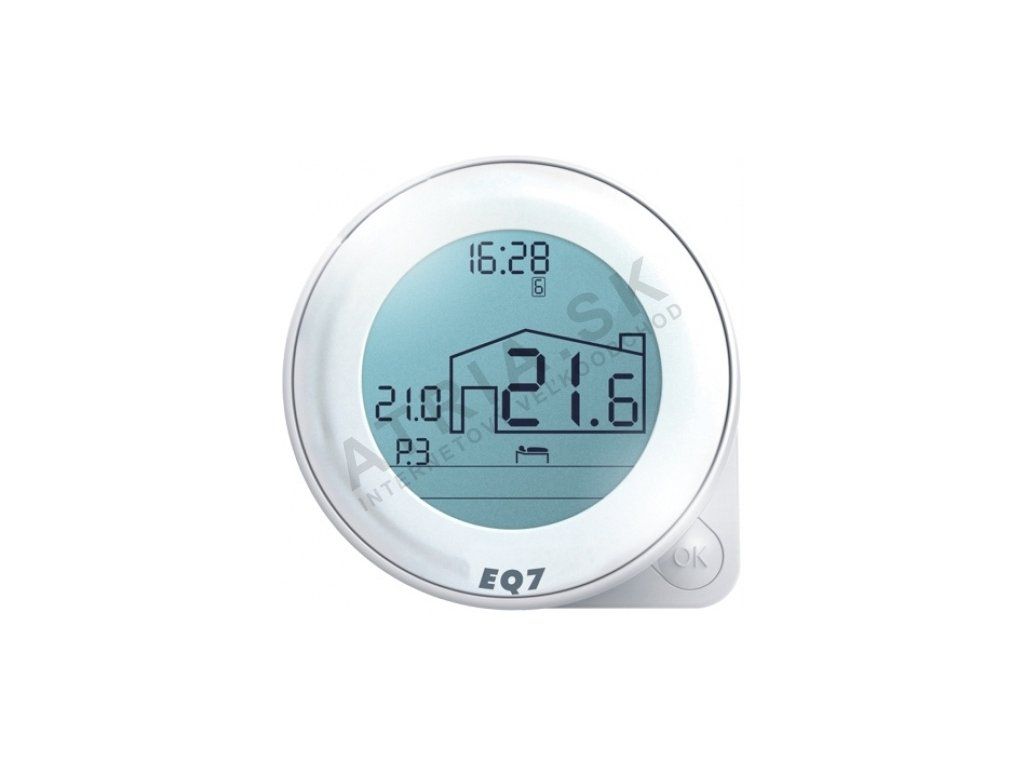 |
Euroster Q7 Programmable weekly thermostat with a clear display — suitable for finer differentiation of temperatures throughout the day, including HDO hours. Price: €74.29 |
You'll find a detailed overview of the differences between the individual types in the article Manual vs. programmable vs. WiFi thermostat, which also explains when investing in a higher-class thermostat actually pays off and when it's unnecessary.
Original controller from the boiler manufacturer vs. universal thermostat with HDO
The price of a controller rises with its level of intelligence and connection to the boiler.
An original controller from the boiler manufacturer (for example Bosch Easycontrol, Protherm MiGo, Vaillant eRELAX) communicates with the boiler over a digital bus (for example eBUS or OpenTherm) — it can smoothly modulate the boiler's output according to current need, display the boiler's error messages, and sometimes also control the compensation curve. A universal thermostat (for example Avansa, Euroster, Salus) works more simply — it only closes or opens a circuit (contact), which the boiler evaluates as a "heat/don't heat" signal. A universal thermostat is cheaper and works with almost any boiler, while an original controller offers smoother control and more features, but only for the given boiler brand.
This topic most often comes up with gas boilers or heat pumps, where a digital bus can make full use of the heat source's potential. With electric boilers, and especially with storage systems using HDO, the situation is somewhat different — an electric boiler generally doesn't need smooth output modulation the way eBUS handles it for a gas boiler, so here you'll far more often encounter a simple contact (switching) universal thermostat supplemented with an HDO input than an "original" digital controller. However, if your household combines an electric source with a gas boiler (for example as a backup or supplementary source), an original controller from the boiler manufacturer can still be an interesting choice for the gas circuit itself, while HDO is handled separately on the electric part of the system.
 |
Bosch Easycontrol CT 200 Original WiFi/smart room controller for Bosch/Junkers boilers, controlled via mobile app, smooth output modulation over the bus. Price: €356.68 |
 |
Protherm MiGo Original WiFi controller for Protherm boilers, controlled via mobile app. Price: €222.48 |
You'll find more about the advantages and limitations of both approaches in the article Original boiler controller vs. universal thermostat.
Weather-compensated control and HDO — can they be combined?
Weather-compensated control doesn't control heating only according to room temperature, but mainly according to the outdoor temperature measured by an outdoor sensor — according to a pre-set compensation curve, the boiler calculates on its own what temperature it should heat the heating water to, so the house has a stable temperature regardless of whether it's freezing outside or the weather is milder. Combining weather-compensated control with a room thermostat (so-called cascade control) gives the most precise and most economical result.
In systems with HDO, weather-compensated control can be combined with a dual-tariff rate especially in the case of storage systems, where a larger heat reserve (for example a storage tank or the mass of storage heaters) is "charged" during the cheap tariff to a higher temperature than immediate need would require, and this reserve is then gradually consumed during the expensive tariff. The compensation curve in that case determines how much heat should actually be "stored" given the outdoor temperature, while HDO determines when it's appropriate to carry out this storing. This is a more advanced setup, worth pursuing especially with larger storage systems, where the difference between the cheap and expensive tariff is noticeable in total annual consumption. With ordinary smaller electric boilers or convectors without storage, weather-compensated control usually isn't used, and a combination of a programmable thermostat with an HDO input is sufficient.
You'll find a more detailed explanation of the principle of weather-compensated control, including how the curve is set and everything that affects its precision, in the article How weather-compensated control works.
Zone control and HDO in practice
Zone control divides the house into several independent circuits (zones), each of which has its own thermostat and its own control valve (actuator) on the manifold or radiator. This makes it possible to have, for example, 22 °C in the living room and 18 °C in the bedroom at the same time, without having to manually adjust radiator valve heads. Zone control is commonly combined with underfloor heating, where typically each room has its own loop and its own thermostat controlling an actuator on the manifold.
Combined with HDO, zone control makes great sense especially with electric underfloor heating or electric storage mats, where you can "charge" individual zones with heat to different degrees depending on when the rooms are actually used. For example, a children's room or bedroom can be heated to a higher comfort temperature during the cheap night tariff, while a less-used study stays at a lower economy level during the day — and all of this automatically, without you having to go around manually adjusting individual thermostats every time the tariff switches. The more zones a house or flat has, the more it pays off to invest in central control that can handle all the zones and the HDO signal together, instead of several completely separate thermostats.
If you're considering zone control for your household, we recommend first reading the separate article Zone heating control, which explains how to properly design zones and everything you need in terms of components (manifold, actuators, central unit).
How to choose a thermostat with HDO input — practical tips
When choosing a thermostat for electric heating with a dual-tariff rate, we recommend checking a few specific points before buying. First, look in the thermostat's technical specification specifically for the term "HDO input" or "HDO terminal" — if it's not mentioned there, the thermostat most likely doesn't have this feature, even if it's otherwise fully programmable or smart. Second, check with your electrician or in the distribution board's technical documentation exactly where the output from the HDO relay is located and how it will need to be connected to the thermostat (voltage-free contact, AC voltage) — this determines whether you can manage the installation yourself or need an electrician.
Third, consider whether a thermostat with just a pre-programmed time schedule aligned with HDO hours is enough for you (a simpler and cheaper solution, works reliably as long as the HDO times don't change), or whether you need a thermostat with a genuine physical HDO input that reacts to the real signal automatically even if the distributor's schedule changes. Fourth, when combining with a storage system (heater, storage tank), it's worth also thinking about zone or weather-compensated control, described above, since with a larger volume of stored heat they can bring noticeably higher savings than a separate simple thermostat.
You'll find the complete selection procedure, including further criteria (adjustable temperature range, sensor type, compatibility with a specific type of heat source), in the article How to choose a room thermostat. Once you've chosen a thermostat and need advice on the wiring itself, also see the article Installing and wiring a room thermostat.
Real-life examples
Two real-life cases of deploying a thermostat with an HDO input.
Example 1: A family house with storage electric heating and a dual-tariff rateAn older family house has its main heat source in the form of storage heaters connected to a dual-tariff rate with HDO. Originally, the heating system was controlled solely by the HDO relay itself, without any room thermostat — the heaters heated up to maximum during every cheap tariff period regardless of the actual room temperature, which in warmer transitional seasons (spring, autumn) led to significant overheating and the need to ventilate even in cooler weather. After adding a programmable thermostat with an HDO input, the setup changed so that the heaters now heat up during the cheap tariff only until reaching the set comfort temperature (not automatically to maximum), while a slightly lower economy threshold is maintained outside HDO. The result is a noticeably more even temperature throughout the house all day, along with better use of the cheap tariff exactly when it's actually needed.
Example 2: A flat in a panel building with direct-heating electric convectors
A flat in a panel building uses direct-heating electric convectors as a supplementary heat source in two rooms, which were originally controlled only by their own built-in thermostat with no connection to HDO whatsoever. The household has a dual-tariff rate thanks to a water heater. After replacing the original built-in thermostats with a wireless programmable solution allowing a different schedule for weekdays and weekends, most of the convector heating was successfully shifted into the evening and night hours of the cheap tariff, when the occupants are home and heat is also cheaper. During the day, when the flat is empty and the tariff is more expensive, the convectors maintain only a lower background temperature, which, without reducing comfort, lowered the share of consumption paid at the more expensive tariff.
Frequently asked questions about HDO and a room thermostat
What exactly does the abbreviation HDO mean?
HDO is ripple control — a signal from the electricity distributor that switches between a high (more expensive) and a low (night, cheaper) tariff. It mainly concerns electric boilers and storage systems with a dual-tariff rate.
How do I find out if my thermostat has an HDO input?
Check the thermostat's technical specification or manual — the term "HDO input" or "HDO terminal" must be explicitly mentioned there. If it's not, the thermostat probably doesn't have this feature, even if it's otherwise programmable or smart.
Do I need a thermostat with an HDO input for a gas boiler too?
Usually not. HDO mainly concerns electric boilers and storage systems, where it makes sense to shift electricity consumption into the cheaper hours. For a gas boiler, an original controller from the manufacturer (eBUS, OpenTherm) or weather-compensated control is more relevant instead.
Can an HDO input be added to an existing thermostat that doesn't have this feature?
Not directly — an HDO input is part of the thermostat's design (the electronics need to be able to evaluate that signal). If your current thermostat doesn't have an HDO input, the solution is to replace it with a model that supports it, or to program a time schedule aligned with HDO hours on an existing programmable thermostat.
Is there a difference between a thermostat with an HDO input and an ordinary programmable thermostat?
Yes. A programmable thermostat without an HDO input works only with a pre-set time schedule that you need to know and program manually. A thermostat with a genuine HDO input reacts directly to the real signal from the HDO relay, so it keeps working correctly even if the distributor changes the tariff times in the future.
Is an HDO input worth it even for a small electric convector in a single room?
For a single smaller convector, the benefit is limited, since the amount of "storable" heat is small. An HDO input makes more sense with storage heaters, a storage tank, or larger underfloor heating, where heat can actually be "stored" during the cheap tariff and drawn from it outside that period too.
Can I use a thermostat with an HDO input even without a dual-tariff rate?
Yes, the HDO input is just an extra supplementary feature — if you don't have a dual-tariff rate, or cancel it in the future, the thermostat will keep working normally as an ordinary programmable or smart thermostat without that feature.
Where does the HDO signal physically connect to the thermostat?
The HDO relay is located in the distribution board near the electricity meter. The connection to the thermostat (or to its receiver, for wireless models) is made by an electrician using another wire or a voltage-free contact — the exact wiring differs depending on the specific thermostat model and how the HDO relay is wired in your distribution board.
Related topics
- How to choose a room thermostat
- Wired vs. wireless thermostat
- Manual vs. programmable vs. WiFi thermostat
- Original boiler controller vs. universal thermostat
- How weather-compensated control works
- Zone heating control
- Installing and wiring a room thermostat
- Thermostat service and common faults
- Frequently asked questions about room thermostats and controllers
Have a question about choosing a room thermostat?
Can't decide, or dealing with a specific situation in your household? Write to us — we're happy to help.