
Manual vs. Programmable vs. WiFi Thermostat
A room thermostat is one of those heating system components that most households only really notice when deciding to replace an old boiler or renovate their heating. Yet it's precisely the thermostat that decides whether the heating system works efficiently, or whether the boiler runs needlessly long and at a higher output than is actually needed at that moment. The difference between the cheapest manual thermostat with a rotary dial and a modern WiFi thermostat with a mobile app isn't just about price and design - it's a difference in how much control the user has over when, for how long, and to what temperature their household is heated.
In this article we go through the three basic categories of room thermostats in detail - manual (mechanical), programmable (weekly), and WiFi (smart) - and explain how they differ, who each type suits, and what to watch out for when choosing. Along the way we'll also touch on related topics that are closely connected to choosing a thermostat: the difference between a wired and a wireless connection, the difference between an original control unit from the boiler manufacturer and a universal thermostat, weather-compensated control, HDO for electric heating, and zone control in multi-room houses.
The goal of this article isn't to convince you that the most expensive option is always the best - in many cases a manual thermostat is entirely sufficient, and money spent unnecessarily on smart features you'll never use isn't a saving. The goal is that after reading this you'll be able to judge exactly which type of thermostat matches the way your household actually operates.
What a room thermostat actually does and why its choice matters
A room thermostat measures the temperature in the room where it's installed and, according to a set target value, switches the heat source on or off - most often the boiler, heat pump or electric heating element. With more modern controls, this isn't just a simple on/off switch, but output modulation - the boiler receives information about how much to raise or lower the heating water temperature so that the target room temperature is reached smoothly, without unnecessary fluctuations.
Without a thermostat, i.e. heating "blindly", the boiler would run continuously at full output regardless of the actual temperature in the room. The result is overheating - the flat is at 24 °C instead of the desired 21 °C, windows have to be opened even in freezing weather, and consumption of gas, electricity or other fuel rises without any extra benefit. A thermostat is therefore, first and foremost, a tool that makes the heating system behave exactly according to actual demand, not according to whatever output the boiler was set to during installation.
That's exactly why it's worth paying the same attention to choosing a thermostat as to choosing the boiler itself. A cheap but unsuitable thermostat (for example a manual one where the household would benefit from a weekly programme) means that the heating system's real saving potential goes unused. Conversely, an expensive smart thermostat with features you'll never use is an unnecessary expense. You'll find a detailed guide on choosing a specific model according to boiler type, household size and budget in the separate article How to choose a room thermostat.
Three basic thermostat types: manual, programmable and WiFi
The three basic thermostat types differ both in price and in degree of automation.
The market offers dozens of thermostat models from various manufacturers, but in terms of function they can be divided into three clearly separated categories. The difference between them isn't cosmetic - each category corresponds to a different way a household approaches heating.
Manual (mechanical) thermostat
A manual thermostat has just a rotary dial (or slider) for setting a single target temperature. The thermostat maintains this temperature continuously until someone manually changes it. It's the simplest and, at the same time, the cheapest option on the market - and that's exactly why it's still very widespread, especially in older flats, cottages, garages, or spaces where there's no need to change the temperature according to time of day.
The main downside of a manual thermostat is that it can't lower the temperature by itself when you're not at home, or at night, when a lower temperature is generally more pleasant and cheaper. If you want to heat less during the day, you have to turn the dial manually - and turn it back in the morning. In practice this means that many households with a manual thermostat heat to the same temperature all day, even when nobody is home, simply because manually adjusting it twice a day is inconvenient and easy to forget.

A simple manual (mechanical) room thermostat with a rotary dial - a classic solution for a single target temperature with no need for programming.
Price: €10.61
Who is a manual thermostat suited to? Typically to spaces with a regular usage pattern that rarely changes - cottages and cabins used occasionally, garages, workshops, or households where someone is present all day and doesn't need to change the temperature regime. In terms of price, a manual thermostat is the most affordable option, which makes it a sensible choice even where investing in a more expensive control simply doesn't make sense.
Programmable (weekly) thermostat
A programmable thermostat lets you set different target temperatures for different times of day and different days of the week. A typical example of a programme: in the morning from 6:00 to 8:00 a comfortable temperature of 21 °C is set, during the day, when the household is empty, the temperature drops to a setback value, for example 18 °C, in the afternoon once people are back from work it rises again to the comfortable level, and at night during sleep it drops to a lower, more economical temperature. On weekends, when the daily rhythm is different, a different programme can be set.
The biggest advantage of a programmable thermostat over a manual one is that this alternation of temperatures happens automatically, without anyone having to remember to turn the dial. The typical saving compared to a manual setting is felt especially in the temperature drop during the night and during absences from the household - it's precisely during these periods that a manual thermostat most often "pointlessly" maintains the same temperature, even when it isn't needed.
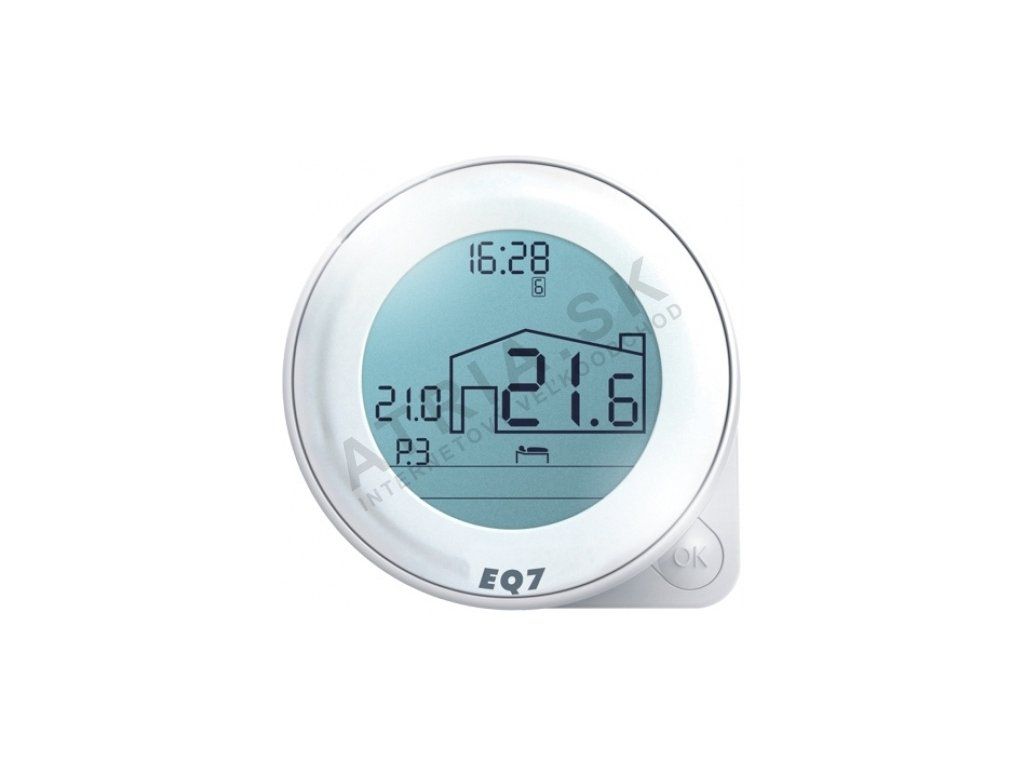
A programmable weekly thermostat with a clear display - lets you set a different temperature regime for every day of the week.
Price: €74.29
Programmable thermostats are made in both wired and wireless versions. The wireless version communicates with a receiver placed near the boiler via a radio signal, so there's no need to run a cable through the flat. An example is a wireless programmable thermostat consisting of a transmitter (the thermostat itself, mounted on the wall or placed freely) and a receiver connected directly to the boiler's control unit.

A wireless programmable thermostat - the transmitter and receiver communicate by radio, so installation is possible even without demolition or running a cable to the boiler.
Price: €56.31
Who is a programmable thermostat suited to? It's the most universal choice for an ordinary household with a regular daily routine - you go to work, the kids go to school, you're home in the evening, you sleep at night. It's exactly this regular rhythm where a weekly programme can save the most without you having to worry about anything else - the programme is set once and then runs automatically.
WiFi (smart) thermostat
A WiFi, or smart, thermostat builds on the basis of a programmable thermostat and adds remote control and monitoring via a mobile app from anywhere with an internet connection. This means you can change the current temperature in the flat, the heating history, and even the programme settings even when you're not at home - for example when coming back from a holiday a day early and wanting the flat heated before you arrive, or conversely, when you've gone away for a longer period and want to turn the heating down remotely.
With original WiFi control units from the boiler manufacturer (for example Bosch Easycontrol or Protherm MiGo), there's also added communication directly with the boiler's electronics - the app can display the boiler's current status, any error messages, consumption, and in some cases even operating history. This type of control connects to the boiler via a digital bus, not just a simple switching contact, which we'll cover in more detail in the next chapter.

Original WiFi/smart room control for Bosch and Junkers boilers - smooth boiler output modulation and control via a mobile app from any location.
Price: €356.68
Who is a WiFi thermostat suited to? Its benefit is most appreciated by people with an irregular daily routine (for example shift work, frequent travel), owners of cottages and recreational properties they don't visit regularly and want to be able to start the heating remotely before arriving, and also households that want as detailed an overview as possible of exactly how the boiler is working. The price of a WiFi control unit is significantly higher than a simple programmable thermostat, so it's worth considering whether you'll actually make use of remote control, or whether a cheaper weekly programme would be enough.
Original control unit from the boiler manufacturer, or a universal thermostat?
An original control unit from the boiler manufacturer is significantly more expensive than a universal thermostat.
When choosing a WiFi or smart control, it's worth distinguishing between two fundamentally different approaches - an original control unit directly from the boiler manufacturer and a third-party universal thermostat. The difference between them isn't just a matter of brand, but also a technical one, and it affects exactly which features you'll actually get from the control.
An original control unit from the boiler manufacturer, for example Bosch Easycontrol, Protherm MiGo or Vaillant eRELAX, communicates with the boiler over a digital bus - most often the eBUS or OpenTherm protocols. Thanks to this two-way communication, the control unit can smoothly modulate the boiler's output exactly according to current demand (not just switch on/off, but tell the boiler to "heat a bit less" or "heat a bit more"), display error messages directly from the boiler, and in some cases even manage the weather compensation curve.

Original WiFi control unit for Protherm boilers - controlled via a mobile app, with direct communication with the boiler's electronics.
Price: €222.48
A universal thermostat, for example from the brands Avansa, Euroster or Salus, works more simply - it doesn't communicate digitally with the boiler, it just opens and closes an electrical circuit (a contact). The boiler interprets this signal simply as "heat" or "don't heat", without more detailed information about exactly how much. The advantage of a universal thermostat is that it's cheaper and works with almost any boiler regardless of brand - it isn't tied to a specific manufacturer. The downside is less smooth control and the absence of features tied to the specific boiler electronics (for example displaying error messages).
Summed up in one sentence: a universal thermostat is the more universal and cheaper choice that works almost everywhere, while an original control unit from the boiler manufacturer offers smoother control and more features, but only for the specific boiler brand it's intended for. You'll find a more detailed comparison with specific examples in the article Original boiler control unit vs. universal thermostat.
Wired, or wireless thermostat?
Both wired and wireless connections have their advantages and disadvantages.
Regardless of whether you decide on a manual, programmable or WiFi thermostat, you'll also have to choose the connection method to the boiler - wired or wireless. This decision is largely independent of the thermostat type and relates more to the conditions in a specific household.
A wired (cabled) thermostat connects to the boiler's control unit via a two-core wire. It's a reliable solution with no batteries - the thermostat is powered directly from the boiler's circuit or has its own power supply, so there's no risk of a failure due to flat batteries. The downside is that it requires running a cable from where the thermostat is placed all the way to the boiler. In a new build this is no problem, since the cable is planned into the electrical wiring project. In the renovation of a flat or house where a cable route wasn't prepared in advance, however, this can mean demolition and cutting into the wall, which makes the installation more expensive and takes longer.
A wireless thermostat communicates with a receiver placed near the boiler via a radio signal, usually on the 868 MHz frequency. Installing a wireless thermostat is faster and requires no demolition at all - you just need to mount the receiver near the boiler and place the thermostat anywhere within signal range. The downside is the need for batteries in the transmitter (the thermostat), which need to be replaced occasionally, and in densely built-up areas, for example panel buildings with many WiFi networks and electronics, the signal can be more sensitive to interference.
Which variant to choose therefore depends mainly on whether or not you have a cable route already prepared. For a renovation without pre-prepared cabling, a wireless solution is practically always simpler and cheaper to install, even though the thermostat itself may be somewhat more expensive than the wired equivalent. You'll find a detailed installation guide for both variants in the article Installing and wiring a room thermostat, and a complete comparison of the advantages and disadvantages in the article Wired vs. wireless thermostat.
Weather-compensated control - when the thermostat works together with an outdoor sensor
A room thermostat by itself only handles the temperature in the one specific room where it's installed. A more advanced solution, often combined with a thermostat, is weather-compensated (equithermal) control. This doesn't control heating only according to the measured room temperature, but primarily according to the outdoor temperature measured by a separate outdoor sensor mounted on the facade of the house.
The principle works as follows: according to a pre-set weather compensation curve, the boiler calculates by itself the temperature it should heat the heating water to, so that a stable temperature is achieved in the house regardless of whether it's −15 °C outside or milder weather around 5 °C. Instead of the boiler reacting only once the temperature in the room drops (which means a certain delay and fluctuations), it reacts preventively to a change in outdoor conditions.
The most precise and most economical result comes from combining weather-compensated control with a room thermostat - so-called cascade control. The weather compensation curve handles the basic output setting according to the weather, while the room thermostat then fine-tunes small deviations caused, for example, by sunlight coming into the room, heat from cooking, or the number of people in the room. This combination is common especially with original control units from the boiler manufacturer, which communicate over the digital bus mentioned above. You'll find a detailed explanation of how weather-compensated control works, including how the curve is set, in the article How weather-compensated control works.
HDO and the room thermostat for electric heating
For households with an electric boiler or storage heating, choosing a thermostat has one more dimension - ripple control, or HDO for short. This is a signal from the electricity distributor that switches between a high and a low (night-time) tariff as part of a dual-tariff rate.
A thermostat with an HDO input can recognise when the cheaper low tariff is active and adjust its behaviour accordingly - for example setting a lower comfort temperature threshold outside the HDO period (to save energy during the more expensive band) and a higher threshold during active HDO, when electricity is cheaper and therefore more advantageous for heating the space to a higher temperature in reserve. Not every thermostat on the market has this input - when choosing a thermostat for an electric boiler on a dual-tariff rate, it's therefore necessary to explicitly check whether the given model supports an HDO input, otherwise you simply won't benefit from this advantage despite paying for a dual-tariff rate.
This is one specific example of why choosing a thermostat isn't universal for every household - it also depends on what heat source you have and what electricity tariff rate you pay. You'll find a complete overview of how HDO and the thermostat work together and what to watch out for when choosing in the article HDO and the room thermostat - how they work together.
Zone control - a different temperature in every room
So far we've been talking about a single thermostat controlling the whole house or flat as one unit. In larger or multi-storey houses, however, it's a common requirement to have a different temperature in different rooms at the same time - for example higher in the living room, where most time is spent, and lower in the bedroom, where you sleep. That's what zone control is for.
Zone control divides the house into several independent circuits (zones), each of which has its own thermostat and its own control valve, or actuator, placed on a manifold or directly on the radiator. Thanks to this it's possible to have, for example, 22 °C set in the living room and 18 °C in the bedroom at the same time, without having to manually adjust individual radiator valves every time you want to change the temperature in one room.
Zone control is commonly combined with underfloor heating, where each room typically has its own heating loop and its own thermostat controlling an actuator on the manifold - this allows precise fine-tuning of temperature room by room, which simply isn't possible with a single shared thermostat for the whole house. If you're planning zone control in your house, you'll find a detailed procedure and operating principle in the article Zone control of heating.
How to decide - summary by household type
Four questions that help you choose the right type of thermostat.
When we sum up all the facts above into a clear decision-making guide, choosing a thermostat can be simplified into a few basic questions. First: does who's home and when change over the course of a day or week? If so, a programmable thermostat brings a real benefit over a manual one, since it automatically lowers the temperature at times when a manual thermostat wouldn't do so by itself. If not - for example if someone in the household is present almost continuously, or it's a space with minimal use like a cabin or garage - a manual thermostat may be entirely sufficient, and there's no need to pay extra for features that won't be used.
Second: do you need remote control and a remote overview? If you spend irregular time in the household, travel, or manage heating at a cottage you don't visit regularly, a WiFi thermostat brings a convenience that's hard to replace any other way - you can start the heating before you arrive, or conversely turn it down when your trip back is extended.
Third: do you have a boiler of a specific brand and want to get the most features out of it, including smooth output modulation and error messages displayed directly in the app? Then it's worth considering an original control unit from the boiler manufacturer, even though it's usually more expensive than a universal thermostat. If, on the other hand, you want a cheaper solution that will work regardless of boiler brand (for example if you're planning to replace the boiler with a different brand in the future), a universal thermostat is the safer investment.
And finally, if you have an electric boiler on a dual-tariff rate, don't forget to check for HDO input support when choosing - without it, the advantage of the cheaper night-time tariff won't show up in the thermostat's behaviour at all.
Real-world examples
Example 1: A family house with a gas condensing boiler and a regular work routine. In a family house where both parents work away from home from morning until afternoon and the children are at school during the day, a simple manual thermostat was originally installed, set to a single temperature of 22 °C that applied practically continuously - during the day, when the house was empty, and at night as well. After switching to a programmable thermostat with a weekly programme, a drop to a setback value was set for the morning and afternoon hours when the house is empty, and a slight drop during the night as well, with a rise back to a comfortable temperature in the morning before the alarm and in the afternoon before the family returns home. The family therefore doesn't need to adjust anything manually, and the house is heated exactly when someone is home - during absences and at night the system automatically saves energy without any intervention.
Example 2: A flat in a panel building with an electric boiler and a dual-tariff rate (HDO). In a flat with electric heating and a dual-tariff contract, an ordinary programmable thermostat without HDO input support was originally installed. The thermostat therefore worked purely according to its set programme, completely independent of whether the cheap night-time tariff or the more expensive daytime tariff was currently active. After switching to a thermostat with an HDO input, the settings were adjusted so that during active HDO (when electricity is cheaper) a somewhat higher comfort temperature was allowed to be reached, while outside HDO the comfort threshold was lowered slightly. This way the system makes better use of the cheaper period to heat the space, instead of producing the same amount of heat regardless of the current electricity price.
Frequently asked questions about choosing a thermostat
Is it worth paying extra for a WiFi thermostat if I'm not the travelling type and I'm almost always at home?
If someone in the household is present practically continuously and you wouldn't actually use remote control, a programmable thermostat with a weekly programme is enough. The main benefit of a WiFi thermostat is precisely the ability to control and monitor the heating remotely - if you won't use this feature, you're paying extra for something you won't use.
Does a universal thermostat work with any boiler?
A universal thermostat (for example Avansa, Euroster or Salus) works on the principle of simply opening and closing a contact, which most ordinary boilers with a standard two-wire input for a room thermostat can accept. Before buying it's always good to check the input type on your boiler, but in most cases a universal thermostat is compatible across brands.
Why is an original control unit from the boiler manufacturer more expensive than a universal thermostat?
An original control unit communicates with the boiler over a digital bus (for example eBUS or OpenTherm), which lets it smoothly modulate the boiler's output, display error messages, and sometimes even manage the weather compensation curve. This two-way communication and deeper integration with the boiler's electronics is technically more demanding, which is also reflected in a higher price compared to the simple switching contact of a universal thermostat.
Can I install a wireless thermostat myself, or does it need to be installed by a professional?
A wireless thermostat is simpler to install precisely because there's no need to run a cable from the thermostat to the boiler - you just need to connect the receiver to the boiler's control unit and place the thermostat anywhere within signal range. Connecting the receiver to the boiler's terminals is, however, still an electrical wiring task where it's worth following the instructions or calling in a professional, especially if you have no experience with electrical wiring. You'll find a detailed procedure in the article on installing and wiring a room thermostat.
What does it mean that a thermostat "modulates" the boiler's output, rather than just switching it on and off?
A simple (switching) thermostat only sends the boiler a "heat" or "don't heat" signal - the boiler then runs at a pre-set output until the signal changes. A modulating control, by contrast, communicates with the boiler in more detail and can say "heat a bit less" or "heat a bit more" according to the current deviation from the target temperature. The result is a smoother heating process without significant temperature swings, which is typical of original control units communicating over a digital bus.
Do I necessarily need a thermostat with HDO support for an electric boiler?
It's not a necessity, but if you have a dual-tariff electricity rate, a thermostat with an HDO input lets you make better use of the price difference between the high and low tariffs by adjusting the heating's behaviour according to which tariff is currently active. Without an HDO input, the thermostat works independently of the tariff and you won't benefit from this advantage, even though you're paying for a dual-tariff rate.
Can zone control be combined with a WiFi thermostat?
Yes, the principles of zone control (a separate thermostat and valve for each zone) and WiFi control (remote control via an app) don't exclude each other. Some zone control systems also offer central WiFi control of all zones at once from a single app, which is especially useful with underfloor heating with multiple rooms and loops.
How often do batteries in a wireless thermostat need to be replaced?
The replacement interval depends on the specific model and intensity of use, but most wireless thermostats last on one set of batteries for a period of months up to over a year. Most models also warn of a low battery on the display before it runs out completely, so replacement can be planned without risk of a control outage.
Related topics
If you want to work through choosing a thermostat in full detail, we also recommend reading these related articles from our knowledge center:
- How to choose a room thermostat
- Wired vs. wireless thermostat
- Original boiler control unit vs. universal thermostat
- How weather-compensated control works
- HDO and the room thermostat - how they work together
- Zone control of heating
- Installing and wiring a room thermostat
- Servicing and common thermostat faults
- Frequently asked questions about room thermostats and controls
Have a question about choosing a room thermostat?
Can't decide, or dealing with a specific situation in your household? Write to us – we're happy to help.