
Installation and connection of a gas instant water heater
A gas instant water heater is one of the most reliable solutions for hot water preparation where it doesn't make sense to install a storage tank, or where there's no electrical connection with enough reserve for electric heating. Unlike electric models, however, a gas device requires a different installation process – from the gas connection through flue discharge to the mandatory inspection. In this article we explain in practical terms what installing a gas instant water heater involves, what the difference is between chimney and turbo flue discharge, how burner ignition works without electricity, and why unpressurised models require a special tap. We also add two real-world examples showing how these devices are actually installed in cottages and flats. If you're still deciding whether a gas instant water heater is the right choice for you, we recommend first reading the article How to choose an instant water heater and the comparison Electric vs. gas instant water heater – this topic covers only the installation of the device you've already chosen.
Gas connection and who may carry out the installation
The first and most important rule is unambiguous: connecting a gas instant water heater to the gas supply must never be done by a layperson on their own. This is work on a household gas installation that may only be carried out by a person with valid professional qualification in gas fitting. This condition isn't an extra formality – incorrect connection of a gas appliance is among the most common causes of serious household accidents, from gas leaks to the risk of explosion or poisoning from combustion products. Besides the safety risk, failing to follow this rule also has a very practical consequence: most manufacturers and retailers make the device warranty conditional on installation having been carried out by an authorised person and on an inspection report having been issued afterwards. A self-installed heater can therefore mean losing the warranty and complications with insurance in the event of a fault or insurance claim.
The installation process for a gas instant water heater itself has several steps that follow one another. First comes choosing and verifying a suitable installation location – taking into account distance from flammable materials, sufficient space for operation and servicing, mounting height above the sink or basin, and, for the turbo variant, also the possibility of routing the flue discharge through the exterior wall to the outside. Next comes actually mounting the heater on the wall, connecting to the cold water supply and hot water outlet, and finally connecting to the gas supply, including fitting a shut-off valve, which must be easily accessible for servicing or in an emergency. After the physical connection, all joints are checked for tightness, the burner is test-ignited, and the device's correct operation is checked at various water flow rates. The whole process concludes with issuing an inspection report confirming that the device is safe to operate – we cover this topic in more detail below in a separate chapter.
When booking the installation, it's worth checking in advance whether the chosen technician is authorised not only to connect the gas appliance itself, but also to carry out the initial inspection, or whether they provide these two services together with an inspection technician. In practice this is often handled by one company or one tradesperson with the relevant certifications, which simplifies the installation – the customer doesn't need to coordinate two different providers and just one visit is enough to connect and test the device.
Flue discharge: chimney vs. turbo variant
A gas instant water heater burns natural gas or propane-butane, and combustion inevitably produces flue gases that must be safely discharged away from the living space. The method of flue discharge is precisely one of the key parameters that determines where and how the heater can even be installed. In principle there are two solutions – a classic chimney discharge with natural draught, and a more modern turbo variant with forced draught.
Chimney variant (natural draught)
The chimney, or so-called type B, heater uses a functional chimney with natural draught to discharge flue gases – the temperature difference between the flue gases and the surrounding air creates a flow that draws the flue gases out of the building through the chimney flue. This solution is typical especially for older buildings, cottages, and properties that already have a chimney that's functional. The advantage is a simpler design and generally a lower purchase price for the device. The drawback is dependence on the condition and patency of the chimney – it must be in good technical condition, with the correct cross-section and draught, otherwise there's a risk of flue gases being drawn back into the room. With the chimney variant, therefore, besides the inspection of the gas appliance itself, a separate chimney inspection by a chimney sweep is also needed, confirming its patency and suitability for connecting this particular type of appliance.
Turbo variant (forced draught)
The turbo, or so-called type C, heater handles flue discharge completely differently – a built-in fan actively pushes flue gases out through a special, generally concentric (one pipe inside another) duct routed directly through the exterior wall to the outside of the building, with no need for any chimney. Both combustion air intake and flue gas discharge thus happen through a single wall penetration, which significantly simplifies installation especially in flats, panel-building cores, or family houses without a functional chimney. This solution has therefore become a popular choice for bathroom and kitchen renovations, where a chimney either never existed or has long been out of use. With the turbo variant, the recommended distances of the pipe outlet from windows, doors, ventilation openings of neighbouring buildings, and property boundaries must be observed during installation, so the flue gases disperse safely and don't return into the living space. This distance and the exact routing of the pipe are part of the installation plan prepared by the installing technician according to the specific conditions of the property.
Which variant is "better" depends on the specific situation. If the building has a functional, adequately sized chimney, the chimney variant is the simpler and cheaper choice. If there's no chimney, it's in poor condition, or it's a flat on a higher floor without access to a chimney flue, the turbo variant is practically the only feasible solution. Both types are available among the gas models in our range – the specific discharge type is always given in the product parameters, so before ordering it's enough to check that it matches the conditions in your household.
Ignition: piezo vs. hydro-generator
The second important feature affecting both convenience and placement options for a gas instant water heater is the method of burner ignition. Modern gas heaters essentially use two principles – piezoelectric ignition and hydro-generator-driven ignition. What both solutions have in common is that neither needs a connection to the electrical mains nor batteries – which is a big advantage from an installation point of view, since no electrical connection needs to be run to the heater, and the device works reliably even where electricity isn't available at all.
Piezoelectric ignition
Piezoelectric ignition works on a simple mechanical principle – pressing a button mechanically generates an electric spark that ignites the gas. In some designs, this spark lights a permanent pilot flame, which then reliably ignites the main burner when the water is opened; in others, the piezo button is pressed directly with every use. The advantage of piezo ignition is simplicity, mechanical reliability, and near-zero failure rate – there's no electronics that could fail. The drawback is somewhat less convenient operation, since the user has to activate ignition themselves, or maintain the pilot flame.
Hydro-generator ignition
Hydro-generator ignition works differently and is, in practice, the more convenient solution: inside the heater's body there's a small turbine that's spun by the flow of water itself when the tap is opened. This turbine drives a generator that produces enough electrical energy to create an ignition spark right at the moment water starts flowing through the device. The result is fully automatic ignition – the user simply opens the tap and the heater ignites itself, with no need to press any button. This is exactly the principle used, for example, in the Karma POV 14BK ZP model, which handles ignition fully automatically thanks to water flow, with no need for an electrical connection.
Precisely this independence from electricity is why gas instant water heaters with piezo or hydro-generator ignition are so often installed in cottages, garden sheds, garages, or other buildings where an electrical connection is either completely missing, or where installing one just for water heating would be disproportionately costly. All that's needed is a functional gas supply (for example from a pressurised cylinder) and a water supply – the device takes care of the rest itself.
Specific tap fittings for unpressurised models
When installing gas instant water heaters, it's essential to distinguish between pressurised and unpressurised versions, since both types connect to the water supply differently and require different fittings. We cover this topic in detail in the separate article Pressurised vs. unpressurised instant water heater; here we explain what this means specifically for the installation itself.
Unpressurised (open) models
An unpressurised heater is designed so that the device's body itself is part of the water circuit together with a special tap that's supplied directly with the device. This tap isn't an ordinary mixer tap of the kind found on a regular sink or washbasin – it has a different design that simultaneously opens and regulates the flow of water through the heater's heat exchanger, and this flow also triggers the burner's ignition (especially in models with a hydro-generator). That's precisely why an ordinary universal single-lever or classic two-tap mixer must never be used with unpressurised models – not only would it fail to work correctly, it could also cause the whole heater to malfunction or even become damaged. The tap supplied by the manufacturer is therefore a mandatory part of the installation, and exactly the one specified for the given model must be used.
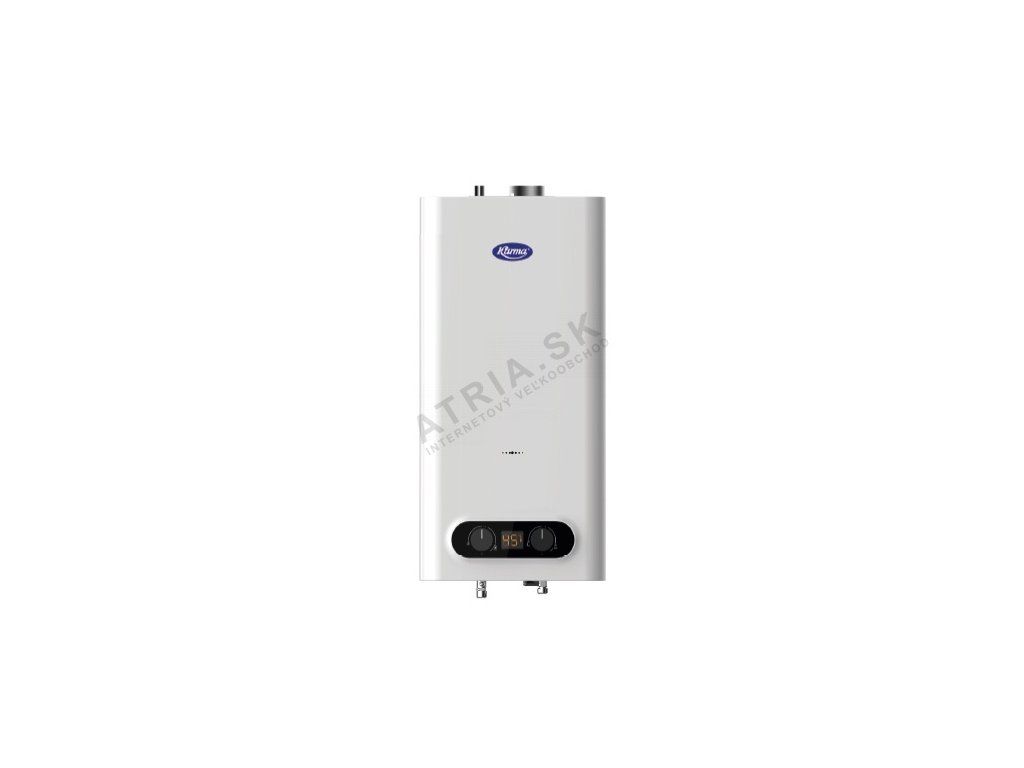
An unpressurised solution is generally used where water heating is needed for just one specific draw-off point – typically a utility sink or washbasin in a kitchen or cottage. The advantage is simpler installation without needing to deal with pressure safety components; the drawback is being limited to a single draw-off point at a time.
Pressurised (closed) models
A pressurised heater works differently – it connects directly into the cold and hot water supply similarly to how you'd connect a small gas boiler or a storage water heater. On the hot water outlet side, it can therefore supply several draw-off points at once (for example a sink and a shower), and a completely ordinary tap can be used at each of them without any restrictions. This freedom, however, comes with a condition – since the whole system is under the pressure of the water supply, a pressurised heater must be fitted with a safety valve that safely releases water if the safe pressure is exceeded, protecting the heat exchanger and piping from damage. Exactly this kind of solution is offered, for example, by the Karma POV 11BW ZP model, designed for connection to a standard pressurised supply, with the ability to supply several draw-off points in the household.

The choice between a pressurised and unpressurised solution should therefore be made before the installation itself – not only because of price and technical design, but also because subsequently switching from an unpressurised to a pressurised solution (or vice versa) often requires replacing the taps and modifying the piping, which increases the cost of installation. If you're not sure which type suits your household better, we recommend going through the comparison in the article Pressurised vs. unpressurised instant water heater before booking the installation.
Inspection and regular tightness checks
Once installation of the gas instant water heater is complete, a step follows that must never be skipped – inspection of the gas appliance. This is a professional inspection and test carried out by an authorised inspection technician, resulting in an inspection report confirming that the device is safe to operate. This inspection isn't just a formality for the insurer or the authorities – it's a real check that can detect leaking joints, malfunctioning safety components, or flue discharge problems before they show up during normal operation.
During the inspection, the technician generally checks several areas at once: the tightness of all gas joints (typically using a special detection spray or a device that can detect even a minimal gas leak), the correct function and setting of the burner, the functionality of safety features (for example the flame failure device, which immediately shuts off the gas supply if the flame goes out), and, for the chimney variant, also the quality of flue discharge into the chimney. The resulting inspection report is a document the property owner should keep – it's often needed for insurance claims, when selling the property, and for future inspections, where it serves as a reference.
Inspection of the gas appliance isn't just a one-off step right after installation – it's a recurring obligation. The interval for subsequent inspections is set by the inspection technician based on the type of device and local regulations, generally on a cycle of several years; the exact date of the next inspection is always given directly in the inspection report, so the simplest approach is to follow that date rather than general estimates. Besides the scheduled professional inspection, a regular visual check by the user is also recommended – noticing any smell of gas, checking that joints aren't visibly damaged or corroded, and not covering ventilation openings in the room where the heater is installed. With the chimney variant, regular care also includes a chimney inspection by a chimney sweep, independent of the appliance's own inspection.
If any unusual change occurs during operation – a change in flame colour, irregular ignition, a smell, soot around the burner, or any other signal – the right response is to shut down the device and call a service technician, not attempt a DIY fix. An overview of the most common faults and recommendations on when to call a service technician can be found in the article Service and common faults of instant water heaters.
Real-world example
Scenario 1: A cottage without an electrical connection
Picture a typical situation of a family who own a mountain cottage used mainly on weekends and in summer. The cottage has no electrical connection – electricity is limited to a small solar panel for lighting, which simply isn't enough to power any instant water heater with electronic ignition. At the same time, the kitchen only has one draw-off point at the sink, where hot water is needed for washing dishes and basic hygiene. In this situation, the logical choice is an unpressurised gas heater with hydro-generator-driven ignition – the device is connected to a pressurised propane-butane cylinder (a common solution for cottages without a gas main) and to the cold water supply, using the specific tap supplied with the device. Thanks to the hydro-generator, the heater ignites automatically every time the family opens the tap – with no need to press a button and no dependence on mains electricity or batteries. After installation by an authorised technician, an inspection followed, confirming the tightness of the connection to the gas cylinder and the correct function of the ignition. The result is a reliable source of hot water that works exactly as if the cottage had electricity – which is a typical and very common reason why owners of cottages and garden houses choose this type of device.
Scenario 2: A flat in a panel building without a functional chimney
The second typical case is a flat on a higher floor of a panel building, where, during a bathroom and kitchen renovation, the owner was considering replacing an old storage heater with instant heating. The problem was obvious at first glance – the apartment building has no functional chimney that could be used for flue discharge, and running a new chimney flue through several floors would be practically infeasible and disproportionately costly. The solution was a pressurised gas instant water heater with turbo flue discharge, which was connected to the gas and water supply similarly to a small boiler, with flue gases routed out through a short concentric pipe directly through the bathroom's exterior wall to the outside of the flat. Since this is a pressurised solution, the existing ordinary taps could remain on the hot water outlets – in both the kitchen and the bathroom, with no need to replace them. Installation also included checking the suitability of the pipe outlet's location (sufficient distance from windows and neighbouring buildings), and after connection, an inspection of the gas appliance followed, confirming safe operation. This case illustrates well why the turbo variant is practically the only feasible solution in apartment buildings without a chimney – and also why it's worth deciding on the flue discharge type already when choosing the specific model, not just before installation.
Recommended products
Below you'll find two gas instant water heaters from our range that represent both main design solutions described in this article – an unpressurised model with a specific tap and automatic hydro-generator ignition, and a pressurised model designed for connection to a standard supply with multiple draw-off points.
| Product | Type | Price |
|---|---|---|
| Karma POV 14BK ZP | Unpressurised, hydro-generator ignition | €849.85 |
| Karma POV 11BW ZP | Pressurised, multiple draw-off points | €1,037.88 |
If you do have an electrical connection available and are looking for an alternative without gas and without needing to deal with flue discharge, it's also worth looking at the comparison in the article Electric vs. gas instant water heater, where you'll also find electric models suitable as a replacement for a gas solution.
Frequently asked questions (FAQ)
Can I connect a gas instant water heater myself?
No. Connection to the gas supply may only be carried out by a person with professional qualification in gas fitting. DIY installation is a safety risk and generally also means losing the warranty on the device.
What's the difference between chimney and turbo flue discharge?
The chimney variant discharges flue gases by natural draught through a functional chimney; the turbo variant forces them out via a fan directly through the exterior wall, with no chimney needed. Turbo is therefore more suitable where there's no chimney or it's not functional.
Do I need an electrical connection for a gas heater?
Not for models with piezoelectric or hydro-generator ignition – both methods work without a connection to the mains and without batteries, which is an advantage when installing in cottages or other places without electricity.
Why can't I use an ordinary tap on an unpressurised heater?
Unpressurised models require a specific tap supplied by the manufacturer, because this tap also controls the flow of water through the heater and triggers ignition. An ordinary mixer tap wouldn't ensure the device works correctly.
How often does a gas heater need to be inspected?
The first inspection is mandatory right after installation. The date of the next regular inspection is set by the inspection technician and stated directly in the inspection report – follow that date rather than general estimates.
Can a gas instant water heater be installed at a cottage without electricity?
Yes, that's precisely one of the main advantages of gas models with piezo or hydro-generator ignition – they work reliably even without any connection to the electrical mains, all that's needed is a functional gas supply (for example from a pressurised cylinder) and a water supply.
What if I smell gas after installation?
In that case, immediately close the main gas shut-off valve, ventilate the space, don't operate any electrical switches, and contact an inspection technician or service. A smell of gas after installation signals a leak that needs to be dealt with immediately, not put off.
Can a pressurised or unpressurised model be later switched to the other type?
Technically yes, but it means replacing the taps and modifying the piping, so it's an additional installation job. It's therefore worth choosing the right type already when selecting the device – the article Pressurised vs. unpressurised instant water heater can help with that.
Related topics
- How to choose an instant water heater
- Electric vs. gas instant water heater
- Pressurised vs. unpressurised instant water heater
- Service and common faults of instant water heaters
Have a question about an instant water heater?
Can't decide, or dealing with a specific situation in your household? Write to us – we're happy to help.