
Instant water heater or storage tank - which pays off
Instant water heater or storage tank – which pays off
When choosing how to prepare domestic hot water, almost every owner of a flat, studio, cottage, or family house faces the same question: does it make sense to invest in an instant water heater, which heats water right at the moment of draw-off, or is it more sensible to go for a classic storage water heater (boiler), which prepares a larger volume of hot water in advance and keeps it ready for later use? There's no universal answer – it depends on the layout of the flat, the number of draw-off points, the size of the household, the available electrical protection or gas connection, and ultimately also on exactly how the family actually uses hot water during the day.
In this article we go through the principles of both solutions in detail, compare them in terms of space, heat loss, source output requirements, and comfort during peak use, look at combined solutions too, and use two real-world scenarios (a studio flat and a family house with multiple bathrooms) to explain when it pays to choose which type of device. If you already know an instant water heater is the right path for you, we also recommend the article How to choose an instant water heater, where you'll find a complete selection process including parameters that don't take centre stage in this text.
The principle of instant heating
An instant water heater (often also called a flow-through heater, although it's a technically different device) stores no reserve of hot water at all. Cold water flows through a heat exchanger right at the draw-off point – that is, directly under the washbasin, at the shower, or at the bathtub – and is only heated at the moment you open the tap. As soon as you stop the water, heating stops immediately, and no heated water remains in the device to cool down further.
There are two basic types: electric instant water heaters, which heat water with a high-power electric element (commonly 3.5 kW to 27 kW depending on the model and intended use), and gas instant water heaters, which use a gas burner and are typical especially where a natural gas supply is available or a propane-butane pressurised cylinder can be connected. With electric models, a further distinction is made between pressurised (supplying several draw-off points at once, installed within the pressurised water system) and unpressurised (supplying a single draw-off point, mounted directly above the washbasin) – we cover this topic in detail in the separate article Pressurised vs. unpressurised instant water heater.
The key feature of instant heating is that it theoretically provides an unlimited amount of hot water, for as long as the draw-off continues and as long as the energy source – the electrical mains or gas connection – can deliver sufficient instantaneous output. In other words, an instant water heater never "runs out" the way a tank can empty: as long as water is flowing and the device has enough power draw, hot water simply keeps flowing. This is a fundamental difference from the storage principle, which we discuss below.
The second important feature is its physically undemanding footprint. Compact instant water heaters fit directly under a washbasin or on the wall next to the shower and take up practically no extra space – compared to a tank with a capacity of 80, 100, or 120 litres, which needs its own spot on a wall or in a utility room, this is a noticeable difference, especially in smaller flats.
The principle of storage heating
A storage water heater works on the opposite principle. Inside an insulated tank, a larger volume of water – commonly 50 to 200 litres, even more in larger family houses – is heated in advance and stored, then gradually drawn off as needed. Heating happens slowly and continuously, either via an electric element or indirectly through a heat exchanger connected to a boiler or heat pump. Because the water is heated gradually rather than "on demand", the source doesn't need as high an instantaneous output as with instant heating – a smaller power draw spread over a longer time is enough.
The drawback of the storage principle is so-called standby heat losses – the tank has to keep the prepared water at the required temperature even when it's not being used, and despite good insulation it gradually cools slightly. In technical terminology this phenomenon is called standby loss, and for an ordinary household tank it represents a real, if not dramatic, item in energy consumption. By contrast, this phenomenon is practically nonexistent with instant heating – water is heated exclusively at the moment of draw-off, and no energy is spent maintaining it between uses.
The storage principle, however, has an undeniable advantage where a larger volume of hot water is needed at once or in quick succession – for example when filling a bathtub, or when several household members shower one right after another. Since the volume is prepared in advance, the source's instantaneous output doesn't matter as it does with an instant system. A detailed guide to choosing a storage tank, including recommended volumes based on the number of people in the household, can be found in the article How to choose a hot water storage tank in the sister category Storage tanks and boilers.
Comparison: space, heat loss, source output requirements, comfort
Space requirements
This is one of the most common decision criteria for smaller flats, studios, and cottages. A compact instant water heater fits in the cabinet under the washbasin or on the wall next to the shower enclosure – it takes up almost no extra space and doesn't require a separate utility room. A tank with a capacity of 80–120 litres, on the other hand, needs a fixed spot on a wall, sufficient structural load capacity (when full of water it can weigh over 100 kg), and some working space around it for maintenance, anode replacement, or servicing. Where every square metre of bathroom or storage space is precious, an instant water heater is clearly the more space-efficient choice.
Heat loss
As mentioned above, instant heating has no standby heat losses associated with keeping a larger volume of water "in stock" – only what's actually being drawn off at that moment gets heated. A tank, on the other hand, even with good insulation, cools slightly even during periods when the water isn't being used, and has to be periodically reheated to maintain the set temperature. For households with irregular or low consumption (for example a cottage used only on weekends, or a studio flat with a single occupant), this difference can be noticeable in practice – the tank keeps reheating even when nobody is home for extended periods.
Source output requirements
Here the situation flips in favour of the tank. Because a tank heats water gradually and has the whole day (or at least several hours) to reach the required temperature, it can manage with a relatively low continuous power draw – commonly on the order of a few hundred watts to a few kilowatts, depending on volume and desired heating time. An instant water heater, on the other hand, has to heat water to the required temperature instantly, in real time, within a few seconds of opening the tap to reaching the outlet – this requires significantly higher instantaneous output.
This feature has a direct impact on the electrical installation. A powerful electric instant water heater with an output of 18 kW or more (typically for supplying an entire bathroom including shower and washbasin, or even the kitchen) places significantly higher demands on the electrical connection, protection, and cable cross-section than a tank's small reheating element. While a tank element with an output of 2–3 kW is fine with standard household protection, an instant water heater with an output of 18–27 kW generally requires a three-phase connection (400 V) and a separate breaker with a higher current rating. Before buying a powerful instant water heater, we therefore always recommend checking with an electrician whether the existing household electrical installation and main breaker can handle such a draw – you'll find more detail on this topic in the article What output instant water heater do I need.
Comfort during peak use
For ordinary, single draw-off – for example washing hands, dishes, or one person showering – comfort is comparable between both solutions, or slightly in favour of the instant water heater, which never "runs out". The situation changes, however, with peak or simultaneous consumption: if two or three people in the household shower one right after another, or if a bathtub needs to be filled with a large volume of water, the tank has the advantage of being able to release a large prepared volume of hot water at once, regardless of the source's instantaneous output. In this situation, an instant water heater works reliably for as long as its output is enough to cover simultaneous draw-off at all open outlets at once – with an undersized model, the water temperature may drop slightly if the shower and washbasin are opened at the same time.
Combined solutions
The choice between instant and storage heating doesn't have to be an "all or nothing" decision. In practice, combining both approaches within a single household is common. A typical example is a central tank supplying the main bathroom (where higher, peak consumption is expected – shower, possibly a bathtub) supplemented by a smaller unpressurised or small pressurised instant water heater directly in the kitchen at the sink. This means there's no need to run long hot water piping from the central source all the way to the kitchen (which would mean a longer wait for hot water at the tap and greater heat loss in the pipe), and the kitchen draw-off – usually short and with lower volume demands – is handled easily by a small instant water heater with an output of 3.5–5.5 kW.
Similarly, this combination is used in cottages or extensions, where the distance from the main hot water source is too great to justify extending the piping, but at the same time it's not a space with high water volume demands. A combined solution thus allows the strengths of both principles to be used exactly where they're most appropriate, instead of a compromise that wouldn't suit one part of the household.
When to choose an instant water heater, when a tank
Let's summarise the practical recommendations more clearly:
An instant water heater is worth choosing when:
- you have limited space (studio flat, small flat, cottage) and don't want to allocate room for a tank,
- hot water draw-off is typically single and even, not bulk and peaked,
- you want to avoid heat losses associated with keeping a large volume of water "in stock",
- the electrical installation (or gas connection) can cover the required instantaneous output,
- you're looking for a supplementary solution for a distant draw-off point (kitchen, guest bathroom) alongside an existing central source.
A tank is worth choosing when:
- several people live in the household and there's simultaneous or closely sequential draw-off (several showers one after another in the morning before work/school),
- you regularly fill a bathtub or need a larger one-time volume of hot water,
- the existing electrical installation or source connection can't provide the high instantaneous output needed for a powerful instant water heater,
- you prefer lower, evenly spread energy consumption throughout the day over short peaks of high power draw.
Real-world example
Scenario 1: A studio flat with an instant water heater as the only solution
Picture a rented studio flat with one occupant, where the bathroom and kitchenette are located right next to each other, with no separate utility room or storage space for installing a tank. In this case, the logical choice is a pressurised electric instant water heater with sufficient output to cover both the shower and the washbasin – for example a model with an output in the range of 18–21 kW, which fits into a small installation cabinet or directly under the washbasin and supplies the whole flat with a single device.
The advantage in this scenario is that the occupant never has to worry about "running out" of hot water – as long as the shower is running, hot water keeps flowing regardless of how many litres have already been used. There's also no need to find space for a tank, which is often a critical space constraint in a small flat. Since it's a single occupant with fairly regular, not simultaneous, draw-off, the device's high instantaneous output is used efficiently, without the risk of two people "competing" for the source's available output at once. The only thing that needs to be checked before installation is whether the flat's electrical connection (in rented flats, this is often protection with limited capacity) can handle connecting a three-phase device with higher power draw – otherwise a model with lower, single-phase output needs to be chosen, along with a slight drop in temperature to be expected if two points are used simultaneously.
Scenario 2: A family house with multiple bathrooms, where a tank is more advantageous
The second scenario is a family house with four occupants and two bathrooms – a main one with a bathtub and shower enclosure, and a second, smaller one with just a shower. The morning rush is typical: two to three people need to shower within half an hour before leaving for work and school, and in the evening the bathtub is sometimes filled for the children. In this case, a storage solution with sufficient volume (for example 150–200 litres, depending on the exact number of people and household habits) is clearly more comfortable – a large volume of hot water is prepared in advance and can cover even peak, simultaneous consumption without a drop in temperature, while the source (for example a boiler or the tank's electric element) doesn't have to handle a high instantaneous output, since it has the whole day available for reheating.
Deploying a standalone instant water heater in this house would mean either significantly undersized comfort during simultaneous showering (with a smaller, cheaper model), or, conversely, the need to install an extremely powerful device requiring a strong three-phase connection that may not even be available in an older family house without costly rewiring. In such a house, therefore, a combination proves effective in practice – a central tank for both bathrooms and possibly a small supplementary instant water heater in the kitchen at the sink, exactly according to the principle described in the section on combined solutions above.
Recommended instant water heater models
If, after weighing all the factors, you decide on instant heating, here's an overview of three proven models from different output categories and technologies, covering most of the common situations described above.
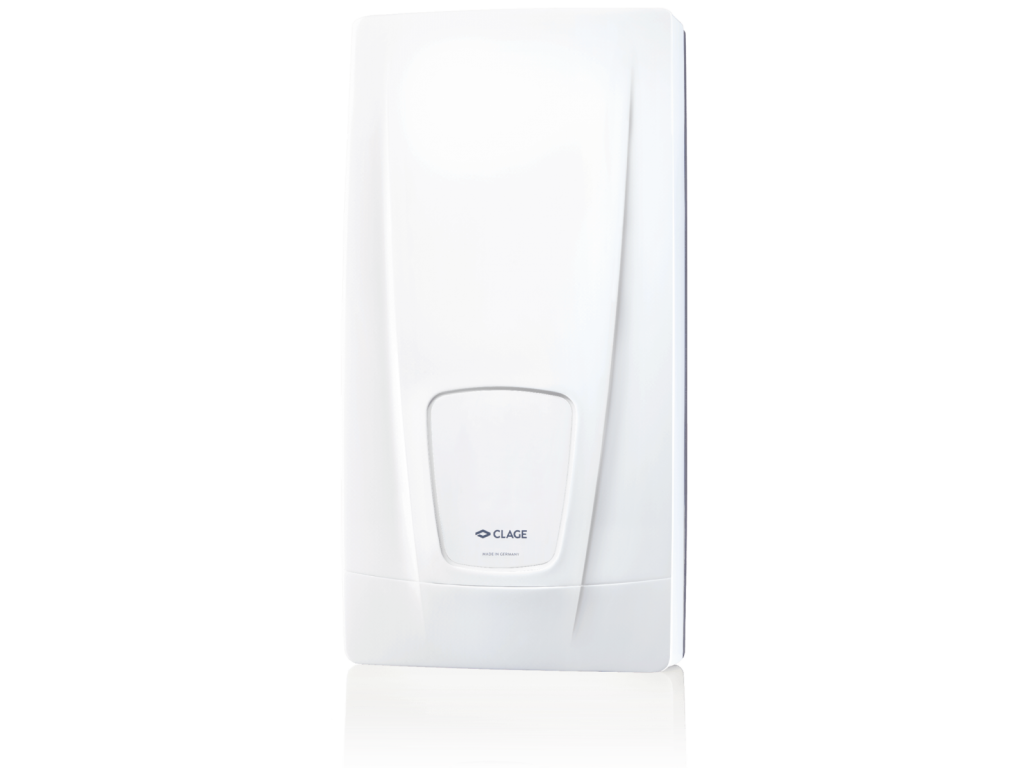 |
CLAGE DBX21 Next 21 kW, 400 V A powerful pressurised electric instant water heater intended to supply an entire bathroom or even several draw-off points at once. Thanks to its 21 kW output, it can cover simultaneous use of the shower and washbasin without a significant temperature drop. Requires a three-phase 400 V connection – suitable especially for new builds or houses with adequately sized electrical installation. Indicative price: €390.60 |
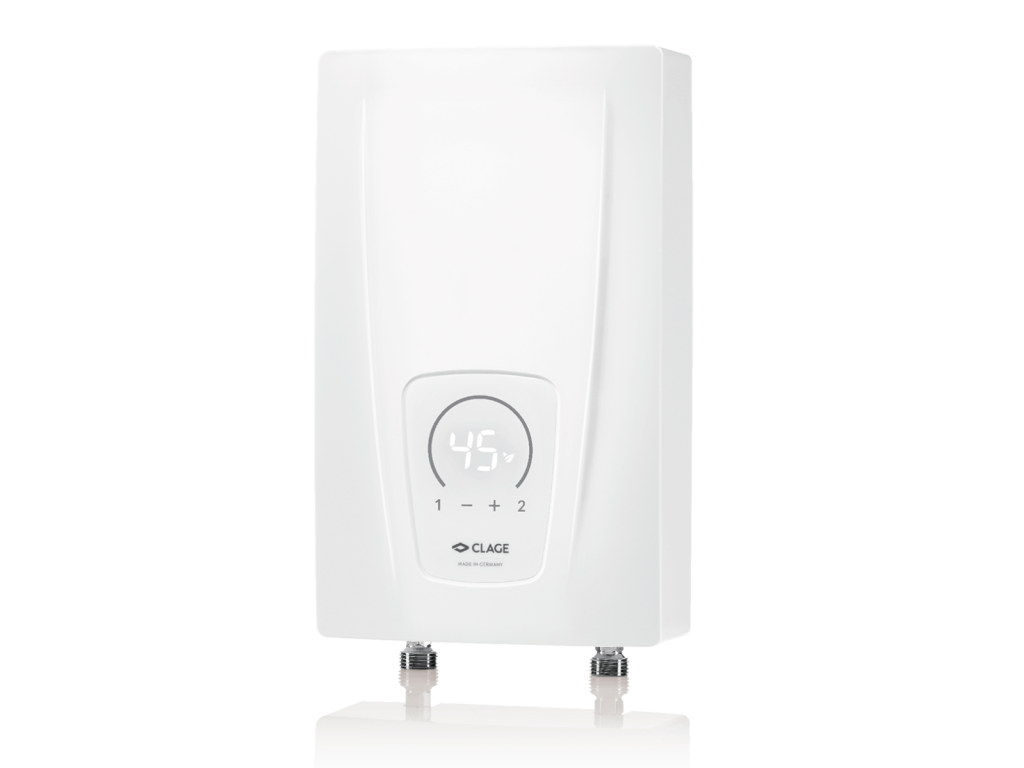 |
CLAGE CEX 11 or 13.5 kW, 400 V A smaller pressurised instant water heater suitable, for example, as a supplementary solution for a kitchen, guest bathroom, or smaller flat with a lower number of simultaneous draw-offs. Its compact dimensions allow installation directly under the washbasin, making the most of exactly the space advantage of instant heating discussed above. Indicative price: €397.70 |
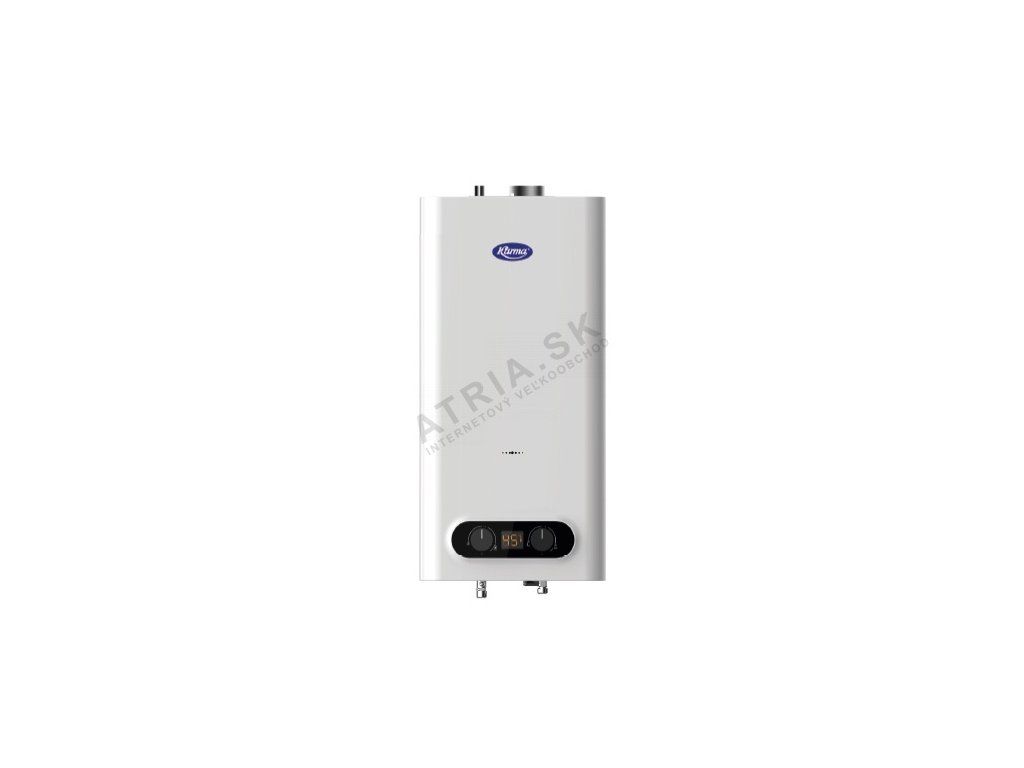 |
Karma POV 14BK ZP A natural gas instant water heater, an alternative to electric models where a gas connection is available but the electrical installation can't handle the high instantaneous draw of a powerful electric instant water heater. A gas solution thus bypasses the electrical mains limit while keeping the principle of instant, tankless heating. Indicative price: €849.85 |
When choosing a specific model, we recommend not relying on price alone, but above all on correctly sizing the output according to the number of simultaneous draw-off points and the actual capacity of your electrical installation – we cover this topic in detail in the article What output instant water heater do I need, where you'll also find an indicative table of recommended outputs by type of draw-off.
FAQ – frequently asked questions
Is an instant water heater cheaper to run than a tank?
It depends on how it's used. Thanks to the absence of standby heat losses, instant heating can be more economical with irregular or low consumption, since no energy is wasted maintaining the temperature of water that isn't currently being used. With regular, higher, and simultaneous consumption (a larger family, multiple bathrooms), however, a tank connected, for example, to a boiler or heat pump with more favourable heating efficiency may be more advantageous in terms of overall energy balance.
Can an instant water heater supply the shower and washbasin at the same time?
Yes, provided it's a sufficiently powerful pressurised model (typically 18 kW or more) and the house's electrical installation can handle its power draw. With an undersized model or insufficient main breaker capacity, simultaneous draw-off can lead to a slight drop in water temperature.
Do I need a three-phase connection for a powerful instant water heater?
For most more powerful models (from roughly 18 kW upward), yes – they require a 400 V connection. Smaller models with an output up to roughly 8–11 kW are generally also available in a single-phase 230 V version, which is fine with a standard household electrical installation, but with lower maximum output and therefore lower comfort during simultaneous draw-off.
Is it worth combining a tank and an instant water heater in one household?
Yes, it's a common and practical solution – for example a central tank for the main bathroom supplemented by a small instant water heater at the kitchen sink, so long hot water piping with its own heat losses doesn't need to be built to a more distant part of the household.
Is a gas instant water heater a better choice than an electric one?
It depends mainly on the availability of a gas connection and the capacity of the electrical installation. A gas instant water heater is a suitable alternative where the electrical mains can't cover the high instantaneous output needed for a powerful electric model, or where gas is already connected and using it is advantageous from an operating cost perspective.
Why does the water temperature fluctuate from my instant water heater while showering?
The most common cause is undersized device output relative to the current flow and required temperature rise, or simultaneously opening another draw-off point (for example a washbasin) while showering. The solution is either reducing the flow at the outlet (for example an economy shower head) or choosing a more powerful model.
How much space does an instant water heater actually save compared to a tank?
A compact instant water heater fits in a space significantly smaller than a cabinet under the washbasin, while an ordinary tank with a capacity of 80–120 litres needs its own spot on a wall with sufficient load capacity and working space around it – in small flats this is often the difference between the device fitting at all or not.
Can an instant water heater connected to a small electrical installation trip the breaker?
Yes, if a model with higher output than the household's electrical installation and main breaker are sized for is chosen, it can trip repeatedly during draw-off. That's why, before buying a more powerful instant water heater (especially above 18 kW), it's always advisable to have the electrical installation's capacity checked by an electrician.
Related topics
- How to choose an instant water heater – a complete selection process including types, parameters, and installation
- What output instant water heater do I need – how to correctly size output based on the number of draw-off points
- Pressurised vs. unpressurised instant water heater – differences, advantages, and disadvantages of both types
- How to choose a hot water storage tank – a sister guide to choosing a storage solution
Have a question about an instant water heater?
Can't decide, or dealing with a specific situation in your household? Write to us – we're happy to help.