
Frequently asked questions about instant water heaters
Instant (tankless) water heaters are among the most common solutions for hot water heating in places where installing a storage water heater doesn't pay off or isn't possible – in flats, cottages, studio apartments, and as a supplementary solution in family houses for more distant draw-off points. The principle is simple: water is heated directly at the moment of use, right as it passes through the heater's heat exchanger, without being stored anywhere and kept "on standby" at temperature. This eliminates the storage tank's heat losses, the heater takes up minimal space, and hot water is available practically instantly, for as long as the tap is running.
Precisely because this is a technically different principle than a classic storage water heater, choosing and operating an instant water heater raises many recurring questions – what type to choose, what output is sufficient, what needs to be done on the electrical installation or gas connection, and how to maintain the heater so it lasts as long as possible without faults. In this article we've gathered our customers' most frequent questions and divided them into five topic areas – from choosing the type, through output, electrical installation and gas connection, to service and brand comparison. If you're looking for a more detailed breakdown of a specific topic, you'll find links to separate guides at the end of the article.
Choice and type
What is an instant water heater and exactly how does it work?
An instant water heater is a device that heats water continuously, right as it's drawn off – without storing it anywhere. Cold water enters the heater, passes through a powerful heating element (an electric heating coil or a heat exchanger heated by a gas burner), and exits already heated to the set temperature. As soon as you close the tap, heating stops immediately, so no energy is wasted keeping water hot "in reserve" as with a storage heater. The drawback is that the heating output must be high enough to heat the required amount of water in real time – that's why more powerful instant water heaters have a power draw comparable to larger household appliances.
What is the difference between an electric and a gas instant water heater?
An electric instant water heater heats water using an electric heating element and only needs a cold water supply and a sufficiently rated electrical connection – for higher outputs (18–27 kW), usually a three-phase 400 V connection. Installation is therefore simpler and faster, since there's no need for a chimney or flue gas discharge. A gas instant water heater, on the other hand, needs a gas connection and safe flue gas discharge – either through a classic chimney, or as a so-called turbo version with coaxial flue routing through the facade. In many regions, the advantage of the gas solution is a lower operating cost per litre of heated water, especially at higher draw-off volumes, while the electric heater is simpler to install and maintain and doesn't require the regular service inspections associated with gas appliances. You'll find a detailed comparison of both types in the separate article Electric vs. gas instant water heater.
Pressurised or unpressurised instant water heater – which should you choose?
A pressurised instant water heater is connected directly into the household's water supply (it's "under the pressure" of the water mains) and can therefore supply hot water to several outlets at once or in sequence – a washbasin, a shower, and a kitchen sink. An unpressurised (open-outlet) heater, by contrast, is always intended for just one specific outlet, to which it's connected via its own special unpressurised tap, and is mounted directly above or below that particular fixture – typically a washbasin in a small bathroom or a kitchen sink. Unpressurised models usually have lower output (typically 3.5–5.5 kW) and a lower purchase price, while pressurised models with higher output (18–27 kW) are more versatile but require a more demanding electrical installation. We discuss the choice between the two types in detail in the article Pressurised vs. unpressurised instant water heater.
Is an instant water heater worth it instead of a storage water heater?
This depends mainly on the character of hot water consumption in the household. If you only need hot water occasionally, at one or two spots, or you don't have space in the flat for a storage tank, an instant water heater is a clear choice – it takes up no space, doesn't waste energy keeping water hot "in reserve", and hot water is available instantly. With higher, regular consumption in a larger household (several showers in a row, filling a bathtub, simultaneous draw-off at multiple points), a storage heater with sufficient volume may be more advantageous, as it can cover peak demand without needing an extremely high instantaneous output. You'll find a complete comparison of both solutions in terms of comfort and operating costs in the article Instant water heater or storage tank – which pays off.
Instant water heater for a flat or a family house – is there a difference?
In a flat, an instant water heater is often the only realistic solution for heating hot water, especially where there's no central hot water supply, or where it pays to have heating independent of the building's shared heating system. In smaller flats and studios, we therefore commonly see lower-output unpressurised heaters right at the washbasin or sink, or a single central pressurised heater for the whole flat. In a family house, an instant water heater is most often used as a supplementary solution – for example, for a more distant bathroom, where a long pipe run from the central source would mean a long wait for hot water, or in a loft studio/apartment. For an entire house with higher consumption (multiple bathrooms, a bathtub, simultaneous use by several household members), it's also worth considering combining it with a central heat source. We describe how to properly choose a specific model in the article How to choose an instant water heater.
Output and comfort
What output instant water heater do I need for a washbasin?
For a single washbasin, where hot water is mainly needed for washing hands or teeth and minor hygiene tasks, a smaller unpressurised heater with an output of around 3.5 to 5.5 kW is fully sufficient. This output can heat a smaller water flow to a pleasant temperature without needing a reinforced electrical installation – in many cases, a standard 230 V socket with an appropriately rated fuse is enough. This is the most commonly used output range for kitchenettes, toilets, garages, workshops, and smaller bathrooms where there's no need for simultaneous draw-off at multiple points.
What output do I need for showering?
For comfortable showering with sufficient hot water flow, an output of at least 18 kW is recommended; in practice, models in the range of 18 to 21 kW and higher are commonly chosen – especially if the household has higher flow demands or colder incoming water in the winter months. Lower output in practice can mean the water will only be lukewarm at full tap flow, because the heater simply won't manage to heat the water sufficiently at that flow rate. You'll find the exact procedure for calculating the required output based on the number of outlets and their simultaneous use in the article What output instant water heater do I need.
Can an instant water heater fill a bathtub?
Yes, but only with sufficiently high output, and bearing in mind that filling will take longer at lower flow rates than with a storage heater with a large volume of hot water "prepared in advance". For comfortable bathtub filling, more powerful models at the upper end of the range are recommended, i.e. 21 to 27 kW, which require a three-phase 400 V connection. At lower output the bathtub can still be filled, but it will either take noticeably longer, or the water will be cooler at higher flow. If the bathtub in your household is regularly used by several people, it's also worth considering the alternative of a storage heater, or a combination of both solutions.
Why does only lukewarm water come out of my instant water heater?
The most common cause is insufficient heater output relative to the current water flow – the more water flows through the heater per second, the less time it has to heat it, and thus the lower the resulting temperature. The solution is either to reduce the flow by throttling the tap (the simplest immediate fix), or to switch to a more powerful model matching real household consumption. A second common cause is significantly colder incoming water in the winter months – a heater sized to the limit of its output in summer may struggle to achieve the same comfort in winter. A third possible cause is a heat exchanger fouled with limescale, which reduces heat transfer efficiency – we discuss this in more detail in the service section below.
Can a single instant water heater supply both the kitchen and bathroom at the same time?
With a pressurised instant water heater with sufficient output (generally from 21 kW upward), simultaneous supply to multiple outlets is possible, but you need to bear in mind that with simultaneous draw-off at two points, the available output is split between both outlets, which can mean a lower temperature or lower flow at both points at once. With unpressurised heaters this isn't an issue – by design they're always intended for just one specific outlet, to which they're permanently assigned. If you plan simultaneous use of multiple taps in the household (for example kitchen and bathroom during the morning rush), we recommend choosing a higher output with reserve rather than pushing the heater to the limit of its capabilities.
| Image | Product | Price |
|---|---|---|
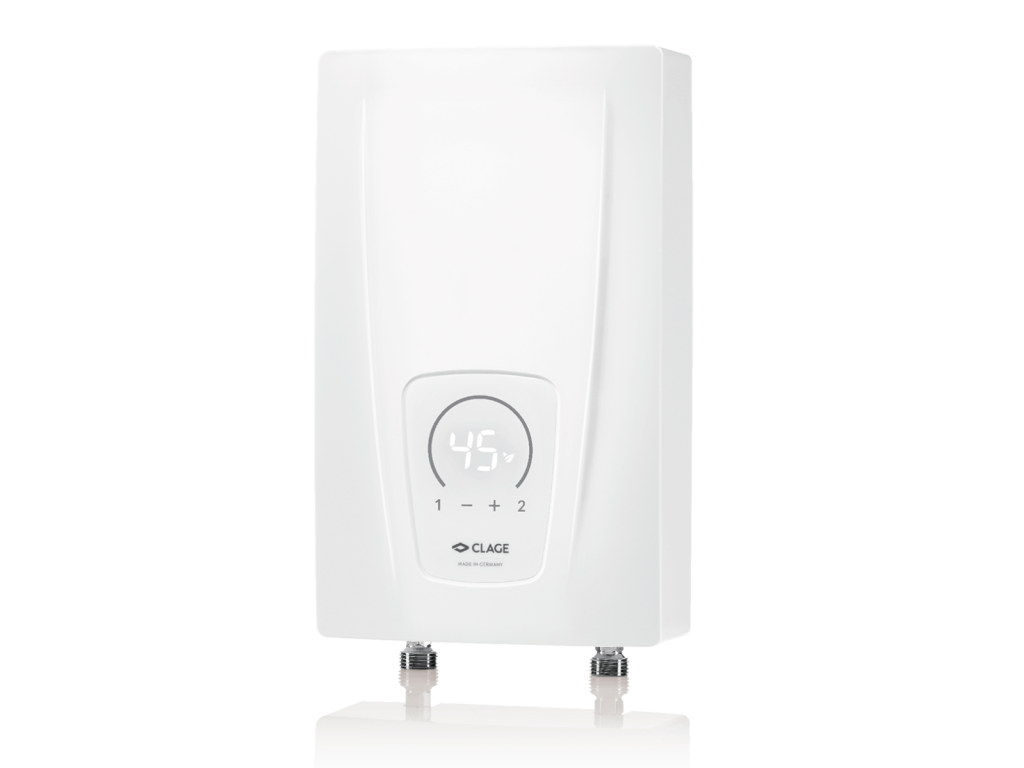 |
CLAGE CEX 11 or 13.5 kW A compact electric instant water heater suitable for a washbasin and light showering, with a choice of 11 or 13.5 kW output depending on the available electrical installation. |
€397.70 |
Electrical installation and gas connection
Do I need three-phase power for an electric instant water heater?
This depends on the output of the chosen model. Smaller unpressurised heaters with an output of 3.5 to 5.5 kW commonly run on a standard single-phase 230 V socket and don't require any modification to the electrical installation beyond a normal household circuit. More powerful pressurised models in the range of roughly 18 to 27 kW generally need a three-phase 400 V connection, since a single-phase circuit at such output would be overloaded and would require a disproportionately thick cable and a heavily rated protective circuit. Before buying a more powerful model, we therefore always recommend checking with an electrician whether a three-phase connection is available at the location, or what electrical installation modifications would be needed.
What cable cross-section and what fuse does a powerful electric heater need?
The exact cable and protection parameters vary by specific model and its output – they're always given in the manufacturer's technical documentation and installation manual, which must be strictly followed. In general, the higher the heater's output, the thicker the cable and the more heavily rated the protective circuit needed, since this is a device with a high instantaneous current draw during operation. That's precisely why connecting more powerful instant water heaters (18 kW and above) is never recommended as a DIY job without an electrician – incorrectly sized cable or protection represents a real safety risk (wiring overheating, fire). You'll find a detailed overview of electrical installation requirements by output class in the article Electrical installation for an electric instant water heater.
Can I connect an electric instant water heater myself, or must an electrician do it?
For small unpressurised models on a standard 230 V socket (for example under a washbasin), the connection is simple and, if the installation instructions are followed, can be handled in most cases by a skilled DIYer – it's essentially connecting to an existing socket and to the water pipe. With more powerful pressurised models with a three-phase 400 V connection, the situation is different: this involves work on a high-current installation with a high power draw, which should be done exclusively by a qualified electrician with the appropriate licence, ideally with an inspection report after connection. Besides safety, there's also the warranty to consider – most manufacturers make warranty repair claims conditional on proof of professional installation.
What do I need altogether to connect a gas instant water heater?
A gas instant water heater requires substantially more complex preparation than an electric model. The basis is a functional gas connection with sufficient pressure and gas flow, which must be assessed and connected by a professionally qualified person (a gas fitter/inspection technician), plus safe flue gas discharge – either by connecting to an existing chimney, or in the form of a so-called turbo version with coaxial flue routing directly through the exterior wall, if no chimney is available. A cold water supply is also needed, as well as an electrical connection for models with electronic ignition or control. After installation, gas appliances also require an initial inspection of the gas equipment. You'll find the complete step-by-step procedure, including safety requirements, in the article Installation and connection of a gas instant water heater.
Can a gas instant water heater be installed in a flat without a chimney?
Yes, provided you choose the so-called turbo version of the heater, which has its own fan and discharges flue gases via a coaxial pipe directly through the facade to the outside of the building, without needing to connect to a classic chimney. This solution is common precisely in flats and apartment buildings where a chimney is either missing or unsuitable for connecting a gas appliance. However, bear in mind that the facade outlet must meet precise safety clearances from windows, doors, and neighbouring buildings under applicable regulations, so it's essential to have the placement assessed by a professional before buying a specific model.
| Image | Product | Price |
|---|---|---|
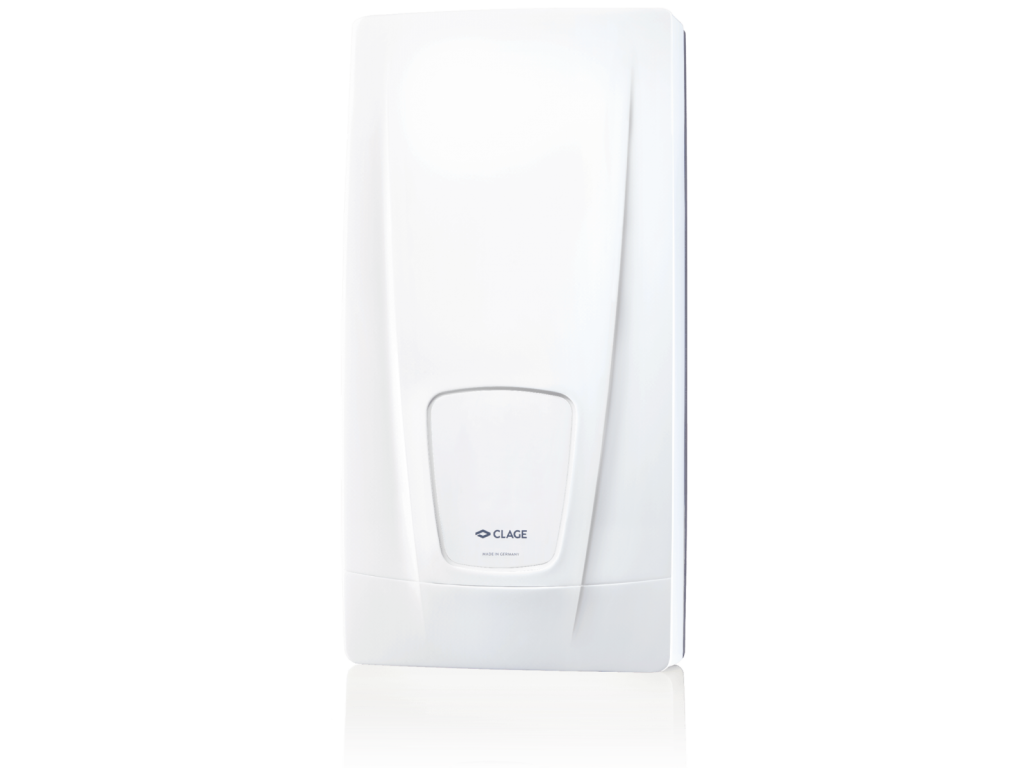 |
CLAGE DBX21 Next 21 kW A more powerful pressurised electric heater for 400 V, suitable for showering and simultaneous supply of multiple outlets in the household. |
€390.60 |
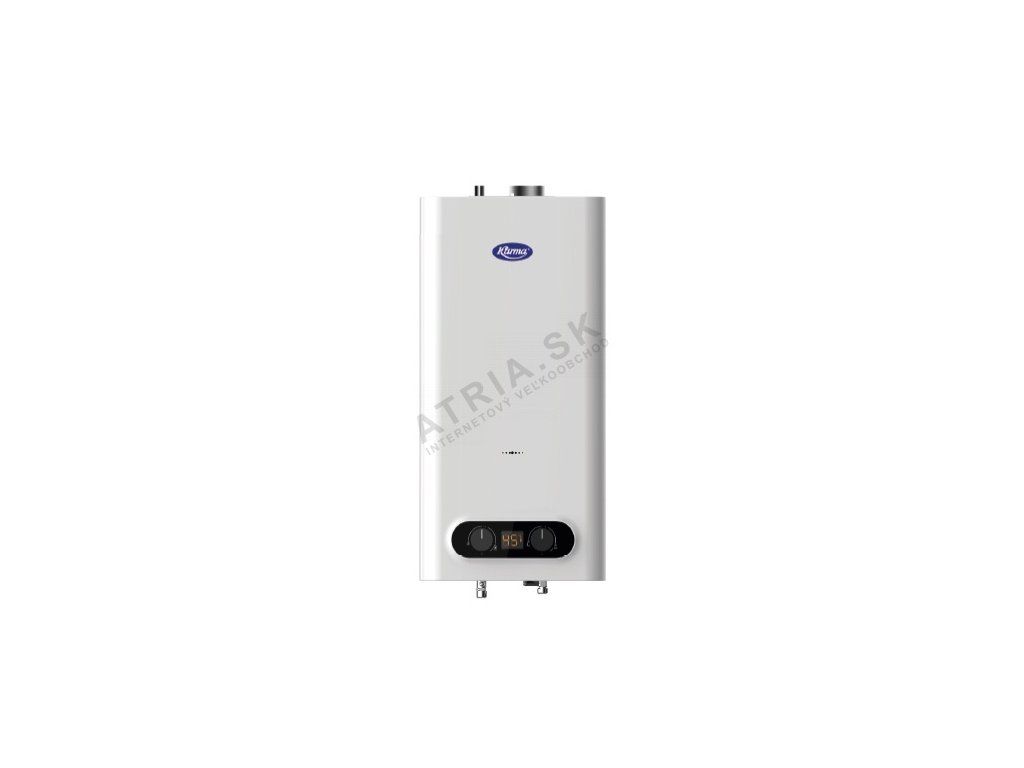 |
Karma POV 14BK ZP A natural gas instant water heater, a solution for households with an available gas connection and a need for greater heating comfort. |
€849.85 |
Real-world example: a flat with an electric solution
A common situation our customers face is a smaller flat in an older apartment building without central hot water supply, where the owner needs to cover a bathroom with a shower enclosure and separately a kitchen sink. Originally there was an older, undersized heater in the bathroom, which delivered only lukewarm water at full shower flow – a typical sign of insufficient output relative to the chosen flow rate. After measuring the available electrical installation (the flat had only a single-phase 230 V circuit, with no easy way to run a three-phase cable through the building's shared areas), the choice fell on a compact electric instant water heater with medium output, which can also be operated on a single-phase connection with a slight limitation on maximum flow. The result was consistently hot water while showering, at a slightly reduced flow compared to the original intention – a fully acceptable compromise for the household between comfort and the reality of the electrical installation in an old apartment building. A separate small unpressurised heater was then added directly under the kitchen sink, since running hot water piping from the bathroom over that distance would have been impractical, with a long wait for hot water.
Service and faults
Why does limescale form in an instant water heater, and why is it a problem?
Limescale is a deposit of minerals (mainly calcium and magnesium) present in harder water, which precipitates on the heater's internal surfaces during heating – primarily on the heat exchanger or heating element, where the highest temperatures occur. This is the most common cause of both output loss and faults in instant water heaters in general, since the layer of limescale acts as a thermal insulator: it reduces the efficiency of heat transfer into the water, the heater has to work longer and harder to reach the same temperature, energy consumption rises, and in extreme cases the heating element can overheat and get damaged. In areas with harder water, limescale buildup is therefore practically an inevitable process, which can only be prevented by regular maintenance, or by using a water softener at the inlet.
How often should an instant water heater be descaled?
The exact interval depends on water hardness in the given location and the intensity of heater use, but in general, regular descaling roughly once a year to once every two years is recommended – more often with significantly harder water. Descaling is done either with a specialised product intended directly for this type of device according to the manufacturer's instructions, or is performed by a professional as part of regular servicing, who also checks the condition of other components (seals, flow sensors, safety valves) at the same time. Regular descaling significantly extends the heater's service life and maintains its original output and energy efficiency – neglected maintenance, conversely, is the most common reason heater output gradually declines and eventually leads to a fault.
The heater isn't delivering hot water or an error light is blinking – what should I do?
The first step should always be checking the operating manual for the specific model, which explains the meaning of individual error messages or blinking indicator lights – different models and brands use different signalling. Common causes include a clogged inlet water filter (reducing flow below the minimum threshold needed to trigger heating), a tripped breaker on electric models after a circuit overload, or, on gas models, an ignition failure or insufficient gas pressure. If a simple check (breaker, filter, closed water or gas supply) doesn't resolve the issue, we don't recommend attempting to intervene inside the heater yourself, especially with gas appliances – in that case, it's appropriate to contact an authorised service centre. We discuss common faults and their most frequent causes in detail in the article Service and common faults of instant water heaters.
How long does an instant water heater last, and when does replacement pay off instead of repair?
With regular maintenance and descaling, quality instant water heaters can reliably serve for many years, though the exact service life varies depending on type, incoming water quality, and intensity of use. When deciding between repairing and replacing an older heater, it's worth considering above all whether the fault relates to the main heating element or heat exchanger (a more costly repair, often not economically worthwhile on an older model) or is just a minor part (for example a flow sensor, a seal), where repair is clearly the more sensible choice. Another factor is energy efficiency – newer models tend to be significantly more economical and regulate temperature more precisely, so with an older, significantly worn heater, replacement can pay off through lower energy consumption alone, not just by eliminating the cost of repeated repairs.
Can basic heater maintenance be done yourself?
Basic tasks, such as cleaning or replacing the inlet strainer/filter and checking the tightness of connections, can be handled by practically any user without specialist knowledge, if the operating manual is followed. Descaling internal parts and any intervention inside the heater, where work is done on the heating element or electrical or gas components, should however be carried out exclusively by a qualified service technician – this isn't just a matter of functionality, but above all of safety (risk of electric shock, or with gas models, risks associated with gas or flue gas leaks) and of preserving the warranty, which manufacturers commonly make conditional on maintaining the prescribed service intervals performed by a professional.
Real-world example: a family house with a gas solution
Another typical case is a family house where the owners were gradually renovating the bathroom and deciding between adding another storage water heater and a gas instant water heater, since the house already had a gas connection and a functional chimney from the original heat source, which was just being replaced with a more modern solution. Since several people live in the house and hot water is regularly drawn at multiple points throughout the day (shower, kitchen, washing machine), the choice fell on a more powerful gas instant water heater connected to the existing chimney – the decisive factor being mainly the lower operating cost of heating at higher, regular consumption compared to an electric solution of the same output, as well as the fact that the necessary infrastructure (gas connection, chimney) was already available in the house and didn't need to be built from scratch. Part of the installation also included a chimney inspection and an initial inspection of the gas equipment after installation, carried out by a professional – without this step the heater couldn't be legally put into operation.
Brands
Why choose CLAGE for electric instant water heaters?
CLAGE is a brand that has long specialised exclusively in electric instant water heaters and related components, which is reflected in the sophistication of its individual ranges – from compact unpressurised models to powerful pressurised heaters with electronic temperature control. Our range includes, for example, the compact CLAGE CEX 11 or 13.5 kW, suitable for lighter demands (a washbasin, or combined with a shower at lower flow), as well as the more powerful CLAGE DBX21 Next 21 kW, intended for comfortable showering and simultaneous supply of multiple outlets. The advantage of CLAGE electric heaters is simpler installation without needing to deal with flue gas discharge, precise electronic outlet temperature control, and a broad portfolio of outputs covering almost any household use.
Why choose Karma for gas instant water heaters?
Karma is an established brand of gas instant water heaters with a long tradition, offering pressurised models for natural gas in various output classes, including variants with both forced (turbo) and natural flue draught. An example is the Karma POV 14BK ZP model, which represents a reliable solution for households with an available gas connection seeking greater heating comfort without needing to deal with a three-phase electrical installation. Karma gas heaters are typically chosen where gas is already connected to the property and there's a functional chimney, or where a flue outlet can be built through the facade, and where, given the intensity of use, the lower operating cost of gas is more advantageous than electricity.
What is the difference between the individual CLAGE heater ranges, for example CEX and DBX?
The ranges differ mainly in output and intended use – the CEX range represents more compact solutions with lower to medium output (in our range, for example, the aforementioned CLAGE CEX 11 or 13.5 kW), suitable for individual draw-off points or more modest hot water flow demands. The DBX range, on the other hand, represents a more powerful category (for example the CLAGE DBX21 Next 21 kW) intended for more demanding use – comfortable showering, or simultaneous supply of multiple outlets in the household. When choosing a specific range, the decisive factor is therefore mainly the expected simultaneous draw-off and the availability of the electrical installation (single-phase vs. three-phase), not just the brand itself.
Does Karma also offer other variants besides pressurised natural gas models?
Alongside pressurised natural gas models such as the Karma POV 14BK ZP, the Karma range also includes other variants adapted to different types of connection and flue discharge – in our range, for example, also the Karma POV 11BW ZP model. The exact technical parameters, method of flue discharge, and recommended connection method differ between individual models, so before choosing a specific type we always recommend checking compatibility with the existing (or planned) gas connection and chimney system in the given property, ideally in cooperation with a gas equipment specialist.
Can an electric CLAGE heater and a gas Karma heater be combined in one household?
Yes, and in practice this is a fairly common solution, especially in family houses with multiple draw-off points. A typical arrangement is a Karma gas heater as the main hot water source connected to the existing gas connection and chimney (for example for a bathroom with higher consumption), supplemented by a smaller electric CLAGE heater at a more distant or less frequently used draw-off point, where running hot water piping from the central source would be impractical – for example at a kitchen sink on the opposite side of the house or in a garage. Combining both types makes it possible to efficiently cover different comfort and operating cost requirements within a single household, without unnecessarily oversizing one central solution.
| Image | Product | Price |
|---|---|---|
 |
Karma POV 11BW ZP A Karma natural gas instant water heater, an alternative to the POV 14BK ZP model with different technical connection parameters. |
€1,037.88 |
Related topics
For a more detailed breakdown of the individual areas summarised in this FAQ article, we recommend the following separate guides from our Knowledge Centre:
- How to choose an instant water heater – a complete step-by-step selection guide
- Electric vs. gas instant water heater – a detailed comparison of both types
- What output instant water heater do I need – calculating output based on number of outlets
- Pressurised vs. unpressurised instant water heater – differences and recommended uses
- Instant water heater or storage tank – which pays off – comparison with a classic storage heater
- Electrical installation for an electric instant water heater – cable, protection, and connection requirements
- Installation and connection of a gas instant water heater – gas connection and flue discharge step by step
- Service and common faults of instant water heaters – solving common problems and descaling
- Comparison of instant water heater brands – CLAGE, Karma and others compared across parameters
Have a question about an instant water heater?
Can't decide, or dealing with a specific situation in your household? Write to us – we're happy to help.