
Installing and Connecting a Tank to a Boiler
Introduction
Buying a new domestic hot water tank is only half the task. The other half – equally important, if not more so – is connecting it correctly. A tank does not heat water by itself. It needs either a heat source (a gas, electric or other boiler) connected to it by pipework, or its own electric heating element that heats it directly. How precisely this connection is designed and carried out determines whether the household will have enough hot water exactly when it needs it, whether the system will not waste energy unnecessarily, and, not least, whether the tank will safely last for many years without faults.
In this article we look in detail at how an indirect-heated tank is connected to a boiler – what pipework circuit is created for it, what role the circulation pump plays, and above all the three-way diverter valve, which decides where the boiler sends heated water at any given moment. We will also explain why almost all modern boilers have hot water priority set over heating, and what this means in practice for household comfort. We dedicate a separate chapter to electric storage water heaters, whose installation is considerably simpler in terms of pipework, but which has its own specific electrical requirements. We will not skip a topic that is often underestimated – the safety group and safety valve, without which no pressurised tank could operate safely. Finally, we look at two real-world installation scenarios and answer the most common questions we receive from customers on this topic.
If you are still deciding which type of tank suits your house or flat better, we recommend first reading the article How to choose a hot water tank or the comparison Indirect-heated vs. electric tank. This text is intended mainly for those who already know which type of tank they want and are interested in how the actual installation and connection works.
How an indirect-heated tank is connected to a boiler
An indirect-heated tank is essentially a large insulated vessel with a built-in heat exchanger (most often in the form of a coiled pipe or a double shell) through which hot water from the boiler (heating) circuit flows. This hot water transfers heat to the domestic water in the vessel but is never physically mixed with it – hence the name "indirect-heated", meaning heating indirectly, via a heat exchanger, not by direct contact.
A separate circuit, isolated from heating
The key thing to understand during installation is that the tank is not connected to the boiler into the same circuit that carries water to the radiators or underfloor heating. A separate pipework branch is created for it – flow and return – which is hydraulically isolated from the heating circuit. The boiler therefore actually serves two different circuits: one leads to the heating system (radiators, underfloor heating, or a combination of both), the other leads to the tank's heat exchanger. This separation matters because the two circuits have different requirements – the heating circuit operates over a long period at a lower or medium water temperature (especially with underfloor heating), while heating the tank often requires a briefly higher thermal output so the water in it reaches the required temperature as quickly as possible.
During installation, a separate pair of pipes is therefore run to the tank (hot water supply from the boiler to the exchanger, and return back to the boiler), which connects to the boiler's distribution either directly or via a manifold or hydraulic separator (depending on the specific boiler room configuration). With some stationary boilers that already have a tank built in or permanently connected directly by the manufacturer, this link is solved as a compact unit – in that case there is no need to worry about the exact connection at all, the installer simply connects the boiler to the existing distribution. We have described such a solution in more detail in the article on boilers with a built-in or connected DHW tank. For a standalone tank connected to an already existing boiler (for example when replacing an old tank with a new one, or when additionally installing a tank to an existing boiler that had none), this circuit needs to be built or adapted to fit.
The role of the circulation pump
For hot water from the boiler to flow through the tank's heat exchanger at all, something needs to move it there – that is the job of the circulation pump. In more modern boilers, especially condensing ones, the circulation pump is usually part of the boiler itself and handles water circulation in both circuits (heating and tank) depending on which one it is currently directed to. With some older boilers, or larger installations, however, a separate circulation pump is installed for the tank circuit, which runs independently of the pump for the heating circuit. This solution provides greater flexibility – for example, it allows heating the tank even when the heating circuit is shut down for some reason, or vice versa.
It is important that the pump is sized (its output and head) to match the length and diameter of the pipework between the boiler and the tank, the volume of the heat exchanger, and the required heating speed. An undersized pump extends the tank's heating time, and in practice shows up as slow "catching up" of hot water after heavy draw-off. This assessment is part of a professional installation design and is one of the reasons DIY installation is not recommended.
The three-way diverter valve – the heart of the system
The most important component deciding where the boiler sends heated water at any given moment is the three-way diverter valve (sometimes also called a three-way valve or DHW/heating diverter valve). Put simply, its job is to act like a railway switch – depending on current need, it directs the flow of heated water from the boiler either into the heating circuit (to the radiators or underfloor heating) or into the tank's heat exchanger.
The valve is usually controlled directly by the boiler's electronics – the boiler's control board evaluates signals (for example a drop in tank temperature below the set value, or current hot water draw-off) and switches the valve position accordingly. In most common household installations this is a motorised or electromagnetic three-way valve, which switches over within a few seconds when the mode changes. During installation it is essential that the valve is connected correctly with regard to flow direction (arrows on the valve body indicate direction) and that it is electrically connected to the boiler's control unit exactly according to the specific manufacturer's wiring diagram – an incorrectly wired valve can result in the boiler running but the tank not heating at all, or conversely, heating constantly being "shut down" in favour of the tank.
With some stationary boilers, such as the Protherm FE 200 BM stationary, the three-way valve and the piping to the tank are part of a well-thought-out, manufacturer-prepared solution – the boiler is designed to work together with an indirect-heated tank, and the installation company follows the exact scheme from the manufacturer, which significantly reduces the risk of a wiring/piping error.
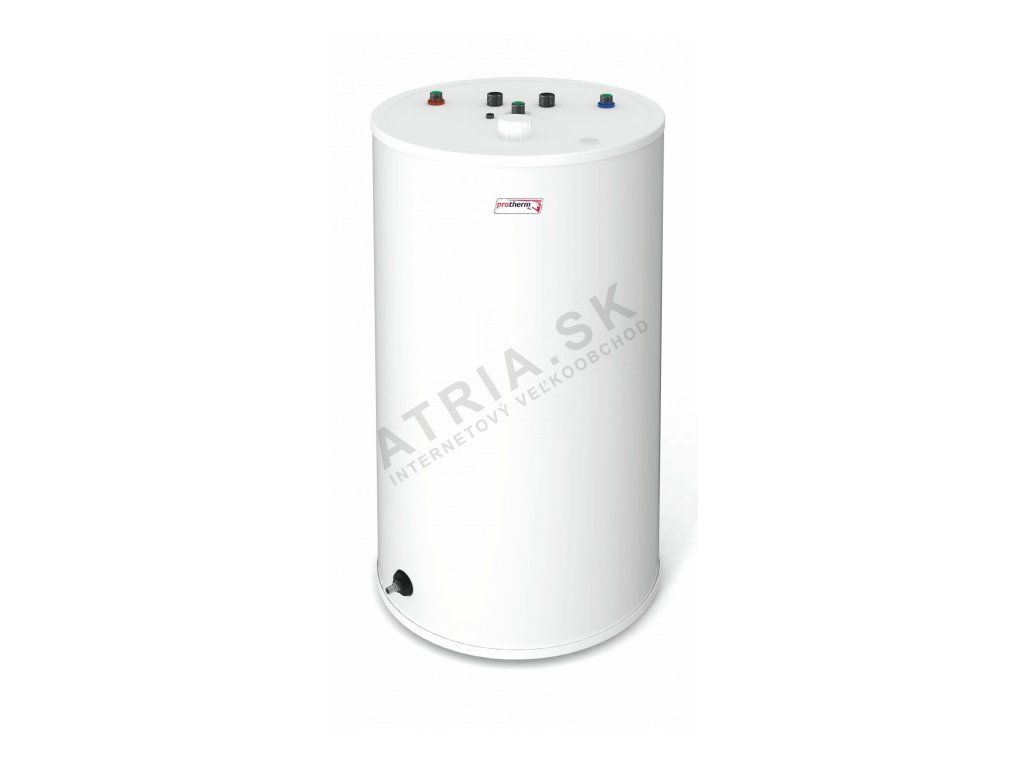 |
Protherm FE 200 BM stationary |
Why hot water heating has priority
Most modern boilers designed to work with an indirect-heated tank have the so-called DHW (domestic hot water) priority activated by default from the factory. This means that when the boiler's control unit determines that the water temperature in the tank has dropped below the set threshold (for example after heavy draw-off during a shower or filling a bathtub), the boiler temporarily interrupts the heat supply to the heating circuit and directs its entire output – precisely through the three-way valve – into heating the tank.
The reason is simple and practical: reheating the tank generally takes considerably less time than maintaining a stable temperature in the heating circuit, and a brief interruption of heating (typically a few minutes) usually goes unnoticed given the thermal inertia of the house and radiators. Conversely, if the system had priority the other way round (heating before DHW), there would be a risk that, during heavier hot water draw-off in colder periods, when the boiler is simultaneously heating intensively, the tank would reheat slowly or incompletely – which would show up as a lack of hot water exactly when it is needed most.
This priority is one of the reasons why it is important to correctly size the boiler's output already at the heating system design stage – if the boiler is too weak, frequent switching to DHW heating can cause noticeable temperature fluctuations in the heating circuit, especially on freezing days. For a typical family household with an appropriately sized boiler and tank (for example around 150 to 200 litres), however, this is a standard, trouble-free mode of operation that boilers are intentionally designed for.
It is worth mentioning that some boilers allow this priority to be adjusted in the settings, or combined with a so-called parallel mode (simultaneous heating of both circuits at a lower output), but this setting should only be handled by a service technician when commissioning the system, taking into account the specific conditions of the given house.
Installing an electric storage water heater – the simpler route
If a household decides on an electric storage water heater instead of an indirect-heated tank connected to a boiler, the installation is considerably simpler in terms of pipework. An electric water heater has its own heating element (an electric coil, or a heating element with an output on the order of a few kilowatts) directly inside the vessel, so it needs no connection to a boiler, no three-way valve, no circulation pump for the tank circuit, and no separate heating pipework branch.
In terms of plumbing, it is enough to connect the electric water heater to the household's ordinary water supply – cold water enters the heater through the inlet port (usually marked in blue), heated water exits it through the outlet port (marked in red), and continues on to the draw-off points (taps, shower, bathtub). This connection is conceptually similar to a classic instantaneous water heater, with the difference that the electric tank first heats water and stores it in reserve, while an instantaneous heater heats water continuously at the moment of draw-off.
An important part of installing an electric water heater, however, is the electrical side. Models with higher power input (commonly from around 2 kW upwards) need a separate electrical circuit run from a dedicated circuit breaker in the switchboard, sized precisely for the given appliance's power input – similarly to, for example, an electric oven, cooker or air conditioner. It is not advisable to connect a higher-power electric water heater to an ordinary socket circuit together with other appliances, since simultaneous load could overload the circuit, trip the breaker, or in a worse case overheat the wiring.
This simpler installation is precisely one of the main reasons an electric storage water heater is often chosen in flats, cottages, or households where a boiler is not available (for example with electric heating, or where hot water is handled completely independently of heating). Models such as the Tatramat PSH100Trend are a popular choice precisely for their quick and uncomplicated installation – in terms of pipework it is essentially connecting two hoses to the existing supply, with the main attention focused on the electrical connection and the safety features we discuss in the following chapter.
You can find a more detailed comparison of both types, including operating costs and suitability for different types of households, in the article Indirect-heated vs. electric tank.
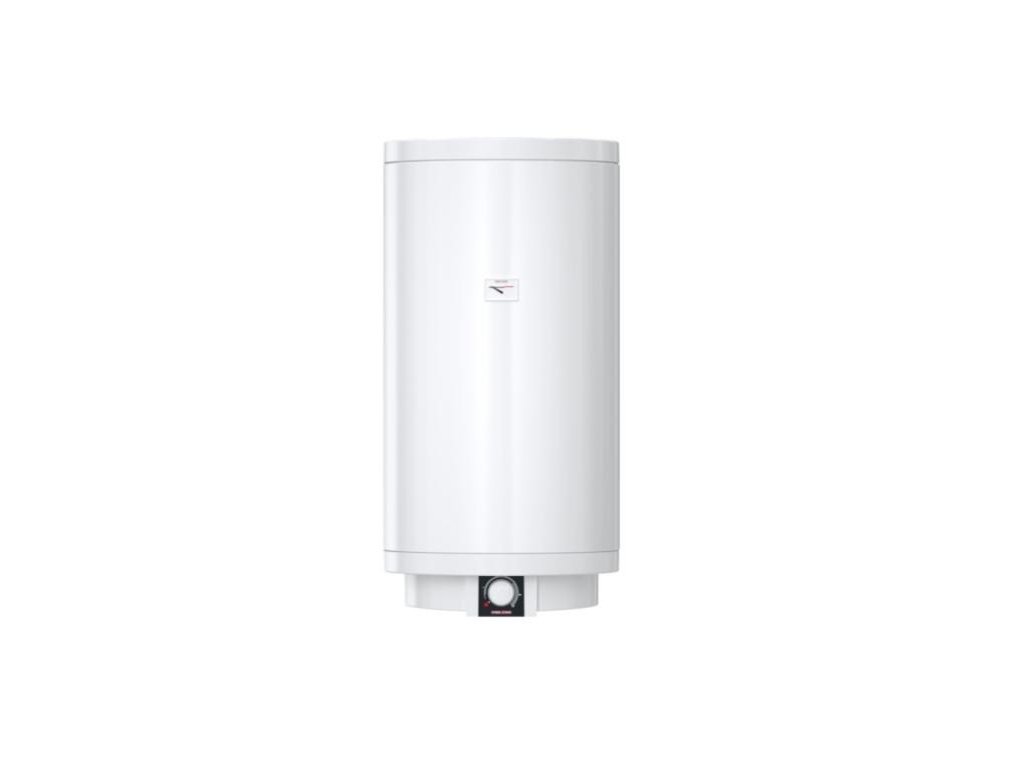 |
Tatramat PSH100Trend |
Safety group and safety valve – a safety feature that must not be skipped
Regardless of whether it is an indirect-heated tank connected to a boiler, or an electric storage water heater, one common rule applies: a safety group, or at least a standalone safety valve, must be installed on the cold water inlet to the tank. This component is not optional accessory equipment, but an essential safety part of every pressurised water heating vessel.
The reason is physical – water expands (increases its volume) when heated. In a closed, pressurised vessel such as a tank, this expansion, without a safeguard, would lead to a constant pressure increase during every heating cycle. The safety valve is set so that on reaching a certain maximum pressure it automatically opens slightly and releases the excess water (or pressure) outward, protecting the tank from damage or, in an extreme case, from the vessel bursting. The safety group usually also includes a check valve that prevents heated water flowing back into the cold water supply, and a shut-off valve in case of the need for a shutdown or servicing.
During installation it is important that the safety valve is installed in the right place – always on the cold water inlet to the tank, as close to it as possible – and that its outlet (dripping, which is a completely common and normal occurrence during heating) is directed to a place where it will not cause damage, for example into a floor drain or via a discharge funnel into the sewer. The discharge pipe from the safety valve must never be closed off or blocked in any way – this would defeat the entire purpose of this safeguard and, in an extreme case, could lead to serious damage to the tank.
Equally important is choosing a safety valve with the correct opening pressure, matching the tank's rated pressure (this value is given in the manufacturer's technical documentation and on the tank's rating plate). This is precisely why choosing and installing the safety group is recommended to be left to a professional – an incorrectly set or unsuitably chosen safety valve can either be ineffective (not protecting the tank), or conversely unnecessarily oversensitive (frequent unnecessary dripping).
For some models, such as the Bosch WST 200-5 C, the manufacturer specifies the recommended safety group type and setting directly in the installation manual, which makes the correct choice easier for the installation company and reduces the risk of error.
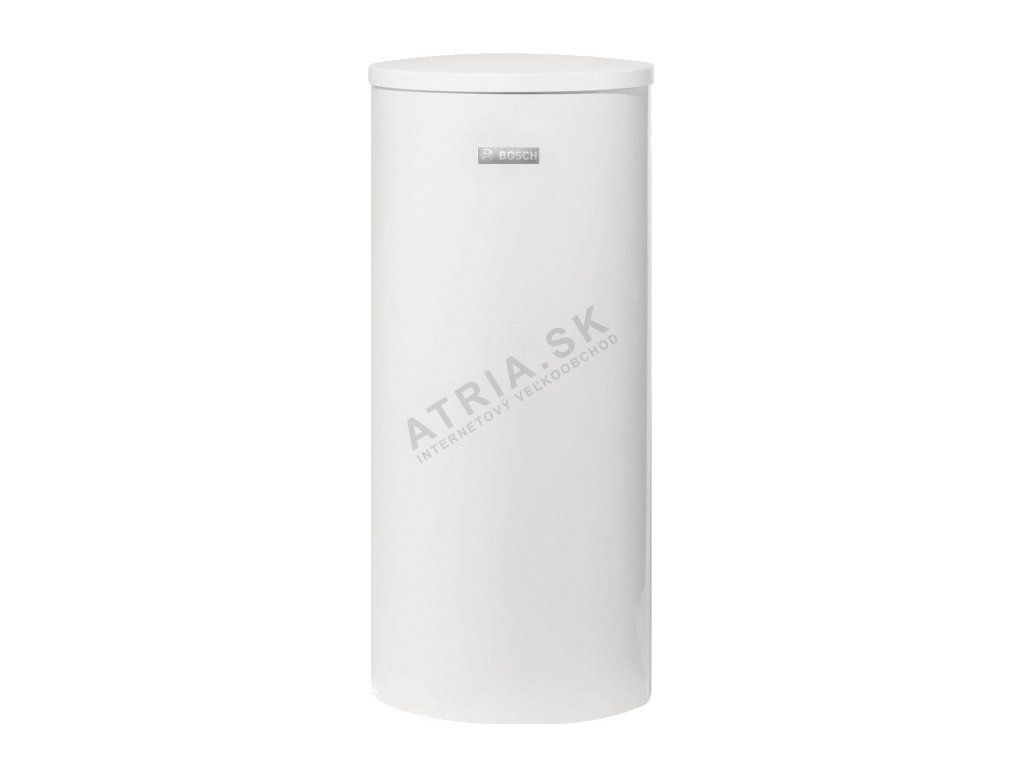 |
Bosch WST 200-5 C |
Who is allowed to carry out the installation
Installing an indirect-heated tank and connecting it to a boiler – that is, creating the pipework circuit, fitting and wiring the three-way valve or circulation pump, setting the heating priority and the safety group – should always be carried out by a professional, usually a heating engineer or plumber experienced with the given technology, ideally with a recommendation from, or in direct cooperation with, the boiler manufacturer's service network. There are several reasons: a correct connection affects not only functionality (whether the tank will heat water properly and quickly), but also operating safety, the appliance's service life, and in many cases also the validity of the warranty provided by the manufacturer. Most boiler and tank manufacturers make the warranty conditional on the installation having been carried out by a professionally qualified person and on professional commissioning having taken place.
With an electric storage water heater the situation is slightly different – the connection to the water supply itself (cold water inlet and hot water outlet) is simpler and can be handled even by an experienced DIY enthusiast, but the electrical connection, especially for models with higher power input requiring a separate protected circuit, should always be carried out by a qualified electrician. The electrician will assess whether the existing electrical installation in the flat or house can handle the additional load, will design the correct sizing of the breaker and wiring, and will ensure the connection meets the safety requirements for working with electric current in a high-humidity environment (bathroom, utility room).
In practice, this means that for an indirect-heated tank connected to a boiler it is advisable to approach a heating company that can handle the complete installation, including both the pipework and the electrical connection of the valve to the boiler. For an electric water heater it is common for a plumber to handle the water installation part and an electrician to handle the electrical connection separately – some installation companies offer both trades within a single job.
We also recommend thoroughly reading the installation manual from the manufacturer of the specific tank and boiler before installation – although the basic principles (separate circuit, three-way valve, DHW priority, safety group) are common to most standard installations, each manufacturer may have minor differences in the recommended wiring, hydraulic diagrams, or control unit settings.
Real-world examples
Scenario 1: Replacing an old tank with a new one on an existing boiler
Picture a typical situation in a family house where a gas boiler connected to an older indirect-heated tank has been in operation for years. The tank gradually starts losing heating performance – water reheats more slowly, or visible corrosion appears on the shell, or water leaks from under the insulation. The owner decides to replace it with a new tank, but wants to keep the boiler, since it is still functional and reliable.
In such a case, the installation company first disconnects and removes the old tank, checking the condition of the existing pipework circuit (flow and return to the exchanger), the circulation pump and the three-way valve – these components often remain and are reused during a replacement if they are functional. The new tank is placed in the prepared location, connected to the existing pipework circuit (adapters or fittings are adjusted if needed, if the new tank has slightly different connection dimensions from the old one), and the water side is also connected (cold water inlet, hot water outlet to the draw-off points), including a new or re-checked safety group.
After connection, the system is filled, the circuit is bled of air, and all joints are checked for tightness. The function of the three-way valve is then verified – the technician runs a test DHW heating cycle and observes whether the valve switches correctly and whether the tank actually receives hot water from the boiler. Finally, the heating priority setting in the boiler's control unit is checked, and the time it takes for the tank to reheat to the set temperature is measured. The entire replacement in a typical family house, where a functional circuit already exists, generally takes place within a single working day.
This scenario is one of the most common reasons customers visit our e-shop – customers look for a replacement for a failing tank with a similar or somewhat larger volume than the original had, to meet the household's current needs (for example if the family has grown in the meantime).
Scenario 2: A new electric water heater installation in a flat
The second common case concerns a flat where no gas boiler or central heating with the option of connecting a tank is available (for example a flat with electric heating, or a flat where the owner wants hot water heating to be completely independent of the heating system for easier maintenance, or because the heating boiler is out of operation outside the heating season). In such a flat, the decision is made to install an electric storage water heater, located in the bathroom or in a cupboard next to the bathroom.
Installation in this case takes place in two steps. First, the plumber connects the heater to the existing cold water supply, fits the safety group on the inlet, and connects the hot water outlet to the piping leading to the sink, shower or bathtub. This part of the work is fairly quick, since it requires no connection to the heating system or a three-way valve. At the same time, or subsequently, an electrician assesses the existing switchboard in the flat – checking whether there is free space for a new correctly sized breaker, and if needed, running a new separate electrical circuit from the switchboard directly to the heater, separate from the flat's normal socket circuits.
Once both parts are complete, the heater is filled with water (it is important never to switch on the electric element "dry", i.e. before the vessel is full of water), the air is bled out, and only then is the power supply switched on and the required heating temperature set on the thermostat. Given the absence of any connection to a boiler and the simpler nature of the wiring, an installation company can generally complete such an installation in a flat within a few hours.
This type of installation is also popular in flat renovations, where the owner does not want to interfere with the heating pipework, or at cottages and cabins, where hot water is handled seasonally and independently of the heating system.
Recommended products
Below you will find an overview of the products mentioned in this article – two indirect-heated tanks suitable for connection to a boiler, and one electric storage water heater with simpler installation.
| Product | Type | Price |
|---|---|---|
| Protherm FE 200 BM stationary | Indirect-heated (connects to a boiler) | €822.66 |
| Bosch WST 200-5 C | Indirect-heated (connects to a boiler) | €1,227.54 |
| Tatramat PSH100Trend | Electric (simpler installation) | €442.44 |
Frequently asked questions (FAQ)
Does a tank always have to be connected to a boiler via a three-way valve?
For the vast majority of common household installations, yes – the three-way valve is the standard way for a boiler to switch between heating the heating circuit and heating the tank using a single heat source. Exceptions are specific larger systems with separate heat sources for each circuit, which, however, do not commonly occur in family houses or flats.
Why does heating occasionally stop briefly when I turn on hot water?
This is a normal, expected phenomenon caused by the set DHW heating priority. When the boiler determines that the tank needs reheating (for example after hot water has been drawn off), the three-way valve switches over and the boiler temporarily directs its output into the tank instead of the heating circuit. This interruption generally lasts only a few minutes and, given the thermal inertia of the house, is practically imperceptible as a drop in indoor temperature.
Can an electric storage water heater be plugged into an ordinary socket?
For lower-power models this is technically often possible, but for most common storage water heaters with higher power input, a separate protected electrical circuit run directly from the switchboard, separate from other household appliances, is recommended and generally also required. You will always find the exact recommendation in the specific model's installation manual; the final assessment should be made by an electrician.
What happens if I skip the safety valve when installing a tank?
Without a safety valve, there is a risk that pressure in the tank will keep increasing with every heating cycle (water expands as it heats) without a safe way to release it. This can lead to damage to the tank, leaks at joints, or in an extreme case a serious fault. A safety group or safety valve is therefore an essential, non-negotiable part of installing any pressurised tank.
Is it normal for water to occasionally drip from the safety valve?
Yes, slight dripping during or shortly after heating is a normal sign that the safety valve is working – it is releasing the pressure created by the expansion of heated water. The only important thing is that the discharge is directed to a place where dripping water will not cause damage (for example into a floor drain), and that the discharge pipe is never blocked or closed off.
Can I install an indirect-heated tank myself if I am handy?
We do not recommend it. Even though the physical pipework connection may look simple, correctly wiring the three-way valve, setting the heating priority in the boiler's control unit, choosing and setting the safety group, and overall professional commissioning require knowledge and experience that affect not only functionality but also safety and warranty validity. We always recommend entrusting the installation to a professional heating company.
How long does a typical tank installation or replacement take?
Replacing an old indirect-heated tank with a new one on an existing, functional circuit is generally a one-day job. For a completely new installation (new circuit, new three-way valve, possibly also new pipework), installation can take longer, depending on the scope of work. Installing an electric water heater, which requires no connection to a boiler, is generally the fastest – a few hours including the electrical connection.
Can an electric water heater later be converted to indirect-heated, or vice versa?
These are different types of appliances with different construction (an electric water heater has its own heating element, an indirect-heated tank has a heat exchanger connected to a boiler), so direct conversion of one type into the other is not possible. When changing the concept (for example from electric heating to connection to a boiler), the entire tank needs to be replaced with a suitable type, including building the corresponding pipework or electrical connection.
Related topics
- How to choose a hot water tank
- Indirect-heated vs. electric tank
- Service, maintenance and anode protection of a tank
- Boiler with a built-in or connected DHW tank
Have a question about choosing a tank?
Not sure what to decide, or dealing with a specific situation in your household? Write to us – we are happy to help.