
Control units and pump groups for solar systems
Control Units and Pump Groups for Solar Systems
The solar collector on the roof is the most visible part of a solar water heating system, but without a control unit and pump group it would remain just a sheet of metal under glass, capable only of heating up and cooling down on its own. It is the control unit and pump group that determine whether the heat from the collector actually reaches where it is needed – the solar storage tank, where it is stored as domestic hot water. In practice, these are two components that are usually supplied and installed together, even though they perform different functions: one "decides", the other "acts".
A solar water heating system (a hydronic solar assembly) generally consists of solar collectors on the roof that heat a heat-transfer fluid (a mixture of water and antifreeze), a solar storage tank with a heat exchanger, a pump unit and a control unit. It is important to have realistic expectations – such a system supplements rather than fully replaces the main heat source (boiler, heat pump), and it covers most of the domestic hot water heating in the summer months, when there is enough sunshine and the demand for space heating is minimal or none at all.
In this article we take a detailed look at the part of the system that is most often underestimated when choosing a setup, even though it has a direct effect on how much heat is actually put to use: the control (solar) unit, the pump group, the connection to the piping and storage tank, as well as related components such as the expansion vessel. If you are dealing with the complete selection of a solar system from scratch, we recommend first reading the article How to Choose a Solar Water Heating System, where you will find broader context for selecting individual components.
The control unit continuously compares temperatures and switches on the pump only when it makes sense to transfer heat to the storage tank.
How the Control (Solar) Unit Works
The control unit is the "brain" of the entire solar circuit. Its job is to continuously compare the temperature at the collector and the temperature in the storage tank using sensors (temperature probes) placed at both locations. When the collector is warmer than the storage tank by a pre-set difference, the control unit switches on the circulation pump of the solar group and the heat-transfer fluid begins to circulate – heat is thus transferred from the collector to the storage tank. When the difference drops below the set threshold (for example in the evening, or when the storage tank is already sufficiently heated), the unit switches the pump off, so that heat does not flow back into the collector and radiate away from the system through the now-cooler collector.
This logic sounds simple, but in real-world operation it handles a number of situations at the same time – the morning start-up phase when the collector is still cold, passing clouds when the collector temperature changes rapidly, and also overheating protection when the storage tank is already full and the collector keeps producing heat with nowhere to send it. A quality control unit is therefore not just a simple thermostat with two sensors, but a device capable of evaluating several operating states at once, protecting both the system and the pump from unnecessary wear.
An example of such a control unit is the Euroster 813 Solar – a solar controller designed specifically to control the pump based on the temperature difference between the collector and the storage tank. It is a typical representative of the category: compact electronics that connect to the sensors and to the circulation pump of the pump group, and from that moment on automatically decide when the system should start and when it should stop.

Euroster 813 Solar
Solar controller/control unit for controlling the pump based on the collector–storage tank temperature difference. Suitable as a replacement for a faulty original controller or as part of a new installation.
Price: €108.94 View product →
When choosing a control unit, it is also worth keeping in mind that it is a component that can be replaced relatively easily on its own in the event of a fault, without having to intervene in the rest of the circuit – which is exactly why it is often sold in practice as a standalone replacement, not only as part of a complete set. If you are dealing with a fault in an existing system, you can find more on this topic in the article Servicing, Filling and Common Faults of Solar Systems.
Pump Unit – the Heart of the Solar Circuit
While the control unit makes the decisions, the pump unit (pump group) physically ensures the actual circulation of the heat-transfer fluid. It is not just the pump itself – the pump unit contains the pump, shut-off valves, thermometers and pressure gauges (for checking the temperature and pressure in the circuit on the spot) and a safety valve. All of these elements are combined in one compact block, which considerably simplifies both installation and later servicing – instead of several separate components scattered around the plant room, the installer has one compact unit that connects easily to the piping from the collector and to the storage tank.
This solution is also practically important in terms of future maintenance. If the pump ever needs to be replaced or the pressure in the circuit checked, the shut-off valves on the pump unit make it possible to isolate that section of the circuit without having to drain the whole system. The pressure gauge directly on the unit also serves as a quick visual check – if the pressure in the closed solar circuit drops below the normal operating value, it is the first sign that there may be a leak somewhere or that the circuit needs topping up.

Solar Pump Unit ZP2-12 ECO
A complete pump group (circulation pump, valves, pressure gauges, safety valve) for circulating the solar fluid between the collector and the storage tank, in one compact block ready for installation.
Price: €750.55 View product →
In practice, the control unit and the pump unit are almost always bought and installed as a pair – one makes no sense without the other, since the control unit needs a pump to switch, and the pump group needs a control unit to tell it when to run. When planning the budget for a solar system, therefore, count on both items as a single functional unit.
Connection to the Piping and Routing Between the Collector and the Plant Room
The pump unit is usually located in the plant room, right next to the storage tank, while the collectors are on the roof – so pipework must run between them, through which the heat-transfer fluid flows back and forth. This pipework is commonly implemented in two ways. The first is classic copper or stainless-steel piping, which is additionally insulated on the roof and in the shaft with weather-resistant thermal insulation. The second, increasingly popular option is a pre-insulated 2-in-1 flexible pipe – a flexible sheath in which the flow and return pipes are combined into a single unit and already insulated at the factory.
The advantage of the 2-in-1 flexible pipe is mainly in installation time – since it is already insulated, the installer does not have to additionally wrap it with insulation directly on the roof or in a narrow shaft, where working with rigid pipe and insulation material is considerably harder. The flexibility of the pipe also makes it easier to route through structural penetrations and corners, where rigid piping would require more joints and fittings.
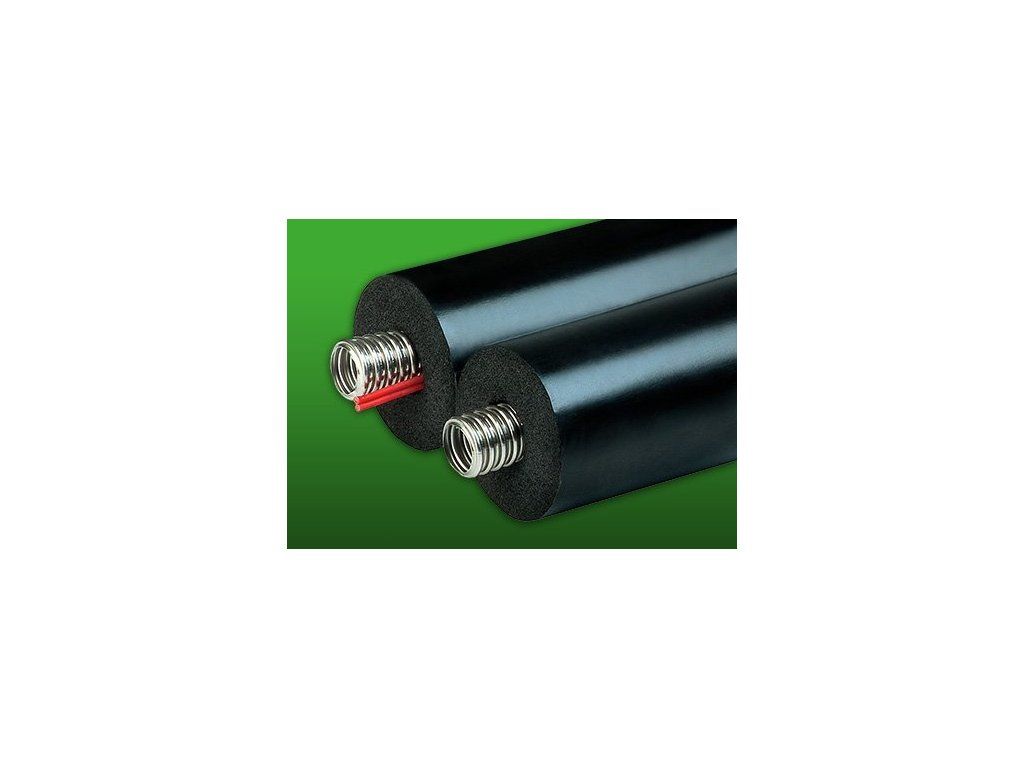
Solar Flexible Pipe 2 in 1, 10 m
Pre-insulated, flexible dual pipe (flow and return in a single sheath) for quick installation of the run between the collector and the plant room – no additional insulation needed on the roof.
Price: €308.75 View product →
Right at the collector connection, where the piping is exposed to high temperatures and must also withstand movement caused by the thermal expansion of the roof structure, a short section of flexible stainless-steel pipe – a so-called corrugated hose (bellows) – is commonly used. This is a flexible stainless-steel pipe that is resistant to the high temperatures of the solar fluid and can also compensate for slight movements at the connection point, where rigid piping could eventually crack or come loose from the joint.

Stainless-Steel Pipe, Corrugated Hose
Flexible stainless-steel pipe (corrugated hose) for the run between the collector and the storage tank, resistant to the high temperatures of the solar fluid – suitable especially for short connecting sections right at the collector.
Price: €3.81 View product →
A more detailed comparison of both types of piping, including when it is worth choosing the flexible pipe and when the classic piping with a corrugated hose, can be found in the separate article Solar Piping and Stainless-Steel Corrugated Hoses – How They Work.
Approximate prices of the main solar circuit components mentioned in the article.
Collector Mounting and Its Effect on Installing the Pump Group
Although it may not seem directly related at first glance, the way the collectors are mounted on the roof also affects how the piping will be routed to the pump unit and what demands the installation will place on the length and path of the run. Collectors are anchored using a specialized mounting structure depending on the roof type – a pitched roof (with various coverings such as tiles, sheet metal or shingles), a flat roof (where a structure with an adjustable tilt, usually 15° or more, is used for self-cleaning by rain) or, alternatively, mounting on a façade or on the ground. The structure must always precisely match the dimensions of the specific collector type being mounted on it.
On a flat roof, a typical solution is, for example, a mounting kit with adjustable tilt, which ensures the collector has the required minimum tilt of 15° even on an otherwise horizontal roof – not only for an optimal angle of incidence of sunlight, but also so that rainwater can run off the collector surface on its own and wash away dirt and dust that would otherwise reduce efficiency.
The choice of mounting type is always made at the start of the project, since it determines the exact position of the collector on the roof and thus also the length of the piping run (whether classic piping or the 2-in-1 flexible pipe) towards the plant room and the pump unit. A complete overview of mounting options by roof type can be found in the article Collector Mounting – Pitched Roof, Flat Roof, Façade, which also includes a specific example of a mounting kit for a flat roof with the KS 2100F collector.
The Solar Storage Tank and Its Connection to the Control Unit
The control unit and pump group would be useless without a suitable storage tank on the other side of the circuit. Compared to an ordinary boiler, a solar storage tank has at least one additional heat exchanger connected to the solar circuit – often also a second exchanger intended for auxiliary heating by a boiler. This means the water in the storage tank is heated indirectly: the solar fluid circulates separately in its own closed circuit (driven precisely by the pump unit and controlled by the solar controller) and never comes into direct contact with the domestic hot water that you later use, for example, in the shower or for washing.
It is precisely at the lower part of this exchanger that one of the control unit's sensors is usually placed – it measures the water temperature in the storage tank and compares it with the temperature at the collector. If the storage tank is not properly sized or does not have the solar exchanger in the right place, the control unit does not have accurate data available and the system may not work efficiently, even if the controller and pump themselves are fine. Choosing a suitable storage tank is therefore just as important as choosing the control unit – we cover this in detail in the article What Solar Storage Tank Do I Need.
Expansion Vessel, Filling and Venting the Solar Circuit
The solar circuit is a closed, pressurized system that undergoes significant temperature fluctuations during operation – from a cold night to the high temperatures of the heat-transfer fluid during a sunny summer day. This fluid expands in volume when heated, and since the circuit is closed, this excess volume needs to be compensated somewhere. This is exactly what the solar circuit's own expansion vessel is for, separate from the expansion vessel of the heating system.
The system is filled and vented using a manual or electric filling pump via filling valves, in a similar way to how an ordinary heating circuit is filled and vented. Any air left in the circuit after filling would hinder the smooth circulation of the fluid and could cause pump noise or uneven heating of the collector. That is precisely why the pump unit also has filling and venting valves available directly in the compact block, together with a pressure gauge – thanks to these, the technician can continuously monitor how the pressure in the circuit develops during filling, and recognize when the system is properly filled and vented.
Checking the pressure in the solar circuit (similar to the heating circuit) is one of the basic tasks of regular maintenance – a significant drop in pressure between checks usually indicates a leak, which is better dealt with before it shows up as a circulation failure or pump fault. You can read more about typical faults and how often it makes sense to check the system in the article Servicing, Filling and Common Faults of Solar Systems.
The Effect of Collector Type on Control Unit Settings
The control unit works essentially the same way regardless of the type of collector on the roof – it always compares the temperature at the collector with the temperature in the storage tank and switches the pump accordingly. However, the collector type affects how quickly and how significantly its temperature changes during the day, which indirectly shows up in how often the control unit switches the pump on and off.
Flat-plate collectors have an absorption surface covered with tempered glass in an insulated frame – they are cheaper, more mechanically resistant (for example to hail), and are usually sufficient for heating domestic hot water in our climate conditions. Vacuum (tube) collectors have higher efficiency, especially at low outdoor temperatures and lower solar radiation intensity, but they are more expensive and more fragile. Regardless of which collector type you choose, the control unit and pump group remain practically the same – the main difference is that vacuum collectors can produce heat even under less favourable conditions, so the control unit will switch the pump on more often during those periods than with a flat-plate collector. A detailed comparison of both types can be found in the article Flat-Plate vs. Vacuum Solar Collectors.
Solar System as a Boiler Supplement – the Control Unit's Role in Switching Sources
As already mentioned in the introduction, a solar system supplements but does not fully replace the main heat source, such as a boiler or heat pump. In practice, this means the storage tank often has a second exchanger connected to the boiler – this tops up the water heating whenever there is not enough sunshine (for example on cloudy days, early in the morning, or during winter). The control unit of the solar circuit takes care exclusively of the solar part – it decides on the operation of the pump between the collector and the storage tank – while boiler top-up heating is handled by the boiler's own separate controller, which usually senses the temperature in the upper part of the storage tank and tops up heating as needed if the solar gain alone is not sufficient.
These two control circuits (solar and boiler) thus operate side by side independently, but in coordination, because each has its own sensor in the storage tank at a different location – the solar sensor near the solar exchanger at the bottom, the boiler sensor closer to the top of the storage tank. Thanks to this arrangement, the boiler only engages in heating when the solar gain truly is not sufficient, which in practice saves the most energy precisely during the summer months. You can find broader context on how a solar system works together with an existing boiler in the article Solar Heating as a Boiler Supplement.
Installation – Where the Control and Pump Unit Come In
When installing a complete solar system, the control and pump unit come into play only at a later stage, after the collectors have been fixed to the roof using a suitable mounting structure and the piping run (classic or 2-in-1 flexible pipe) towards the plant room is ready. The pump unit is then connected to the piping and to the storage tank, the sensors are fitted at the collector and in the storage tank, the control unit is connected to them, and finally the whole circuit is filled and vented via the filling valves on the pump unit.
Only after filling and setting the control unit (for example setting the required temperature difference at which the pump should switch on) can the system be started up on a trial basis to verify that the pump responds to temperature changes as it should. A complete step-by-step installation procedure, including the order of individual steps from the collector to the storage tank, can be found in the article Installing a Solar System – Step-by-Step Procedure.
Real-World Examples
Two real cases – supplementing a boiler with solar and replacing a faulty control unit.
Family House with a Pitched Roof and an Existing Gas Boiler
A family house with a four-person household and a gas condensing boiler is dealing with high gas consumption for heating domestic hot water, especially in summer, when the boiler is practically not used for space heating and yet still runs just to heat the water. During an inspection of the roof (classic tile covering, a tilt suitable for direct mounting), the proposed solution is to supplement the existing boiler with a solar storage tank with two exchangers – one for the solar circuit, the other remaining connected to the original boiler as a backup source of top-up heating.
The collectors are fixed to the pitched roof using a mounting structure matching the given roof covering; the run between the collectors and the plant room is handled with a pre-insulated 2-in-1 flexible pipe, since the route runs through a fairly narrow roof structure, where working with classic piping and additional insulation would be considerably slower. In the plant room, a pump unit is fitted to the new storage tank together with a control unit, which takes over control of the solar pump independently of the boiler's original controller. As a result, during the summer months hot water heating runs predominantly on solar power, and the boiler only engages in top-up heating in the event of prolonged cloudy weather.
Cottage with a Flat Roof and a Faulty Original Controller
At a holiday cottage with a flat roof, a solar water heating system had been installed years earlier, but the original control unit started to develop faults – the pump sometimes failed to respond to temperature changes, the system would not start even in sunny weather, or conversely it kept running even when it made no sense. Since the collectors themselves, their mounting on the flat roof, and the piping run were all functional and in good condition, the solution chosen was to replace just the control unit with a new one, without touching the rest of the system.
On this occasion, the pump unit was also checked – the shut-off valves made it possible to isolate the relevant section of the circuit, check the pressure gauge, and verify that the pressure in the circuit was fine and that the pump itself was working. After replacing the control unit and briefly readjusting the temperature difference at which the pump should start, the system once again reliably responds to sunlight. This case shows that the control unit is a typical component that can be replaced on its own, without needing to touch the collectors, piping or storage tank, as long as those parts are in good condition.
FAQ – Frequently Asked Questions About Control Units and Pump Groups
How do I know the solar control unit is working correctly?
The basic sign of correct operation is that the pump starts when the collector is noticeably warmer than the storage tank (typically during a sunny day) and switches off when the temperature difference drops or when the storage tank is already sufficiently heated. If the pump does not respond to weather changes at all, or conversely runs continuously regardless of sunshine, it is a sign that the settings or the functioning of the control unit and sensors need to be checked.
The control unit decides, the pump unit physically ensures fluid circulation.
What is the difference between the control unit and the pump unit?The control unit is the electronics that evaluate temperatures from the sensors at the collector and in the storage tank and decide when the pump should run. The pump unit is a mechanical block that physically ensures fluid circulation – it contains the pump itself, shut-off valves, thermometers, pressure gauges and a safety valve. The control unit thus "decides", the pump unit "acts".
Does the pump unit need to have a safety valve?
Yes, a safety valve is a standard part of the pump unit, since this is a closed, pressurized system exposed to large temperature fluctuations. The safety valve protects the circuit against excessive overpressure, which could arise, for example, from a fault in the expansion vessel or from extreme overheating of the collector.
Can a pump unit be retrofitted to an older solar system?
If the collectors, piping and storage tank are functional and in good technical condition, replacing just the pump unit or the control unit on its own is a common solution, as we showed in the second practical example above. There is no need to automatically replace the whole system just because of a fault in one component.
How often should the pressure in the solar circuit be checked?
The pressure gauge on the pump unit allows a quick visual pressure check at any time, but it is worth doing regularly as part of routine plant-room maintenance. A significant drop in pressure between checks is usually the first sign of a leak in the circuit.
Why isn't the pump running even though the sun is shining?
The most common reason is that the storage tank is already warm enough and the difference compared to the collector temperature has dropped below the set threshold, so the control unit deliberately does not switch on the pump – there is no point pumping heat into an already-heated storage tank. Another possibility is a fault in a sensor, the control unit or the pump itself, or insufficient pressure in the circuit.
Can I program the control unit for other functions too, for example top-up heating?
The control unit of the solar circuit takes care exclusively of the solar part of the system – that is, the operation of the pump between the collector and the storage tank. Top-up heating by the boiler is handled by the boiler's own separate controller, connected to its own sensor in the upper part of the storage tank, independently of the solar control unit.
Is a specialist needed to install the pump group and control unit?
Installation involves working with a pressurized circuit, heat-transfer fluid, and the electrical wiring of the sensors and pump, so it is recommended to entrust it to a specialist experienced with solar systems – just as with anchoring collectors to the roof or connecting to an existing storage tank or boiler.
Related Topics
- How to Choose a Solar Water Heating System
- Flat-Plate vs. Vacuum Solar Collectors
- What Solar Storage Tank Do I Need
- Solar Piping and Stainless-Steel Corrugated Hoses – How They Work
- Collector Mounting – Pitched Roof, Flat Roof, Façade
- Solar Heating as a Boiler Supplement
- Installing a Solar System – Step-by-Step Procedure
- Servicing, Filling and Common Faults of Solar Systems
- Frequently Asked Questions About Solar Assemblies and Collectors
Do You Have a Question About Solar Systems or Collectors?
Can't decide, or dealing with a specific situation in your home? Write to us – we'll be happy to help.