
How to Choose a Solar Water Heating System
In our climate, the sun can cover a large share of the cost of heating domestic hot water – especially from spring to autumn, when it shines long and intensely. A solar system is therefore not an exotic technology reserved for passive houses, but a proven, widely available solution that today practically any household with a suitable roof can order and have installed. The question usually isn't "whether", but "exactly what it should look like" – how many collectors, what kind of storage tank, what control unit and what piping to choose so that the system works reliably and for a long time without unnecessary compromises.
Choosing the individual components is exactly where mistakes are most often made. An undersized storage tank means that surplus heat in summer has nowhere to go; an undersized or poorly set pump unit means that heat from the collector can't be carried away quickly enough. Poorly chosen collector mounting can threaten their service life in strong wind, and cheap, leaky pipe joints will sooner or later show up as a leak of heat-transfer fluid. This article therefore goes through the solar system component by component – from the collector on the roof to filling the circuit – so that you know what to look for when choosing and what to realistically expect from each part.
It's worth stating right at the start what a solar system doesn't do. It is not a standalone, year-round self-sufficient heat source – in the winter months, when there is little sun and hot water consumption still continues, a solar system always needs a supplementary source (a boiler, a heat pump) to bring the water up to the required temperature. Exactly how this cooperation works is covered in a separate article, Solar heating as a supplement to a boiler. In this text we focus on how to put together a functional, reliable solar system step by step.
What a solar water heating system is and what to realistically expect from it
The diagram shows the four basic components that must work together in a solar system.
A solar water heating system, more precisely a hot-water solar assembly, consists of four basic parts that must work as a single whole: solar collectors placed on the roof (or facade, or on the ground), a solar storage tank with a heat exchanger, a pump unit and a control unit. The collectors heat the heat-transfer fluid – a mixture of water and antifreeze that must withstand frost in winter and high temperatures in summer. This fluid circulates in a closed circuit, gives up its heat at the exchanger in the storage tank and returns to the collector to be heated again.
The whole process is run by automation: when the collector is warmer than the storage tank by a set value, the control unit switches on the circulation pump. When the difference drops (for example in the evening or when it clouds over), the pump switches off again, so that heat from the already-heated water in the storage tank doesn't escape back to the cooling collector. The system therefore works on its own, without operator intervention – once the parameters are set, it simply keeps evaluating temperatures and reacting to them.
Setting the right expectations is essential. In Central European conditions, a solar system typically covers most of the domestic hot water demand from April to September, contributes partially in the transitional months (March, October), and in winter mainly serves as a preheating stage for the water going into the main heat source. The system therefore supplements, not fully replaces, a boiler or heat pump – but it can still save a significant share of water-heating costs over the year, since summer lasts long enough for the investment to gradually pay back.
Flat-plate or vacuum-tube collectors – what to choose in Slovakia
Comparison of the main properties of flat-plate and vacuum-tube collectors.
The first key decision when choosing a solar system is the type of collector. Two main types are available on the market: flat-plate collectors and vacuum-tube (tubular) collectors. You can find a detailed technical comparison article at Flat-plate vs. vacuum-tube solar collectors; here let's summarize the essentials.
Flat-plate collectors have an absorber surface covered with toughened glass, housed in an insulated aluminium frame. Their main advantages are a lower purchase price, easier installation and, above all, higher mechanical resistance – toughened glass withstands hail well, as well as mechanical stress from larger temperature swings. For an average family household that wants to cover hot water heating mainly in the spring-to-autumn months, flat-plate collectors are usually a sufficient and economically most advantageous solution in our climate.
Vacuum-tube (tubular) collectors consist of a set of glass vacuum tubes, in which the absorber is protected from heat losses by vacuum insulation. Thanks to this, they achieve higher efficiency especially at low outdoor temperatures and lower solar radiation intensity – that is, precisely in the conditions where flat-plate collectors lose the most output (overcast days, early spring or late autumn months, colder regions). This advantage comes at a price, however: vacuum-tube collectors are more expensive to buy and service, and mechanically more fragile – a single damaged tube usually won't take the whole collector out of operation, but replacing it requires a service visit.
The practical recommendation is: if the main goal is the cheapest and most reliable coverage of summer hot water consumption, go for flat-plate collectors. If the priority is maximum solar yield even outside the summer months (for example with a larger share of solar heating, not just DHW heating) and the budget allows it, vacuum-tube collectors can meet that goal better.

Euroster 813 Solar – €108.94
A solar controller (control unit) that compares the temperature of the collector and the storage tank and, based on the set difference, switches on the circulation pump of the solar pump unit. Regardless of the type of collector chosen, every solar system needs exactly this kind of control unit.
Solar storage tank – the heart of the system that determines comfort
While the collector produces the heat, the storage tank has to be able to receive it, hold it, and release it at the right moment. A solar storage tank differs from an ordinary boiler mainly in that it has at least one additional heat exchanger connected to the solar circuit – most often a coiled exchanger placed in the lower part of the tank, where the domestic hot water temperature is lowest, so the solar yield can be used even in milder sunshine. Many solar tanks also have a second exchanger, placed higher up, connected to the boiler or another main heat source – this brings the water up to the required temperature whenever the solar yield isn't enough.
The heating principle is indirect: the solar fluid circulates exclusively within its own closed circuit (collector – piping – exchanger in the tank – back to the collector) and never comes into direct contact with the domestic water. Thanks to this it can contain an antifreeze mixture without any risk of contaminating the water that then comes out of the tap. This separated circulation is exactly why a solar tank can't simply be replaced by an ordinary boiler with a coil added afterwards – it needs a carefully designed construction with sufficient exchanger surface area and correctly placed connections.
Choosing the right tank size is one of the most common questions when designing a system – too small a volume means the tank overheats quickly on a sunny day and there's nowhere left to store further solar yield, while too large a volume extends the time before the water becomes noticeably warm at all. You'll find a complete guide to choosing the right size and type of tank in the article What solar storage tank do I need – we recommend reading it before ordering the collectors, since the tank is usually the component that's hardest to change after installation is complete.
Control unit and pump unit – the brain and the circulation of the system
The control (solar) unit is the part that decides when the system should work. Using sensors placed on the collector and in the storage tank, it continuously compares the two temperatures. As soon as the collector is warmer than the tank by a preset difference (typically a few degrees Celsius), the control unit switches on the circulation pump of the solar pump unit and the fluid starts moving. When the difference drops below a second, lower threshold, the pump switches off – this prevents a situation where heat from the already-heated tank would escape back out through the cooling collector, for example in the evening or when the sky suddenly clouds over.
This logic is exactly why even a simple, small solar system needs a quality, reliably set controller – without it the pump would either run needlessly (wasting electricity and straining the system), or conversely fail to switch on at moments when it would make sense to. Controllers such as the Euroster 813 Solar (mentioned above) are therefore a standard part of even smaller installations.
The pump unit is the physical component that provides the actual circulation of the fluid. In one compact block it usually contains the circulation pump, shut-off valves (in case of servicing, so the whole circuit doesn't have to be drained), thermometers and pressure gauges for monitoring operating values, and a safety valve that protects the circuit against excess pressure. The compact design makes both installation and any later servicing significantly easier – all the important elements are accessible in one place instead of being scattered across the whole system.

Solar pump unit ZP2-12 ECO – €750.55
A complete pump group – circulation pump, valves, pressure gauges and safety valve in a single block – ensuring circulation of the solar fluid between the collector and the storage tank.
You'll find a more detailed comparison of different types of control units and pump groups, including what to watch out for when choosing based on the number of collectors and the length of the piping run, in the article Control units and pump groups of solar systems.
Piping and pipe insulation – how the fluid travels down from the roof
Between the collector on the roof and the utility room where the storage tank stands, there must run a pipe system capable of withstanding high temperatures and pressure changes. In practice, two main solutions are used. The first is classic copper or stainless-steel piping, joined by soldering or press fittings and then insulated by hand with thermal insulation resistant to UV radiation (on exterior sections) and to high temperatures.
The second, increasingly popular solution is a pre-insulated 2-in-1 flexi pipe – a flexible twin pipe in which both the flow and return lines run together inside a single, already-insulated jacket. A big advantage is installation speed: since the pipe is already insulated at the factory, nothing needs to be insulated afterwards on the roof or where it passes through the roof structure or a shaft, which shortens installation time and reduces the risk of poorly done insulation in hard-to-reach places.
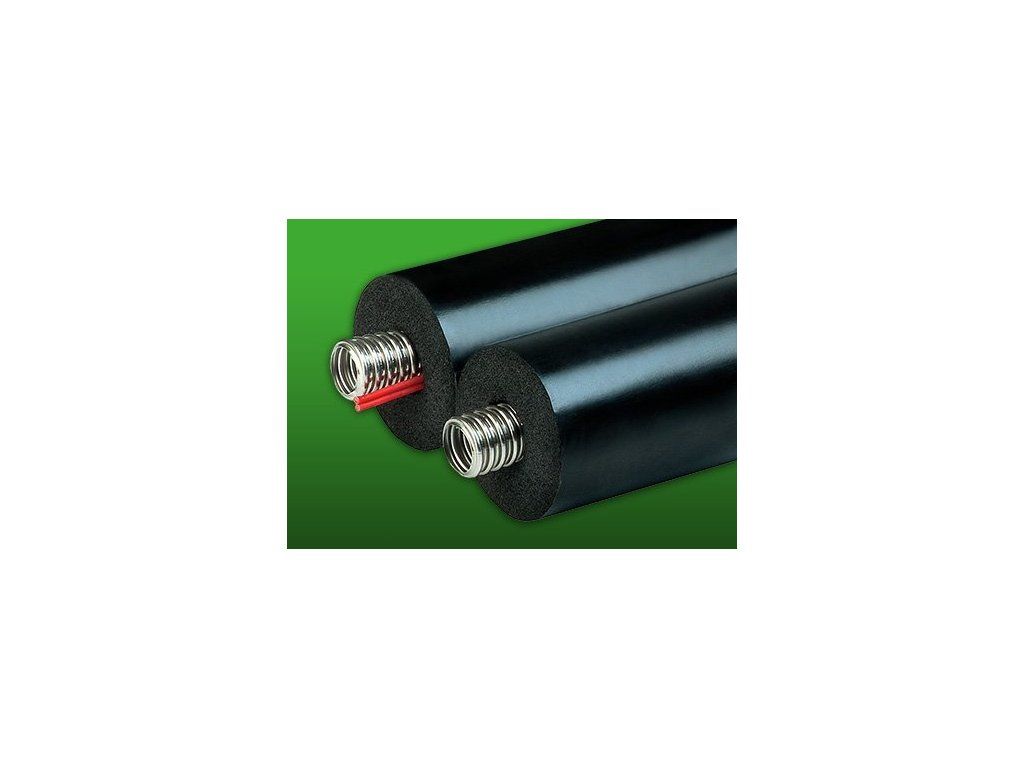
Solar 2-in-1 flexi pipe, 10 m – €308.75
Pre-insulated, flexible twin pipe (flow and return in a single jacket) for fast installation of the run between the collector and the utility room – with no need for additional insulation on the roof.
For shorter connecting sections right at the collector or in the utility room, flexible stainless-steel pipe, the so-called corrugated hose, is often used instead, as it withstands the high temperatures of the solar fluid well and can also be easily shaped in tight spaces without any need for soldering. An example is Stainless-steel pipe, corrugated hose (€3.81) – a cheap but important connecting element that in practice works well as an addition to the main run, not as a replacement for it along the whole route. The longer the run and the more demanding the route (more bends, penetrations, height differences), the more worthwhile it becomes to consider a pre-insulated flexi pipe instead of assembling the run from individual pieces of pipe and on-site insulation.
You'll find a complete overview of pipe types, joining methods and common mistakes when installing the run in a separate article, Solar piping and stainless-steel corrugated hoses – how they work.
Collector mounting – pitched roof, flat roof, facade
No matter how good a collector, storage tank or controller you choose, the whole system stands (literally) on reliable mounting. Collectors are anchored with a specialized mounting structure chosen according to the type of roof and roofing material. On a pitched roof, the structure is adapted to the specific type of roofing – tiles, sheet metal roofing or beaver-tail tiles each have their own system of anchoring hooks and rails that respects the profile and laying method of that particular roofing.
On a flat roof, a different type of structure is used – an adjustable stand that tilts the collector to the required angle, usually at least 15°. This minimum tilt is not arbitrary: at a lower tilt, water, dust and dirt could linger on the collector surface for a long time, since rainwater doesn't run off an almost horizontal surface fast enough to clean it effectively. An alternative for plots with enough space is mounting on a facade or directly on the ground on its own supporting structure – these variants are especially suitable where the roof isn't well oriented to the sun or where its structure doesn't allow installation.
A key rule worth emphasizing: the mounting structure must exactly match the dimensions and fixing points of the specific type and size of collector. Universal "one-size-fits-all" structures don't really exist in practice – a structure that doesn't fit the dimensions correctly can mean insufficient fixing and a risk of damage in strong wind or under snow load.

Mounting kit for collectors on a flat roof up to 15° pitch, for the KS 2100F 1.82 m² collector – €117.34
A mounting structure for fixing a flat-plate collector to a flat roof with an adjustable tilt – a typical example of a solution tailored exactly to the dimensions of a specific collector.
You'll find a detailed breakdown of the individual mounting types, including recommendations for specific roofing materials, in the article Collector mounting – pitched roof, flat roof, facade.
Expansion vessel, filling and pressure in the solar circuit
The solar circuit is a closed, pressurized system – just like a regular heating circuit, it too needs its own expansion vessel. Its job is to compensate for the volumetric expansion of the heat-transfer fluid, which changes over the course of the day from a cool morning temperature to a high temperature at solar noon and back. Without an expansion vessel, these volume changes would cause excessive pressure swings in the circuit that would strain the joints, the exchanger and the pump itself.
Filling and venting the solar circuit is done through filling valves using a manual or electric filling pump, similar to filling a regular heating circuit. Thorough venting is important here – air bubbles in the circuit reduce the efficiency of heat transfer and, at higher temperatures, can also cause the pump to be noisy. At the same time, the solar fluid (a mixture of water and antifreeze) naturally degrades over time due to repeated heating to high temperatures, so checking its condition and replacing it if needed is part of regular maintenance.
This is exactly the area – filling, pressure, venting and common faults such as a pressure drop or a noisy pump – that owners of solar systems most often contact service technicians about. You'll find a comprehensive overview of procedures and typical faults in the article Service, filling and common faults of solar systems.
How much a solar system costs and how to choose the right combination
Indicative prices of selected solar system components mentioned in the article.
The price of a complete solar system is made up of the price of the collectors, the storage tank, the control unit, the pump group, the piping run, the mounting structure and finally the installation itself. From the components mentioned in this article, you can get an approximate idea of the smaller items in the assembly: a solar controller (for example the Euroster 813 Solar) costs around €109, a pump unit (ZP2-12 ECO) around €751, a pre-insulated flexi pipe for a ten-metre section around €309, and a mounting structure for a flat roof around €117 – to this you need to add the price of the collectors themselves and the storage tank, which make up the largest part of the budget and vary according to the number of collectors and the volume of the tank.
When choosing a specific combination of components, it's worth following the order that matches the logic of the design: first work out the household's hot water consumption and derive the required tank volume from it (see What solar storage tank do I need), then choose the type and number of collectors according to the available roof area and orientation (see Flat-plate vs. vacuum-tube solar collectors), then sort out the mounting according to the specific roof, and finally choose the controller, pump group and piping according to the length and difficulty of the route. If you're not doing the installation yourself but ordering it from a professional company, you'll find the exact step-by-step procedure from preparation to start-up in the article Solar system installation – step-by-step procedure – even if you're not installing it with your own hands, it's useful to know everything that should be part of a proper installation so you can check it.
Real-world examples
Example 1: a house with a pitched roof and a four-person household. A house with the roof facing south, a gable roof with clay tile roofing, pitch approximately 35°. A four-person household has average daily hot water consumption of around 160–200 litres. A typical solution for this case is an assembly with flat-plate collectors (more mechanically resistant, more cost-effective, sufficient for mainly summer coverage), a solar storage tank with two exchangers (solar and boiler backup) and a mounting structure adapted exactly to that type of tile. A Euroster 813 Solar-type control unit ensures automatic switching of the pump based on the temperature difference, while a ZP2-12 ECO-type pump unit provides circulation between the roof and the utility room in the basement. Since the utility room is in the basement in this case, i.e. relatively far from the roof, a pre-insulated flexi pipe is worthwhile for the longer vertical section of the run, as it shortens installation time and reduces the risk of heat losses over the long route. In the summer months, such an assembly usually covers most of the hot water demand without needing top-up heating from the boiler; it contributes partially in the transitional months, and in winter it mainly serves to preheat the incoming cold water.
Example 2: a recreational cottage with a flat roof and seasonal use. A cottage used mainly from spring to autumn, with a flat roof (no option for a pitched angle) and a smaller, two- to three-person occupancy during stays. In this case an adjustable-tilt mounting structure for a flat roof (for example up to 15°) is essential, which also ensures sufficient self-cleaning of the collector by rain even without regular year-round care from the owner. Since this is seasonal use with mainly summer operation, it's exactly here that a solar system shows its greatest advantage – demand for hot water is highest precisely when the solar yield is also greatest. A smaller tank volume is sufficient given the lower number of people, and a shorter run (utility room close to the roof) allows the use of a shorter section of stainless-steel corrugated hose instead of a longer flexi pipe, saving part of the budget without losing functionality.
FAQ – frequently asked questions about choosing a solar system
Will a solar system completely replace my boiler or heat pump?
No. A solar system supplements, not fully replaces, the main heat source. It covers domestic hot water heating the most in the summer months; in winter and during periods of lower solar radiation, top-up heating from a boiler or heat pump is necessary.
What's the difference between a flat-plate and a vacuum-tube collector from an ordinary household's point of view?
Flat-plate collectors are cheaper and mechanically more resistant (for example to hail), and are usually enough for DHW heating in our climate. Vacuum-tube collectors have higher efficiency at low outdoor temperatures and weaker radiation, but are more expensive and more fragile. Details in the article Flat-plate vs. vacuum-tube solar collectors.
Why can't a solar storage tank just be an ordinary boiler?
A solar storage tank has at least one additional heat exchanger connected to the solar circuit, through which the water is heated indirectly – the solar fluid circulates separately and doesn't come into contact with the domestic water. An ordinary boiler doesn't have this construction.
This is how the control unit decides when to switch the circulation pump on and off.
How does the control unit actually know when to switch the pump on?It compares the temperature at the collector and in the storage tank using sensors. When the collector is warmer than the tank by a set difference, it switches on the circulation pump of the solar pump unit. When the difference drops, it switches the pump off, so heat doesn't escape back to the cooling collector.
Is a pre-insulated flexi pipe worth it compared to classic copper piping?
For longer or more demanding routes, yes – the 2-in-1 flexi pipe has the flow and return lines in a single, already-insulated jacket, so it doesn't need additional insulation on the roof or in a shaft, which shortens installation time. For short connecting sections, stainless-steel pipe (corrugated hose) is often used instead.
Does the roof collector have to be tilted at exactly a certain angle?
On a pitched roof, the collector follows the pitch of the roof. On a flat roof, an adjustable structure is used, usually with a tilt of at least 15°, so the collector can naturally self-clean with rainwater.
Why does the solar circuit need an expansion vessel?
The solar circuit is a closed, pressurized system, and the heat-transfer fluid changes its volume with temperature. The expansion vessel compensates for this volumetric expansion at high temperatures, protecting the circuit from excess pressure.
How often does a solar system need to be checked or topped up with fluid?
The solar fluid naturally degrades over time due to repeated heating to high temperatures, so regular checking of its condition and replacement when needed is advisable, along with checking the circuit pressure. Common faults and service procedures are described in the article Service, filling and common faults of solar systems.
Can a solar system be added to a house that already has a heating boiler?
Yes, that's a common and recommended configuration – the solar system connects to a solar storage tank with a second exchanger connected to the existing boiler, which tops up the water temperature whenever the solar yield isn't enough. More in the article Solar heating as a supplement to a boiler.
Related topics
- Flat-plate vs. vacuum-tube solar collectors
- What solar storage tank do I need
- Solar piping and stainless-steel corrugated hoses – how they work
- Control units and pump groups of solar systems
- Collector mounting – pitched roof, flat roof, facade
- Solar heating as a supplement to a boiler
- Solar system installation – step-by-step procedure
- Service, filling and common faults of solar systems
- Frequently asked questions about solar assemblies and collectors
Have a question about solar systems or collectors?
Not sure what to decide, or dealing with a specific situation in your household? Write to us – we're happy to help.