
What Solar Storage Tank Do I Need
The question "what solar storage tank do I need" sounds simple at first glance, but in reality it is the sum of several partial decisions that influence each other. You never choose a storage tank in isolation – its construction, the number of heat exchangers and the way it is connected are directly related to what collectors you will have on the roof, how the system will be topped up during periods without enough sun, and what pipework and pump station will connect the whole circuit. Anyone who deals with the storage tank separately from the rest of the setup often ends up with a tank that is undersized for the collector area, or conversely unnecessarily large and expensive relative to the household's actual hot water consumption.
In this article we look at how a solar storage tank differs from an ordinary boiler, why it makes sense to consider two heat exchangers instead of one, how the choice of storage tank relates to the type of collectors (flat versus vacuum), and everything else besides the tank itself that you need – from the control unit through the pump station to the pipework, collector mounting and expansion vessel. The aim is that after reading you will be able to ask your supplier the right questions and understand why they recommend exactly the combination of components they propose.
If you are dealing with a specific case – a family house, a cottage, or simply adding solar water heating to an existing boiler – we also recommend reading our broader guide How to choose a solar water heating system, which describes selecting the whole set. This article, by contrast, focuses specifically on the storage tank and the components directly related to it.
What is a solar water heating system and what role does the storage tank play in it
A solar set consists of four interconnected components.
A solar water heating system, sometimes also called a solar thermal set, consists of four basic parts: solar collectors mounted on the roof (or on the facade or on the ground), a solar storage tank with a heat exchanger, a pump unit and a control unit. The collectors heat a heat-transfer fluid – a mixture of water and antifreeze – which circulates through a closed circuit to the storage tank, where it transfers heat to the domestic hot water via the heat exchanger.
It is important to say right at the start that a solar system supplements, not fully replaces, the main heat source such as a boiler or heat pump. In practice this means that solar covers most of the domestic hot water heating specifically in summer, when there is enough solar radiation and heating demand is zero or minimal. In transitional months and in winter the sun only supplies part of the required energy, and the main source has to heat the rest. This is precisely why the storage tank – and above all its internal construction with heat exchangers – is the key element of the whole set, because that is where the energy from the sun actually meets the energy from the boiler or heat pump, and where heat is stored for use at any time during the day.
So the storage tank is not just a "water tank". It is a heat accumulator and at the same time the place where two or more heat sources meet. That is precisely why it does not pay to cut corners or rush the decision when choosing a storage tank – an incorrectly chosen tank can limit the output even of well-designed collectors.
Solar storage tank versus an ordinary boiler – what the real difference is
An ordinary electric or combined boiler heats water directly – either with an electric element, or with a single heat exchanger connected to the boiler. A solar storage tank, by contrast, has at least one additional heat exchanger connected to the solar circuit, but very often also has a second heat exchanger for backup heating from the boiler or another source. Water in a solar storage tank is always heated indirectly – the solar fluid circulates separately in its own closed circuit and never comes into direct contact with the domestic water that later comes out of the tap.
This separation of circuits has a practical reason: the heat-transfer fluid contains an antifreeze component, and at the high temperatures reached at the collector (which in summer months can be significantly higher than the temperature of ordinary domestic water) direct contact with drinking water would not be appropriate either hygienically or technically. The heat exchanger therefore acts as both a thermal barrier and a transfer medium at the same time – it transfers heat but keeps the media separate.
In storage tanks with two heat exchangers (commonly called bivalent), the lower heat exchanger is usually connected to the solar circuit and the upper one to the boiler or another backup source. This arrangement is not accidental – the solar fluid's temperature varies throughout the day, and the lower position of the heat exchanger allows even a moderate warming of the collector to be used to pre-heat the cold water entering the tank from below. The upper heat exchanger then, if needed, heats the water further to the required temperature regardless of whether the sun is shining at that moment.
So when comparing offers and someone offers you a "solar storage tank", it is worth asking exactly how many heat exchangers it contains and how they are connected – this is the basic feature that determines whether the tank can work on its own with solar as well as in combination with an existing boiler.
How many heat exchangers do you need – standalone solar, or combined with a boiler
When deciding on the number of heat exchangers in a storage tank, the decisive factor is the answer to a simple question: should the solar system work completely independently (for example in a building with no other heat source, or where backup heating is handled by a separate, independent boiler), or should it be part of a single storage tank together with an existing boiler or heat pump?
If the answer is the second option – which is the most common case in family houses with central heating – you need a storage tank with two heat exchangers, or a tank that is designed in advance as a solar bivalent tank. In such an arrangement the system works automatically: when there is enough solar heat, heating is handled exclusively by the solar circuit and the boiler does not switch on at all. When there is not enough sun (overcast days, winter, higher hot water consumption), the missing energy is automatically supplied by the backup heat exchanger connected to the boiler. It is precisely in this combination that you can best see that solar really does supplement the main heat source, as mentioned in the introduction – it is not a replacement for the boiler, but a reduction of its operating hours, especially in the warmer part of the year.
You can find more about exactly how solar heating cooperates with an existing boiler, including practical connection recommendations, in the separate article Solar heating as a supplement to a boiler.
How the type of collectors relates to the choice of storage tank
The storage tank and the collectors form one functional whole, so it is worth deciding on both at the same time, not one after the other. On the market you commonly encounter two types of collectors – flat and vacuum (tube) collectors – and their properties have a direct effect on how the storage tank will work in practice.
Flat collectors have an absorption surface covered by tempered glass in an insulated frame. They are cheaper, mechanically more resistant – for example to hail – and in our climatic conditions are usually sufficient for heating domestic hot water. Vacuum (tube) collectors achieve higher efficiency especially at low outdoor temperatures and lower solar radiation intensity, but are more expensive and more fragile. In practice this means vacuum collectors can supply heat more efficiently even on colder and less sunny days, which can slightly shift the storage tank's usefulness towards the spring and autumn months. With flat collectors, on the other hand, the strongest effect is concentrated in the summer months with high solar radiation intensity.
For the storage tank itself, this leads to one practical recommendation: when designing the set, it is worth matching the size of the storage tank to the area and type of the collectors so that the tank can store the energy the collectors actually deliver during a typical sunny day, but without being unnecessarily oversized relative to the household's actual hot water consumption. It is best to discuss this balance with a supplier who knows the parameters of the specific collectors and storage tank, since it involves the interaction of several components at once, not one universal number.
A detailed comparison of both types of collectors, including when the surcharge for vacuum technology is worth it, can be found in the article Flat vs. vacuum solar collectors.
Control unit and pump station – how they affect the storage tank's operation
The storage tank alone, even with the right number of heat exchangers, is only half the solution. For the heat from the collector to actually reach the storage tank at the right time, you need a control (solar) unit and a pump station.
This is how the control unit automatically switches the solar fluid circulation on and off.
The control unit compares the temperature at the collector and the temperature in the storage tank using sensors located at both points. When the collector is warmer than the storage tank by a preset difference, the unit switches on the circulation pump of the solar station and the fluid starts to circulate – heat is transferred from the collector to the storage tank via the heat exchanger. When the difference falls below the set threshold (for example when it is overcast or when the storage tank is already sufficiently heated), the pump automatically switches off, so that electricity is not wasted unnecessarily and heat does not flow back from the storage tank to the cooler collector.
One proven solution for this task is the Euroster 813 Solar controller, which is designed exactly for controlling the pump based on the temperature difference between the collector and the storage tank.

Solar controller (control unit) for controlling the pump based on the temperature difference between the collector and the storage tank.
Price: €108.94
The pump unit, in turn, is a compact block that combines the circulation pump, shut-off valves, thermometers, pressure gauges and a safety valve. Because all these elements are grouped in a single block, it significantly simplifies both installation (the installer does not have to assemble the circuit from individual components on site) and later servicing, since all the elements for checking pressure, flow and temperature are in one place, clearly accessible.

Complete pump station (circulation pump, valves, pressure gauges, safety valve) for circulating the solar fluid between the collector and the storage tank.
Price: €750.55
So when choosing a storage tank, always also think about which control unit and pump station it will work with – this is a set whose components must be mutually compatible, not just individually functional. More detailed information about different types of control units and pump stations can be found in the article Control units and pump stations for solar systems.
Pipework and insulation between the collector and the storage tank
The pipework between the collector on the roof and the storage tank in the utility room is another element that affects how much heat actually gets from the roof to the storage tank. There are basically two solutions. The first is classic copper or stainless steel pipe, which has to be bent, joined on site and then additionally insulated with thermal insulation resistant to high temperatures.
The second solution is a pre-insulated 2-in-1 flexible pipe – meaning the flow and return combined in a single flexible, already insulated jacket. This solution significantly shortens installation time, since the pipe does not need to be additionally insulated either on the roof or in a shaft or passage through the building structure – the insulation is already part of the delivery from the factory.
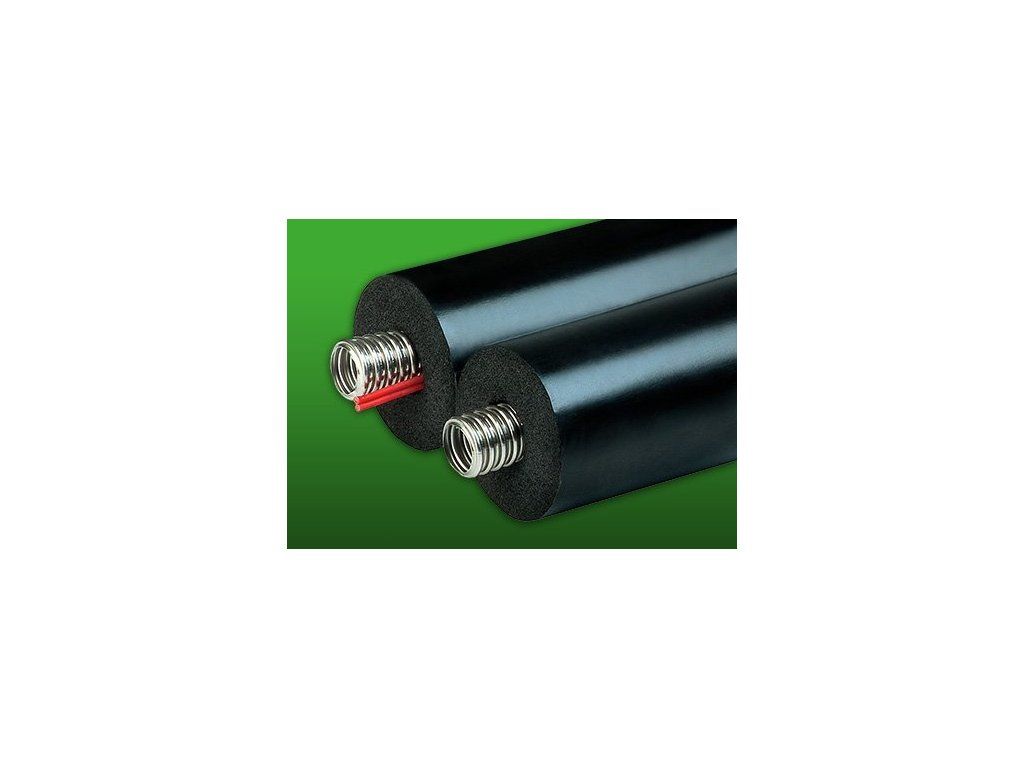
Solar flexible pipe 2 in 1, 10 m
Pre-insulated, flexible dual pipe (flow and return in a single jacket) for fast installation of the run between the collector and the utility room.
Price: €308.75
Directly at the collector connection, a short section of flexible stainless steel corrugated pipe is also often used, which withstands the high temperatures of the solar fluid right at the collector and at the same time compensates for small structural movements that could cause stress in the joint with a rigid pipe.
Comparison of prices of selected components mentioned in the article.
The choice between classic pipework and a pre-insulated flexible pipe is not just a question of price, but also of route feasibility (length, number of bends, passage through the structure) and the installation company's time availability. A complete overview of both solutions can be found in the article Solar pipework and stainless steel corrugated pipes – how they work.
Collector mounting – why it also relates to choosing the storage tank
Although collector mounting at first glance seems like a completely separate topic unrelated to the storage tank, in fact it determines what type and how many collectors can actually be fitted on a given roof – and thereby indirectly also how large a storage tank it makes sense to connect to that collector area.
Collectors are anchored using a specialized mounting structure depending on the type of roof. On a pitched roof, the structure varies according to the roofing – tiles, sheet metal, plain tiles – because each type of roofing requires a different way of anchoring into the roof truss without compromising the roof's watertightness. On a flat roof, an adjustable tilt is used, usually at least 15°, which is not a random number – this tilt ensures that rainwater can naturally drain off the surface of the collector and at the same time partially self-clean it, which maintains its efficiency. An alternative is mounting on a facade or on the ground, which is used where the roof is not suitable or accessible.
It is important that the mounting structure must exactly match the dimensions of the specific type of collector – so it is not a universal part, but a "made-to-measure" solution for the given model. An example is a structure designed directly for the flat collector KS 2100F with an area of 1.82 m².

Mounting kit for collectors on a flat roof up to 15° tilt, for the KS 2100F 1.82 m² collector
Mounting structure for fixing a flat collector on a flat roof, with adjustable tilt.
Price: €117.34
If the shape, orientation or structural load capacity of the roof limits the number and area of collectors that can be installed, this has to be taken into account already when designing the storage tank – it makes no sense to design a large storage tank for a small collector area that the roof simply does not allow to be expanded. More about mounting options for different types of roofs can be found in the article Collector mounting – pitched roof, flat roof, facade.
Expansion vessel and filling the solar circuit
The solar circuit is a closed, pressurized system that has its own expansion vessel. Its job is to compensate for the volumetric expansion of the heat-transfer fluid at high temperatures – when the fluid in the collector heats up significantly on a hot summer day, its volume increases, and without an expansion vessel the pressure in the closed circuit would rise above a safe limit.
The system is filled and vented using a manual or electric filling pump via filling valves, in a similar way to filling and venting an ordinary heating circuit. This task is part of the installation and later also of regular servicing, since it is advisable to check the pressure and condition of the fluid in the solar circuit from time to time, similar to a heating system.
When assembling a complete solar set, the expansion vessel is part of the pump unit or is added as a separate element depending on the specific design – in both cases, however, the circuit cannot work safely without it. You can find the installation procedure, including filling and venting the circuit step by step, in the article Installing a solar system – step by step procedure. If, on the other hand, you are more interested in operation after years of use, i.e. servicing, topping up the fluid or the most common faults, read Servicing, filling and common faults of solar systems.
Summary – what to think about when choosing a solar storage tank
Before you decide on a specific storage tank, it is worth being clear on the following points:
First, how many heat exchangers the storage tank needs – one, if the solar system is to work on its own, or two, if it is to be part of a shared system with an existing boiler or heat pump. Second, what type of collectors (flat or vacuum) will supply the storage tank with heat and how that corresponds to the actual conditions of your roof and location. Third, which control unit and pump station will control and drive the whole circuit – these components must be compatible with the storage tank and tuned together. Fourth, what kind of pipework (classic or pre-insulated flexible pipe) will carry the heat from the collector to the storage tank, and finally, how the collectors will be mounted on the roof or facade, since this determines the actual area available for capturing solar energy.
All these decisions are interconnected – a change in one part of the set (for example switching from flat to vacuum collectors) can also affect which storage tank, which pump unit or which pipework it makes sense to use. That is why in most cases it is worth treating the storage tank as part of the whole set, not as an isolated purchase.
Real examples from practice
Two real-world examples of deploying a solar storage tank in practice.
Family house with an existing condensing boiler. An older family house has had a condensing boiler running for years, providing both heating and domestic hot water via an ordinary boiler tank all year round. The owner decided to add solar heating to reduce the amount of gas needed for water heating in the summer months, since space heating is not needed in summer anyway. The solution in this case is a bivalent solar storage tank with two heat exchangers – the lower one connected to new flat collectors on a pitched roof with tile roofing, the upper one left for the original boiler as a backup source. Thanks to the control unit, which compares the temperature of the collector and the storage tank, the boiler practically never switches on for water heating on sunny summer days and only starts up when it is overcast or night-time consumption is higher than what the solar system heated during the day. The existing pipework to the utility room was replaced during this renovation with a pre-insulated flexible pipe, since the route through the attic was narrow and difficult to insulate additionally with classic pipework.New build with a flat roof and a heat pump. In a new building with a flat roof and a heat pump as the main heat source, collector mounting had to be solved from scratch, since a flat roof with no slope requires an adjustable mounting structure to achieve the recommended tilt for self-cleaning by rain. The investor chose a combination of flat collectors (due to their lower price and higher durability in operation) with a bivalent storage tank whose second heat exchanger is connected to the heat pump instead of a gas boiler. A complete pump unit with pressure gauges and a safety valve was placed directly in the utility room together with the control unit, which made any future servicing easier, since all the control elements are in one place. A short section right at the collector is handled by flexible stainless steel pipe, which withstands both high temperatures and small structural movements during temperature fluctuations throughout the year.
Frequently asked questions about choosing a solar storage tank
Does a solar storage tank necessarily have to have two heat exchangers?
Not necessarily. If the solar system is to work completely independently, with no link to an existing boiler or other heat source, a storage tank with a single heat exchanger connected to the solar circuit is sufficient. If it is to be part of a shared system with a boiler or heat pump, you need a storage tank with two heat exchangers – one for solar, the other for backup heating.
Why doesn't the solar fluid come into direct contact with the water we later use?
Because these are two separate systems – a closed solar circuit with antifreeze fluid and an open domestic water circuit. The heat exchanger in the storage tank transfers heat between them, but the media never mix, which is essential from both a hygiene and a technical point of view.
Does the type of collectors (flat vs. vacuum) affect the choice of storage tank?
Yes, directly, since the storage tank should be sized to the area and type of the collectors so that it can efficiently store the heat the collectors actually deliver. You can find the detailed differences between the two types of collectors in the separate article Flat vs. vacuum solar collectors.
What exactly does a solar system's control unit do?
It compares the temperature at the collector and in the storage tank using sensors. When the collector is warmer than the storage tank by a set difference, it switches on the circulation pump of the solar station so that heat is transferred to the storage tank. When the difference is insufficient, it switches the pump off.
What exactly does a pump unit contain and why is it in a single block?
It contains a circulation pump, shut-off valves, thermometers, pressure gauges and a safety valve. Grouping them into a single compact block makes both installation and later servicing easier, since all the control and safety elements are clearly located in one place.
What is the difference between classic pipework and a pre-insulated 2-in-1 flexible pipe?
Classic copper or stainless steel pipe has to be additionally insulated on site during installation. A pre-insulated 2-in-1 flexible pipe combines the flow and return in a single flexible, already insulated jacket, which shortens installation time since it does not need to be additionally insulated either on the roof or in a shaft.
Why do collector mounting structures on a flat roof have an adjustable tilt?
Because a flat roof by itself does not have sufficient slope. An adjustable tilt, usually at least 15°, ensures that rainwater drains off the surface of the collector and also partially self-cleans it, which maintains its efficiency in operation.
Why does the solar circuit need its own expansion vessel?
Because it is a closed, pressurized system, and the heat-transfer fluid expands in volume at high temperatures at the collector. The expansion vessel compensates for this expansion so that the pressure in the circuit does not exceed a safe limit.
Does the collector mounting structure have to be chosen exactly according to the collector model?
Yes. The mounting structure must exactly match the dimensions of the specific type of collector and the type of roof (pitched with the given roofing, flat, or facade or ground) – it is not a universal part that would fit any collector.
Related topics
If you found this topic interesting, we also recommend continuing with other related articles from our Knowledge Centre:
- How to choose a solar water heating system
- Flat vs. vacuum solar collectors
- Solar pipework and stainless steel corrugated pipes – how they work
- Control units and pump stations for solar systems
- Collector mounting – pitched roof, flat roof, facade
- Solar heating as a supplement to a boiler
- Installing a solar system – step by step procedure
- Servicing, filling and common faults of solar systems
- Frequently asked questions about solar sets and collectors
Do you have a question about solar systems or collectors?
Can't decide, or are you dealing with a specific situation in your home? Write to us – we're happy to help.