
Solar heating as a boiler add-on
The sun hits your roof for free every single day, yet the vast majority of households never put that energy to use for water heating – the boiler or heat pump still has to fire up even on a scorching July afternoon just to warm up a few dozen litres of hot water for a shower. Solar heating as a boiler add-on is exactly about closing that gap: it's not meant to replace the main heat source, but to sensibly supplement it, taking over a large share of DHW heating during the warm months and sparing the boiler from unnecessary cycling.
A solar water heating system (a hot-water solar assembly) consists of solar collectors mounted on the roof that heat a heat-transfer fluid – a mix of water and antifreeze – plus a solar cylinder with a heat exchanger, a pump station that circulates the fluid, and a controller that evaluates the whole process and switches the pump on or off. All of these components form a closed, self-contained loop that connects to the household's existing heating system at a single point: the solar cylinder.
In this article we'll break down what a solar assembly actually consists of, the difference between flat-plate and vacuum tube collectors, how the solar cylinder, controller and pump station work, how the piping between the roof and the collectors is routed and fixed to different roof types, and finally why the solar loop needs its own expansion vessel and regular filling. If you're considering a solar add-on for your boiler, this overview will help you understand what you're really investing in and what such a system can and cannot deliver.
A solar assembly consists of four interconnected components.
What a solar assembly actually contains and how it works with the boiler
A solar system isn't a single device but a sum of several interconnected components. Solar collectors are mounted on the roof, whose job is to capture solar radiation and turn it into heat in the heat-transfer fluid – a mix of water and antifreeze that must withstand freezing in winter as well as high temperatures in summer, when the collector isn't being drawn on (for example during a holiday). This fluid circulates through a closed loop toward the plant room, where it releases its heat via a heat exchanger in the solar cylinder.
The solar cylinder is the central point where the solar loop meets the household's existing heating system. The boiler (gas, electric, or any other heat source) still tops up the water in the cylinder to the required temperature whenever there isn't enough solar heat available – in practice this means the system supplements the main heat source rather than fully replacing it. A solar assembly can cover the largest share of domestic hot water heating in the summer months, when there's plenty of solar radiation and space-heating demand is minimal or zero.
The controller is the "brain" of the whole assembly – it continuously compares the temperature at the collector with the temperature in the cylinder, and based on that difference decides when it makes sense to start circulation. The pump station, meanwhile, is the "heart" – it physically drives the movement of the fluid through the loop. Without either of these elements the system would either not work at all, or would work inefficiently (for example, the pump could keep running even when the collector is colder than the cylinder, drawing heat away instead of delivering it). For a complete guide on choosing the right assembly for a specific house, see the article How to choose a solar water heating system.
The choice of collector type depends on whether the priority is summer heating or output outside the summer season too.
Flat-plate or vacuum tube collectors – how to choose
When choosing a collector, the question almost always comes down to flat-plate versus vacuum (tube) type. Flat-plate collectors have an absorber surface covered with tempered glass set in an insulated frame. Their main advantages are a lower purchase price and greater mechanical resistance – they withstand hail, for instance, better than the more fragile vacuum tubes. For everyday domestic hot water heating in our climate, flat-plate collectors are usually more than sufficient, which is why they're the most common choice for a supplementary solar add-on to a boiler.
Vacuum (tube) collectors, on the other hand, achieve higher efficiency especially at low outdoor temperatures and lower solar radiation intensity – typically in winter, spring, or autumn, when the sun isn't as strong and the air is cold. This trait comes at a cost, literally: vacuum collectors are more expensive and more fragile than flat-plate variants. The decision therefore mostly depends on what role the solar system is meant to play in a given household – if the main goal is cheap summer DHW heating as a boiler add-on, flat-plate collectors are the logical, more economical choice. If, on the other hand, the aim is to capture as much solar energy as possible outside the summer months too, vacuum collectors offer better output at the cost of a higher investment and the need for more careful handling during installation and operation (for example when clearing snow off the roof).
A more detailed comparison of both collector types, including their suitability for different building types, is available in the separate article Flat-plate vs. vacuum solar collectors. There you'll also find what to consider when choosing a specific model.
Solar cylinder – a cylinder with two heat exchangers
A standard electric water heater isn't suitable for solar heating because it lacks an exchanger connected to the solar loop. A solar cylinder has at least one additional heat exchanger compared to a standard water heater, one that's connected precisely to the solar loop – very often it even has two exchangers, with the second used for boiler top-up heating when solar energy isn't enough. Thanks to this arrangement, the water in the cylinder is heated indirectly: the solar heat-transfer fluid circulates separately in its own closed loop and never comes into direct contact with the domestic water you draw from the tap at home.
This separation matters for two reasons. First, the heat-transfer fluid in the solar loop contains an antifreeze component and isn't meant for direct contact with drinking water. Second, thanks to the two independent exchangers the cylinder can receive heat simultaneously from two different sources – from the sun via the solar loop and from the boiler via the classic heating loop – and intelligently combine both sources depending on which is available at a given moment. In practice this means that on a sunny summer day heat is delivered almost exclusively by the solar loop, while on an overcast winter day the boiler takes on almost the entire load via the second exchanger – the cylinder itself doesn't manually switch between these modes, it simply physically receives heat from whichever source happens to be warmer at that moment.
Choosing the right size and configuration of the solar cylinder depends on the number of people in the household, the collector area, and whether the cylinder is meant to serve DHW only or also partly contribute to space heating. A detailed guide to choosing a specific cylinder is available in the article What solar cylinder do I need.
Controller and pump station – the system's brain and circulation
The solar controller continuously compares the temperature at the collector with the temperature in the cylinder using sensors placed at both points. As soon as the collector is warmer than the cylinder by a preset temperature difference, the controller switches on the solar pump station's circulation pump and heat starts transferring into the cylinder. When the difference drops below the set threshold (for example in the evening as the sun sets, or when the cylinder is already sufficiently heated), the pump switches off again – the system therefore works automatically, with no need for manual intervention.
The pump station physically drives the circulation of the heat-transfer fluid and, in one compact block, typically houses the circulation pump itself, shut-off valves, thermometers and pressure gauges for monitoring temperature and pressure in the loop, and a safety valve in case of excess pressure. This compact solution significantly simplifies both installation and subsequent servicing – all the important elements are neatly in one place instead of scattered across the plant room.

Solar controller for driving the pump based on the collector–cylinder temperature difference.
€108.94

Complete pump station – circulation pump, valves, gauges and safety valve in a single block.
€750.55
Precisely because the controller and the pump station need to be mutually compatible and correctly set up, it pays to give their selection the same attention as choosing the collectors themselves. More on how these two components work together and what to watch out for when combining them is in the article Controllers and pump stations for solar systems.
Piping between the collector and the plant room
The heat-transfer fluid has to travel from the collectors on the roof all the way to the solar cylinder in the plant room, often through an attic, a shaft, or the facade of the house. Traditionally this run uses classic copper or stainless steel pipe, which is then insulated on site – meaning the installer first has to lay the pipe and only afterwards insulate it step by step against heat loss and weather exposure.
An alternative is a pre-insulated 2-in-1 flexible tube, which carries both the flow and return pipe together inside a single flexible jacket, already insulated from the factory. This design significantly shortens installation time, since nothing needs to be additionally insulated either on the roof or in the shaft – you simply run the tube from point A to point B and connect it. For installation companies and households dealing with a roof renovation or limited installation time, it's a practical choice that reduces the risk of insulation errors when working at height on a roof.
Shorter sections of piping, for example directly in the plant room where the pump station or cylinder is connected, are often handled with flexible stainless steel corrugated pipe (a bellows hose), which withstands the high temperatures that commonly occur in the solar loop, especially when the collector isn't being drawn on and the fluid inside it can reach very high temperatures.

Stainless steel corrugated pipe, bellows hose
Flexible stainless steel pipe for the run between the collector and the cylinder, resistant to the high temperatures of the solar fluid.
€3.81
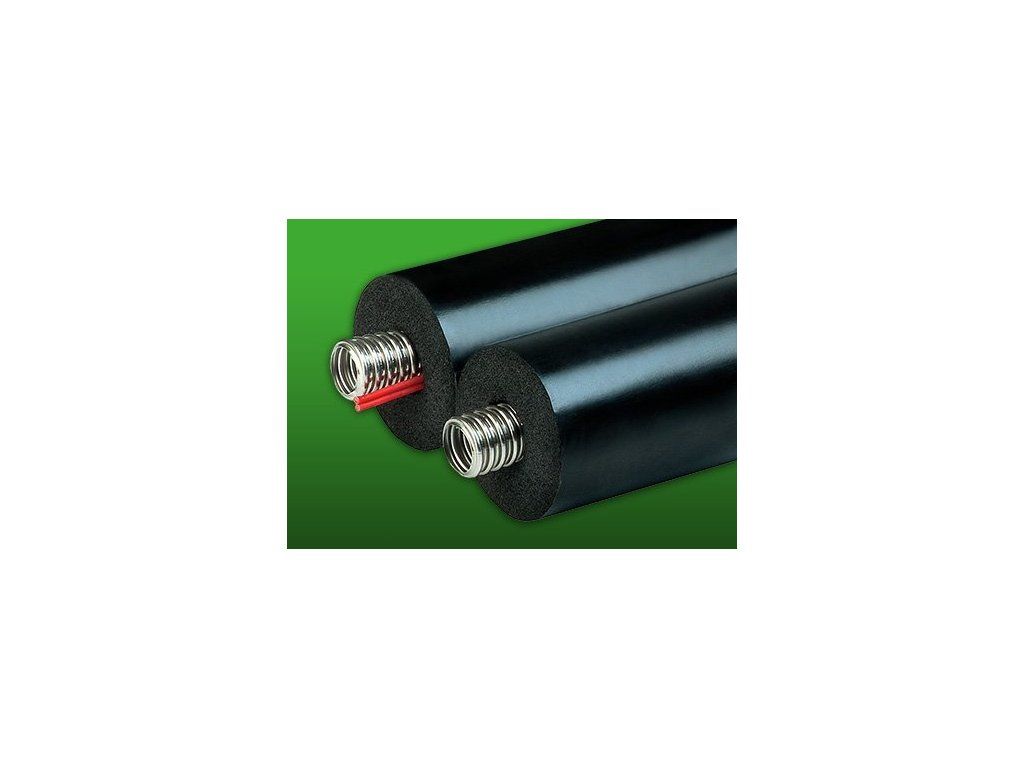
Solar 2-in-1 flexible tube, 10 m
Pre-insulated, flexible double pipe (flow and return in a single jacket) for fast installation of the run.
€308.75
The choice between classic pipe and a 2-in-1 flexi tube mainly depends on the length of the run, roof accessibility, and how much time the installation company has allocated for the job. A detailed comparison of both solutions is available in the article Solar piping and stainless steel bellows hoses – how they work.
Fixing collectors according to roof type
Collectors can't simply be placed on the roof – they need a specialized mounting structure that matches exactly the roof type and the dimensions of the specific collector. On a pitched roof, the structure differs by roofing material – tile, sheet metal, or plain tile each require a different fixing method so that the roofing isn't damaged during installation and the mount remains stable long-term, even under strong wind and snow loads.
On a flat roof, by contrast, a mounting structure with an adjustable tilt is used, usually at least 15 degrees. This minimum tilt isn't arbitrary – it ensures the collector can naturally self-clean with rainwater, which runs off the tilted collector surface and washes away dust and dirt. Without a sufficient tilt, grime could build up on the collector surface over time, reducing its output. Besides pitched and flat roofs, collectors can also be mounted on a facade or directly on the ground, if the layout of the plot and the orientation toward the sun allow it.
The key point is that the mounting structure must precisely match the dimensions of the specific collector type – it's not a universal part that fits anything, but a component designed for a precisely defined model and roof type.

Mounting set for collectors on a flat roof up to a 15° tilt, for collector KS 2100F 1.82m²
Mounting structure for fixing a flat-plate collector to a flat roof, adjustable tilt for rain self-cleaning.
€117.34
If you're dealing with installation on an unusual roof or aren't sure which structure suits your collector, an overview of the various solutions by roof type is available in the article Fixing collectors – pitched roof, flat roof, facade.
Prices of individual solar assembly components vary considerably depending on type and function.
Expansion vessel, filling, and pressure in the solar loop
The solar loop is a closed, pressurized system, meaning the heat-transfer fluid inside it circulates continuously without contact with the surrounding air. At the high temperatures the fluid reaches on the collector in summer, its volume expands – and it's precisely to compensate for this volumetric expansion that the solar loop has its own dedicated expansion vessel. Without it, the rising pressure in the system could damage the piping, the joints, or the collector itself.
The system is filled and vented using a manual or electric filling pump via filling valves, similar to a standard house heating loop. This filling isn't a one-off task done only at installation – during operation the loop may need to be topped up or vented again, for example after a service intervention or if an air pocket appears in the system that blocks proper fluid circulation.
Checking the pressure in the solar loop is one of the basic tasks a solar system owner should keep an eye on – which is exactly why the pump station is fitted with a pressure gauge, so the current pressure is always visible. More details on servicing, filling, and the most common faults in solar systems are available in the article Servicing, filling, and common faults in solar systems.
Solar heating throughout the year – summer, transitional seasons, winter
The benefit of a solar system varies significantly by season. In summer, when solar radiation is at its peak and the house isn't being heated at the same time, a solar assembly can take over a large share of domestic hot water heating – the boiler then fires up only rarely, if at all, because the cylinder is being sufficiently heated directly by the sun. This is the main and most realistic benefit of a solar boiler add-on, and it's what anyone considering the investment should primarily keep in mind.
In the transitional seasons, spring and autumn, solar radiation is lower and its intensity fluctuates with the weather – the solar system contributes to water heating only partially during these months, and the boiler still needs to top up regularly via the second exchanger in the solar cylinder. In winter, when sunshine is at its lowest and heat demand for space heating is at its highest, the main heat source – the boiler or heat pump – takes on almost the entire load of both water heating and space heating. The solar system therefore isn't, and isn't meant to be, designed as a replacement for the boiler, but as an add-on that saves the most precisely in the months when the boiler would otherwise run inefficiently just to cover a small hot-water draw.
The exact step-by-step procedure for installing such an assembly – from fixing the collectors, through routing the piping, to connecting the cylinder, pump station, and controller – is available in the article Installing a solar system – step by step.
Real-world examples
Family house with a south-facing pitched roof. A family of four in a detached house used only their existing condensing boiler with a cylinder heater for domestic hot water. In summer, despite zero heating demand, the boiler still kept firing up regularly just to top up water for showering and washing. During a roof renovation, the family decided to add flat-plate solar collectors, which, given the tiled pitched roof, were fixed using a mounting structure designed exactly for that roof type. The existing cylinder heater was replaced with a solar cylinder featuring two exchangers – one for the solar loop, the other for boiler top-up. Pump control was taken over by a solar controller that compares the collector and cylinder temperatures and switches on the circulation pump only when transferring heat makes sense. Since the roof renovation coincided with re-roofing, a pre-insulated 2-in-1 flexi tube was used for the run between the collectors and the plant room, allowing faster installation without needing additional insulation on the roof at height. As a result, during the summer months the boiler in this household practically stopped firing up for water heating – heat is delivered almost exclusively by the solar loop, with the boiler serving only as backup for overcast days.
Bungalow with a flat roof. The owner of a bungalow with a flat roof wanted to add solar DHW heating to an existing electric boiler. Since the roof was flat, a mounting structure with an adjustable tilt of at least 15° had to be chosen so the collector could naturally self-clean with rainwater and not become clogged with dust from the roof. The short run inside the plant room itself, where the piping connected to the pump station and cylinder, was solved using flexible stainless steel corrugated pipe (a bellows hose), which handles well the high temperatures the heat-transfer fluid can reach in summer under low draw-off. Control was taken over by a solar controller wired to sensors on both the collector and the cylinder. At first start-up, the loop had to be filled and vented using a filling pump via filling valves – a routine task that the installation company carried out directly at handover. The owner thus gained a supplementary water-heating source without any intervention in the existing electric boiler, which continues to serve as the main heat source outside the summer months.
Frequently asked questions about solar heating as a boiler add-on
Will a solar system completely replace my boiler?
No. A solar system supplements the main heat source – the boiler or heat pump – but doesn't fully replace it. It can cover the largest share of domestic hot water heating in the summer months, when there's plenty of solar radiation. In winter and during the heating season, the boiler continues to carry the main load.
Which collector type is better – flat-plate or vacuum?
Flat-plate collectors are cheaper and mechanically more durable, for example against hail, and are usually sufficient for everyday DHW heating in our climate. Vacuum (tube) collectors have higher efficiency at low temperatures and weaker solar radiation but are more expensive and more fragile. The choice depends on whether you mainly want cheap summer heating or output beyond the summer too.
What is a solar cylinder and why isn't a regular water heater enough?
A solar cylinder has, compared to a standard water heater, at least one additional heat exchanger connected to the solar loop, often even a second exchanger for boiler top-up. The water is heated indirectly – the solar fluid circulates separately in a closed loop and never comes into contact with the domestic water. A regular water heater has no such exchanger, so the solar loop can't simply be connected to it.
The controller automatically switches the pump on and off based on the temperature difference between the collector and the cylinder.
How does the controller know when to switch the pump on?The controller compares the temperature at the collector and in the cylinder using sensors. When the collector is warmer than the cylinder by the set difference, it switches on the solar pump station's circulation pump. When the difference narrows, the pump switches off so heat isn't transferred in the opposite direction.
What's the difference between classic pipe and a 2-in-1 flexi tube?
Classic copper or stainless steel pipe has to be insulated additionally on site after it's laid. A pre-insulated 2-in-1 flexi tube carries both the flow and return pipe in a single, already insulated flexible jacket, so nothing needs additional insulation either on the roof or in the shaft – installation is therefore faster.
How are collectors fixed to different roof types?
Collectors are fixed with a specialized mounting structure according to roof type: on a pitched roof according to the roofing material (tile, sheet metal, plain tile), on a flat roof using a structure with an adjustable tilt, usually at least 15° for rain self-cleaning, or alternatively on a facade or on the ground. The structure must precisely match the dimensions of the specific collector type.
Why does the solar loop need an expansion vessel?
The solar loop is a closed, pressurized system. At the high temperatures the heat-transfer fluid reaches, its volume expands, and the expansion vessel compensates for this volumetric expansion – without it, excess pressure could build up in the loop, potentially damaging the piping, joints, or collector.
How is the solar system filled and vented?
The solar loop is filled and vented with a manual or electric filling pump via filling valves, similar to the house's heating loop. This task is needed not only at first installation but occasionally later too, for example after a service intervention.
Do I need to service the solar system separately from the boiler?
The solar loop is a separate, closed system with its own pump station, which also includes pressure gauges for easy monitoring of the system's condition. Details on servicing, filling, and the most common faults are available in a separate article on the topic, linked below among related topics.
Related topics
- How to choose a solar water heating system
- Flat-plate vs. vacuum solar collectors
- What solar cylinder do I need
- Solar piping and stainless steel bellows hoses – how they work
- Controllers and pump stations for solar systems
- Fixing collectors – pitched roof, flat roof, facade
- Installing a solar system – step by step
- Servicing, filling, and common faults in solar systems
- Frequently asked questions about solar assemblies and collectors
Have a question about solar systems or collectors?
Not sure what to decide, or dealing with a specific situation in your home? Write to us – we're happy to help.