
Flat vs. Vacuum Solar Collectors
Solar energy is the only heat source you never pay a supplier for – all you need to do is capture it and transfer it into the water you actually use at home. That is exactly what a solar domestic hot water (DHW) system does: an assembly of roof-mounted collectors, a solar storage tank, a pump unit and control electronics that automatically evaluates and runs the whole process. The system supplements rather than fully replaces the main heat source – a boiler or heat pump – but especially in the summer months it can cover a large share of DHW heating without the main source switching on at all.
When designing such a system, sooner or later one key question comes up: flat or vacuum (tube) collectors? The answer affects not only the price of the whole investment, but also how the system behaves in winter, spring and autumn, how long it lasts without a fault, and whether it survives unpleasant weather such as hail. In this article we explain the difference between the two types in detail, look at the other components a collector has to work with (tank, controls, piping, mounting, expansion vessel), and finish with two real-world examples.
If you are dealing with a solar system for the first time, we recommend reading our general guide How to choose a solar water heating system alongside this article, where you will find a broader context for choosing the whole assembly. Here we focus mainly on the collectors themselves and what belongs with them.
What is a solar water heating system and what does it consist of
A solar water heating system, sometimes also called a hot-water solar assembly, is not a single device but a set of several components that have to work together:
- Solar collectors on the roof – capture solar radiation and use it to heat the heat-transfer fluid (a mix of water and antifreeze, so the circuit does not freeze even in winter).
- Solar storage tank with a heat exchanger – this is where heat from the heat-transfer fluid is passed to the domestic water that you then draw from the tap.
- Pump unit – ensures circulation of the heat-transfer fluid between the collector and the tank.
- Control (solar) unit – evaluates temperatures and decides when the pump should switch on and off.
It is important to stress one thing many customers get wrong right from the start: a solar system supplements the main heat source, it does not replace it. In practice this means that in summer, when there is plenty of sunshine and hot-water consumption is not extreme, the solar assembly can cover DHW heating almost on its own. In winter, when there is little sun and days are short, the balance automatically shifts back to the boiler or heat pump – the solar system simply "tops up" heat whenever it is available. This is exactly why solar is most often combined with an existing heat source rather than used as a standalone solution.
This combination of two heat sources (sun + boiler/heat pump) is also why it makes sense to invest in quality controls and a suitably chosen tank – you can read more about this in the article Solar heating as a supplement to a boiler.
Flat vs. vacuum collectors: the main difference
Comparison of the main differences between flat and vacuum collectors.
This is the core of the whole decision and deserves more space. There are essentially two types of solar water-heating collectors on the market – flat and vacuum (tube). Both do essentially the same thing (capture solar radiation and convert it into heat), but they differ significantly in construction and operation.
Flat collectors
Flat collectors have an absorber surface (a dark metal plate that absorbs solar radiation) covered with tempered glass, the whole assembly housed in an insulated aluminium frame. This construction has several practical advantages:
- Lower purchase price – flat collectors are generally cheaper than vacuum ones, not only per unit but also including mounting accessories.
- Higher mechanical resistance – tempered glass in a rigid frame better withstands, for example, hail, falling branches or mechanical stress during installation than the thinner glass tubes of a vacuum collector.
- Sufficient output for typical conditions – in our climate (i.e. in Slovakia) flat collectors are usually sufficient for reliable DHW heating, especially if the main goal is to cover summer and transitional periods.
Exactly this combination of lower price, higher durability and sufficient output is why flat collectors are the most common choice in Slovakia for an ordinary family household that primarily wants to save on DHW heating without needlessly complicated and expensive technology.
Vacuum (tube) collectors
Vacuum collectors work on a different principle – the absorber surface is enclosed in an evacuated glass tube that functions similarly to a thermos flask. The vacuum significantly limits heat loss back to the surroundings, which brings a different set of properties:
- Higher efficiency at low outdoor temperatures and lower solar radiation intensity – i.e. exactly when flat collectors struggle more (cold days, lower sun in the sky, overcast weather).
- Higher price – vacuum collectors are more expensive than flat ones, even for a comparable surface area.
- Greater fragility – the glass vacuum tubes are more sensitive to mechanical damage than the full tempered glass of a flat collector.
Vacuum collectors therefore make the most sense where output outside the summer months matters – for example if, besides DHW, the system is also meant to partly contribute to space heating, or if the location/roof orientation is less favourable in terms of solar radiation and you need to extract as much as possible from every ray.
Which type should you choose?
If your main goal is the simplest and most affordable way to cover hot-water heating mainly in summer and the transitional months, flat collectors are, in the vast majority of cases, the more sensible choice – lower price, higher durability and, in our conditions, sufficient output. Vacuum collectors are justified where you need to maximise yield even during periods of weaker solar radiation and are willing to pay a higher price and accept a more fragile construction.
If you still feel unsure at this stage of the decision, we recommend also reading our more general guide How to choose a solar water heating system, where this topic is placed in the broader context of choosing the whole assembly (not just the collector, but also the tank, controls and piping).
Control unit and pump group – how the system decides when to heat
The control unit decides on switching the circulation pump on and off based on the temperature difference.
Whichever type of collector you choose, on its own, without the rest of the system, it would be useless. This is where the control (solar) unit plays a key role. Using sensors, it continuously compares the temperature at the collector with the temperature in the tank. As soon as the collector is warmer than the tank by a pre-set temperature difference, the control unit switches on the circulation pump of the solar group – the heat-transfer fluid starts moving, carries heat from the collector to the tank, and the whole cycle repeats. When the temperature difference drops below the set threshold (for example in the evening, when the sun sets), the pump switches off automatically so it does not needlessly circulate cold fluid and cool the tank back down.

A solar controller (control unit) that compares the temperature at the collector and in the tank and automatically switches the solar group's circulation pump on according to the set temperature difference.
Price: €108.94
In practice, the pump itself is usually not on its own – it is supplied as part of a so-called pump unit (solar pump group). In one compact block this contains the circulation pump, shut-off valves, thermometers and pressure gauges for monitoring temperature and pressure in the circuit, and a safety valve. The advantage of this solution lies above all in installation and servicing – everything needed is in one place, so the installer does not have to source and connect individual components separately, and diagnostics are also easier in the event of maintenance or a fault.

A complete pump group (circulation pump, shut-off valves, pressure gauges, safety valve) for circulating solar fluid between the collector and the tank, in one compact block for easier installation and servicing.
Price: €750.55
For more detail on exactly how control units and pump groups work and what to look out for when choosing them, see the separate article Control units and pump groups of solar systems.
Solar storage tank – where heat from the sun meets water from the tap
At first glance a solar storage tank looks like a classic hot-water cylinder, but it has one important structural difference – compared to an ordinary cylinder it has at least one additional heat exchanger connected to the solar circuit. Very often it even has two exchangers: one for the solar circuit and a second for backup heating from the boiler when there is not enough solar energy.
The principle here is indirect – the heat-transfer fluid from the solar circuit never comes into direct contact with the domestic water. It circulates separately, in a closed circuit, and passes heat to the domestic water solely through the wall of the exchanger. This means the antifreeze mixture from the collectors never mixes with the water you draw from the tap or the shower – these are two completely separate circuits that only "meet" at the heat exchanger.
Choosing the right size and construction of the solar storage tank (for example whether it will have one or two exchangers) depends on the size of the household, hot-water consumption and how the system will be backed up. We cover this topic in detail in the article What solar storage tank do I need.
Piping: pipework and insulation between the collector and the utility room
Two common solutions for the run between the collector and the utility room.
Something has to connect the collector on the roof and the tank in the utility room – and this, at first glance inconspicuous, part of the system has a direct impact on how much heat is lost along the way and how long installation takes. In principle there are two common solutions:
Classic copper or stainless steel pipework
The traditional method is classic copper or stainless steel pipework, which is then insulated separately directly on site – i.e. on the roof, in the shaft and in the utility room. Stainless steel pipework in the form of a corrugated tube (a flexible pipe with a wavy surface) is prized in particular for its resistance to the high temperatures the solar fluid can reach in summer under full sun, and for its flexibility when passing around corners and through penetrations in the building structure.

Stainless steel corrugated pipe
A flexible stainless steel corrugated pipe for the run between the collector and the tank, resistant to the high temperatures of the solar fluid.
Price: €3.81
Pre-insulated 2-in-1 flexible pipe
The second option is a pre-insulated 2-in-1 flexible pipe, which combines the flow and return in a single flexible, already insulated jacket. The advantage of this solution lies mainly in installation speed – since the insulation is part of the pipe from the factory, the installation company does not need to insulate it additionally on the roof or in the shaft, which with the classic solution can take a noticeable amount of time (and therefore also labour cost).
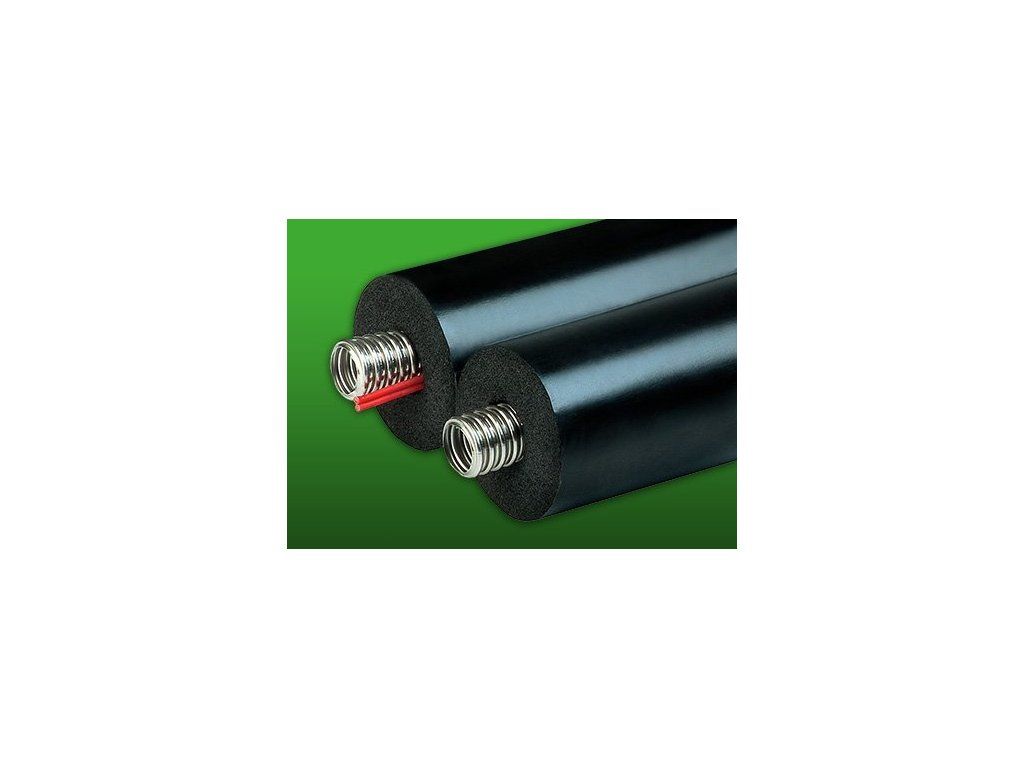
Solar 2-in-1 flexible pipe, 10 m
A pre-insulated, flexible dual pipe (flow and return in one jacket) for fast installation of the run between the collector and the utility room without the need for additional insulation on the roof or in the shaft.
Price: €308.75
Which solution to choose depends on the specific building situation (length of the run, number of penetrations, roof accessibility) and on the installation company's preferences. You can read more about both variants, including what the term "corrugated tube" means and why stainless steel is used specifically in solar technology, in the article Solar piping and stainless steel corrugated tubes – how they work.
Mounting collectors according to roof type
The collector on its own is only half the task – it also needs reliable mounting that will withstand decades of exposure to wind, rain, snow and temperature swings. The mounting structure is therefore always chosen according to the type of roof (or other mounting surface):
- Pitched roof – different types of roofing (tiles, sheet metal, plain tiles) require different anchoring elements, fixed directly into the rafter or batten beneath the roofing.
- Flat roof – here a structure with an adjustable tilt is used, usually at least 15°. This tilt is not random – it ensures the collector can naturally self-clean in the rain (on a completely flat surface, dirt, and possibly water, would instead collect).
- Facade or ground – an alternative solution where the roof is, for various reasons, unsuitable or inaccessible.
It is important that the mounting structure exactly matches the dimensions of the specific collector type and model – it is therefore not a universal part but a solution "tailored" to the given combination of collector and roof type.

Mounting set for collectors on a flat roof up to a 15° tilt, for the KS 2100F 1.82 m² collector
A mounting structure for fixing a flat collector on a flat roof, with adjustable tilt – it ensures the correct angle for the collector to self-clean in the rain.
Price: €117.34
This particular set is a good example of how closely mounting accessories and collector type are linked – it is designed specifically for the flat KS 2100F collector with a surface area of 1.82 m² and a flat roof with a tilt of up to 15°. If you are installing on a different roof type or a different collector model, you will need a different structure. A detailed overview of mounting options for all roof types can be found in the article Mounting collectors – pitched roof, flat roof, facade.
Expansion vessel, pressure and filling the solar circuit
The solar circuit is a closed, pressurised system – meaning that the heat-transfer fluid circulates within it in a closed loop under pressure, similar to a classic heating circuit. Since the fluid heats up to high temperatures during hot summer days, its volume increases due to thermal expansion. To prevent this expansion from damaging the pipework or components, the circuit includes an expansion vessel (expansomat), which can safely accommodate this increase in volume.
Filling and venting the solar circuit takes place through filling valves using a manual or electric filling pump – the principle is very similar to filling an ordinary heating circuit. This step is important mainly because air bubbles in the circuit would hinder proper circulation of the heat-transfer fluid and reduce the efficiency of heat transfer between the collector and the tank.
Servicing and regular checks of the pressure in the circuit, and topping up or replacing the heat-transfer fluid where necessary, are among the routine maintenance tasks of a solar system. You can read about everything solar system servicing involves and the most common faults in the article Servicing, filling and common faults of solar systems.
How to decide: summary for flat and vacuum collectors
If we were to sum up the whole decision in a few sentences: flat collectors are a reliable, affordable and mechanically durable choice that, in our climate, is usually sufficient for heating domestic hot water – especially if the main goal is to cover summer and transitional periods and thereby supplement the main heat source. Vacuum collectors have their place where higher efficiency is needed even at lower temperatures and weaker solar radiation, at the cost of a higher purchase price and a more fragile construction.
Regardless of which type of collector you choose, the resulting comfort and lifespan of the system depend equally on the quality of the other components – the solar storage tank, the control unit, the pump group, the piping and the mounting structure. That is exactly why we recommend always looking at a solar system as a whole, not just as the choice of a single component. If you are planning a DIY installation, or simply want to know what to expect, also check out our guide Installing a solar system – step-by-step procedure.
Real-world examples
Approximate prices of selected components mentioned in the article.
Example 1: A family house with a gable roof and a gas boiler
A family of four in a house with a pitched (gable) roof covered with tiles heats with a gas boiler, and the same boiler used to heat their domestic hot water year-round. The owners decided to supplement water heating with a solar system in order to reduce gas consumption, especially in the summer months, when the boiler runs practically only for water heating rather than for space heating.
Given the gable roof with a standard pitch, the choice of mounting structure was straightforward – anchoring elements designed specifically for tile roofing, fixed into the rafters beneath the roof. When choosing the collector type, the family opted for flat collectors – the main reason was the lower price and the fact that the primary goal was to cover exactly the summer months, when flat collectors are usually sufficient. The assembly was completed with a solar storage tank with two heat exchangers (one for the solar circuit, the other for backup heating from the existing gas boiler), a pump unit, and a control unit that compares the temperature of the collector and the tank and switches circulation accordingly. The run between the roof-mounted collectors and the utility room in the basement was handled with classic stainless steel pipework in the form of a corrugated tube, since the route ran through an existing installation shaft where additional on-site insulation could be done quickly.
Example 2: A bungalow with a flat roof, new build, transitional period
For a new-build bungalow with a flat roof, the owners approached the question of collector mounting differently than in the previous example – a flat roof requires a mounting structure with an adjustable tilt (in this case set to 15°, so that the collector could naturally self-clean in the rain and neither water nor dirt would collect on it). Since the investor planned to use the house year-round, including the cooler transitional months (spring, autumn), and wanted to get as much as possible out of the investment even outside the hottest summer weeks, after weighing both options they chose vacuum collectors – i.e. the option with a higher purchase price but better performance precisely at lower outdoor temperatures and weaker solar radiation.
For the run between the roof and the utility room, the investor chose a pre-insulated 2-in-1 flexible pipe – the main argument was installation speed during construction, when the route through the ceiling and wall was only accessible for a short window before insulation and finishing work. Because the pipe is insulated from the factory, the installation company avoided additional on-site insulation and completed the installation within the planned schedule.
Frequently asked questions (FAQ)
What is the main difference between a flat and a vacuum collector?
Flat collectors have an absorber surface covered with tempered glass in an insulated frame – they are cheaper and mechanically more durable, for example against hail. Vacuum (tube) collectors have higher efficiency at low outdoor temperatures and lower solar radiation intensity, but are more expensive and more fragile.
Which type of collector is more suitable for an ordinary family house in Slovakia?
For ordinary domestic hot water heating in our climate, flat collectors are usually sufficient – they combine a lower price and higher mechanical durability with adequate output. Vacuum collectors make more sense where output outside the summer months also matters.
Can a solar system completely replace a boiler or heat pump?
No. A solar system supplements the main heat source; it does not fully replace it. It covers the most domestic hot water heating in summer, while in winter and at lower solar radiation intensity, the boiler or heat pump remains the main heat source.
Can flat collectors withstand hail?
Thanks to their construction with tempered glass in an insulated frame, flat collectors are mechanically more resistant, for example specifically to hail, compared with vacuum collectors, whose glass tubes are more fragile.
Why doesn't the solar fluid come into contact with the water we drink or shower with?
Because the water in the solar tank is heated indirectly, via a heat exchanger. The heat-transfer (solar) fluid circulates separately, in a closed circuit, and never mixes with the domestic water.
Why doesn't the pump in a solar assembly run constantly, only when the sun shines?
Because the control (solar) unit continuously compares, using sensors, the temperature at the collector and in the tank. The circulation pump of the solar group only switches on once the collector is warmer than the tank by a pre-set temperature difference – otherwise the pump could actually needlessly cool the tank down.
What is the difference between classic pipework and a 2-in-1 flexible pipe?
Classic copper or stainless steel pipework (for example in the form of a corrugated tube) is insulated additionally, directly on site. A pre-insulated 2-in-1 flexible pipe combines the flow and return in a single flexible, already insulated jacket, which shortens installation time since it does not need to be insulated additionally on the roof or in the shaft.
Why do flat-roof mounting structures have an adjustable tilt of 15° or more?
A collector mounted on a flat roof needs at least a minimal tilt (usually 15° or more) so it can naturally self-clean in the rain – on a completely flat surface, dirt and water would instead collect.
What is an expansomat and why does the solar circuit need it?
An expansomat is an expansion vessel that is part of the closed, pressurised solar circuit. It compensates for the volumetric expansion of the heat-transfer fluid at the high temperatures the collector reaches, especially during sunny summer days.
Related topics
- How to choose a solar water heating system
- What solar storage tank do I need
- Solar piping and stainless steel corrugated tubes – how they work
- Control units and pump groups of solar systems
- Mounting collectors – pitched roof, flat roof, facade
- Solar heating as a supplement to a boiler
- Installing a solar system – step-by-step procedure
- Servicing, filling and common faults of solar systems
- Frequently asked questions about solar assemblies and collectors
Have a question about solar systems or collectors?
Not sure what to decide, or dealing with a specific situation in your home? Write to us – we're happy to help.