
Service, Filling and Common Faults of Solar Systems
A well-installed solar water heating system is one of those devices that usually needs very little attention afterwards - the collectors on the roof have no moving parts that could wear out quickly, and the basic principle (the sun heats a liquid, which then transfers heat in a heat exchanger) is simple and reliable. Even so, it is a closed pressurised circuit with a pump, control electronics, valves and dozens of metres of piping exposed to extreme temperature swings - from winter frost to the high temperatures of stagnating liquid in summer, when the tank is full and the collector has "nowhere to go" to release excess heat. These are exactly the places where the most common faults occur.
This article is a practical guide to servicing, filling and troubleshooting a solar water heating system - from regular checks, through topping up and bleeding the circuit, to the typical symptoms that let you recognise something is wrong before it shows up on your energy bill or in the water temperature at the tap. We'll explain what you can check yourself, and when it makes sense to call in a service technician.
We should also mention that in the vast majority of Slovak households a solar system is a supplementary heat source - it covers most of the domestic hot water heating in the summer months, while the main source (a boiler or heat pump) takes over the extra heating in transitional periods and in winter. That's precisely why minor faults sometimes show up late - as long as there's enough sunshine and the system works at least partially, the owner may not notice the failure of a single component. Regular checks are therefore worthwhile even when, on the surface, "nothing seems to be happening".
How a solar system is built and why that affects servicing
The solar fluid transfers heat from the collector to the tank via a circulation pump.
For the following sections to make sense, let's briefly recap what a hot-water solar setup consists of. Solar collectors on the roof heat a heat-transfer liquid - a mix of water and antifreeze that, thanks to the additive, doesn't freeze even at low winter temperatures. This liquid circulates in a closed loop to a solar tank with a heat exchanger, where it transfers heat to the domestic hot water, and back to the collector. Circulation is provided by a pump unit, switched on by a control unit based on the temperature difference between the collector and the tank. The system supplements, but doesn't fully replace, the main heat source - in practice this means that even if one part fails, the house won't be left without hot water, because the boiler or heat pump makes up the rest.
From a servicing point of view, this structure has one important feature - it's a chain of several components (collector, piping, pump unit, control unit, tank, expansion vessel), and a fault in any one of them shows up the same way on the outside - insufficient water heating. That's why it's worth knowing at least the basic symptoms for each component, so you can narrow down the problem before the technician arrives.
Filling and bleeding the solar circuit
The solar circuit is a closed, pressurised system with its own expansion vessel, which compensates for the volumetric expansion of the heat-transfer liquid at high temperatures - when the liquid in the collector heats up strongly in summer, it needs somewhere to "expand" to, otherwise the pressure in the circuit would rise dangerously. It's filled and bled using a manual or electric filling pump via the filling and drain valves, similar to a classic heating circuit in a house.
This is precisely the most common reason a solar system stops heating water efficiently even though it looks fine on the outside - air trapped in the piping or the collector. An air bubble blocks the smooth flow of the liquid; the pump still runs, but heat isn't transferred as it should be. This typically shows up as uneven heating (on a bright sunny day the water is only lukewarm), a noisier-running pump (gurgling, bubbling in the pipes), or fluctuating pressure on the pump unit's pressure gauge. The solution is to bleed the circuit and, if necessary, top up the liquid to the correct pressure - which is exactly what the filling pump connected to the pump unit's filling valves is for.

Solar pump unit ZP2-12 ECO
A complete pump group (circulation pump, shut-off valves, pressure gauges, safety valve) for circulating solar liquid between the collector and the tank - including the filling valves needed to fill and bleed the circuit.
Price: €750.55
Bleeding and topping up the liquid isn't a one-shot job - air sometimes escapes gradually from a branched pipe network, so it's worth checking the pressure and operation of the system again after a few days. If the pressure in the circuit keeps dropping repeatedly (you have to top up the liquid more often than once in a long while), it almost always signals a leak somewhere in the system, not normal operational loss - in that case you need to find the leak, not just keep topping up the liquid indefinitely.
Control unit and circulation pump - most common faults
The control (solar) unit compares the temperature at the collector and in the tank using sensors - when the collector is warmer than the tank by a set difference, it switches on the solar group's circulation pump. It's essentially the brain of the whole system, and most "mysterious" solar heating faults can be traced back here - either to the unit itself, or to its sensors and their wiring.
Typical symptoms of a control unit or sensor fault:
- The pump doesn't run at all, even though it's sunny and the collector is clearly warm to the touch (checked in the plant room, not on the roof) - the problem may be in the collector sensor, its wiring, or the unit itself.
- The pump runs continuously even when the sun isn't shining or the tank has long been fully heated - most often a misread or damaged temperature difference between the sensors, or an incorrectly set switching difference on the unit.
- The unit's display shows no temperatures, or shows obviously nonsensical values (for example extremely high or negative numbers outside the realistic range) - a typical sign of a disconnected or damaged sensor.
- The pump starts and immediately switches off again at short intervals (so-called "cycling") - often related either to air in the circuit, or to a switching difference on the unit that's set too sensitively.
When troubleshooting, it makes sense to start with the simplest checks - whether the unit is powered, and whether the sensor connectors are firmly seated and not corroded - and only then consider replacing the sensor or the unit. Since control units and pump groups are a relatively affordable component, on an older system it's often worth simply replacing the unit with a new one rather than spending a long time hunting for a minor fault in decades-old electronics.

Euroster 813 Solar
A solar controller/control unit that switches the circulation pump based on the temperature difference between the collector and the tank - a suitable replacement in case of a fault or an outdated original unit.
Price: €108.94
The pump itself, inside the pump unit, is a mechanical part, so over the years it may show signs of wear - noisier running, vibrations, or conversely a complete stop despite a correct signal from the control unit. Since the pump unit contains the pump, shut-off valves, thermometers, pressure gauges and a safety valve all in one compact block, servicing and any replacement are simplified as a result - there's no need to take apart the whole circuit component by component; you simply disconnect and replace the entire block.
Heat-transfer liquid leaks, damaged piping and insulation
The pipework between the collector and the plant room runs either through classic copper or stainless-steel piping, or through pre-insulated 2-in-1 flexible tubing, where the flow and return lines are combined with insulation in a single flexible sheath. Both solutions have their own typical faults, which show up on the outside in similar ways - a drop in circuit pressure, damp stains around joints, or (where the pipe passes through the roof or facade) leaking.
The most common locations for heat-transfer liquid leaks:
- Screwed or pressed pipe joints, especially where the pipe passes through the roof structure or a shaft - repeated thermal expansion and contraction can loosen even a joint that was originally properly tightened.
- A flexible corrugated pipe at a point where it's repeatedly stressed by bending (for example right at the collector inlet) - stainless-steel corrugated pipe is resistant to the high temperatures of solar liquid, but mechanical folding at a sharp angle can over time lead to a micro-crack.
- The pump unit's safety valve, which, if the pressure is too high (for example due to a damaged expansion vessel), starts continuously releasing a small amount of liquid - this shows up as a slow, repeated pressure drop without a visible wet stain on the pipe.
- Damaged pipe insulation on the roof or in an unheated space - on its own it doesn't cause a leak, but it increases heat losses and in freezing weather can, in extreme cases, contribute to freezing of an insufficiently protected part of the circuit.
If you suspect a leak, the first step is a visual check of all accessible joints and the pump unit itself (pressure gauge, safety valve) - a damp stain, a dried trace of evaporated liquid, or a drop in pressure on the gauge are reliable indicators. The average owner can only check the collector and the roof pipework visually from the ground or from an attic window, not by climbing directly onto the roof - that's already a job for a service technician with the right equipment.

Stainless-steel piping, corrugated pipe
Flexible stainless-steel piping (corrugated pipe) for the run between the collector and the tank, resistant to the high temperatures of solar liquid - a suitable replacement when servicing a damaged section.
Price: €3.81
If an entire section of pipework is being dealt with at once during a service call (for example during a roof renovation or when relocating the plant room), it's also worth considering pre-insulated 2-in-1 flexible tubing instead of classic piping - since it combines the flow and return lines together with insulation in a single flexible sheath, it shortens installation time because there's no need for additional insulation on the roof or in a shaft. This is an advantage especially for service work carried out within a limited time window (for example between two storms or over a weekend).
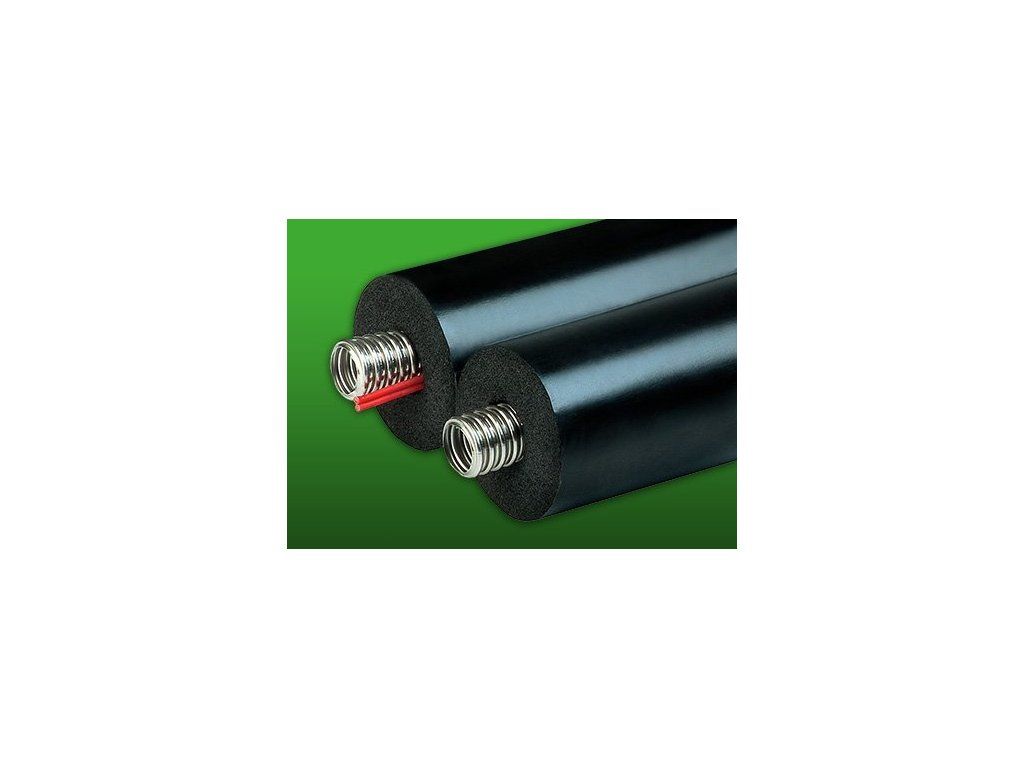
Solar flexible 2-in-1 tubing, 10 m
Pre-insulated, flexible dual piping (flow and return in a single sheath) for quick service replacement of the run between the collector and the plant room, without the need for additional on-site insulation.
Price: €308.75
You can find more about both pipework solutions, including when each one is worth choosing, in the article Solar Piping and Stainless-Steel Corrugated Pipes - How They Work.
Checking collector mounting and mechanical damage
Collectors are anchored using a specialised mounting structure depending on the roof type - a pitched roof with various coverings (tiles, sheet metal, plain tiles), a flat roof with an adjustable tilt (usually at least 15° for self-cleaning by rain), or a facade or ground mount. This structure must exactly match the dimensions of the specific collector type - which is precisely why, when servicing, it's important to know what type of collector and what mounting structure a given system has, before ordering a replacement part.
When inspecting after a storm, take into account which type of collector you have.
In terms of mechanical damage, the difference between collector types matters. Flat-plate collectors have an absorber surface covered by tempered glass in an insulated frame - they're mechanically more resistant, for example to hail, and in most cases are sufficient for heating domestic hot water in our climate. Vacuum-tube collectors have higher efficiency especially at low outdoor temperatures and lower solar radiation intensity, but they're more expensive and more fragile - the individual glass tubes are more sensitive to mechanical impact. After a storm or hailstorm, it's therefore worth visually inspecting the collector (cracks, fogged or damaged glass/tubes) as well as the condition and tightness of the mounting structure itself.
A loose or corroded mounting structure may not show up immediately - the collector can stay in a slightly shifted position for a long time, until the situation worsens in a stronger wind or another freeze-thaw cycle. It's therefore recommended, at every major service inspection (for example after winter or after a severe storm), to also check the visible anchoring elements, not just the collector and pipework themselves.

Mounting kit for collectors on a flat roof up to 15° tilt, for collector KS 2100F 1.82 m²
A mounting structure for attaching a flat-plate collector to a flat roof, adjustable tilt - also suitable as a replacement when servicing a corroded or damaged original structure.
Price: €117.34
Comparison of indicative prices for the spare parts mentioned in this article.
A detailed overview of mounting options by roof type can be found in the article Mounting Collectors - Pitched Roof, Flat Roof, Facade. When choosing a replacement structure, it's essential to know the exact type and dimensions of the original collector, since the structure is made to measure for a specific model.
Solar tank - heat exchanger maintenance and common problems
Compared to a regular boiler, a solar tank has at least one additional heat exchanger connected to the solar circuit, and often a second exchanger for backup heating by the boiler. The water inside is heated indirectly - the solar liquid circulates separately in a closed loop and doesn't come into direct contact with the domestic hot water. This design with multiple exchangers has one important feature from a servicing point of view - if the tank isn't heating enough, the problem might not be in the solar part at all, but for example in the fact that only one of the exchangers is active.
Typical symptoms of a problem directly at the tank:
- Water heats up more slowly than usual, even though it's sunny and the pump is confirmed to be running - a possible sign of scale on the exchanger side, impairing heat transfer from the liquid to the water.
- The tank is unevenly heated - warm at the top, cold at the bottom - which may be related to the position of the solar exchanger or insufficient circulation.
- Increased noise during heating (cracking, bubbling directly inside the tank) - often related to scale, similar to a classic boiler.
Since the exchanger is part of the tank and isn't normally accessible for simple home cleaning, checking and removing any scale is a task for a service technician. When choosing or replacing a tank, we also recommend reading the separate article What Solar Tank Do I Need, which explains how the different tank types differ in the number of exchangers and how they're connected to the main heat source.
How often to service a solar system, and what you can check yourself
Simple checks you can do yourself; work on the roof or dismantling the tank is a job for a technician.
A solar system doesn't need servicing as often as, say, a gas boiler, but regular visual and functional checks pay off - ideally in spring (before the summer season, when solar heating covers the largest share of hot water consumption) and in autumn (before the onset of frost). Tasks that most owners can carry out themselves without special tools include:
- Checking the pressure in the solar circuit on the pump unit's gauge and comparing it with the value from the previous check - a significant drop indicates a leak.
- A visual check of accessible pipe joints, the pump unit and its safety valve - looking for damp stains or traces of dried liquid.
- Checking the control unit's display - whether it shows realistic temperatures at the collector and tank, and whether the pump behaves logically (running when it's sunny and the tank isn't yet fully heated, not running when the sun isn't shining).
- A visual check of the collector from the ground or an attic window - cracks, fogged glass, a visibly loose or corroded mounting structure.
Tasks that require a service technician are primarily topping up and bleeding the solar liquid via the filling valves (requires a filling pump and knowledge of the correct procedure), any work directly on the roof (close inspection of the collector, its mounting or connections), replacing sensors or the control unit, and checking/cleaning the exchanger in the solar tank.
When to call a service technician and when you can manage yourself
A simple rule worth remembering - if the problem relates purely to what's visible and accessible in the plant room (for example the pressure gauge, the control unit's display, visible joints near the pump unit), it can usually be checked and diagnosed yourself first. As soon as work on the roof, direct draining and topping up of the liquid, or dismantling the tank is required, it's already a job for a service technician - partly for safety reasons (working at height, hot liquid under pressure), and partly because an incorrectly performed intervention (for example an improperly bled circuit or an incorrectly tightened joint) can cause more damage than the original fault.
When booking a service call, it's useful to prepare as much information as possible in advance - the type and approximate age of the system, the collector type (flat-plate or vacuum-tube), the readings on the pressure gauge and control unit display, and a description of exactly how the problem shows up (for example "the water is lukewarm even on sunny days" or "you can hear the pump running continuously"). This shortens diagnosis time, and the technician can prepare any replacement parts in advance.
Real-world examples
A family house with flat-plate collectors on a pitched roof, system about ten years old. The owner noticed that even on bright summer days the water in the bathroom was only lukewarm, whereas previously it had been noticeably warmer at the same time of year. When checking the plant room, he found that the pressure on the pump unit's gauge was noticeably lower than he remembered from previous years, and that the pump was making quieter bubbling sounds while running that he hadn't heard before. After calling in a service technician, it was confirmed that there was air in the circuit and the level of heat-transfer liquid had also slightly dropped - the cause was a slowly seeping joint where the pipe passed through the roof, which had loosened slightly over the years due to repeated thermal stress. The joint was tightened, the circuit was topped up and bled via the pump unit's filling valves, and the system returned to its original performance.
An apartment in a block of flats with a shared (building-wide) solar system for multiple units, vacuum-tube collectors on the flat roof of the building. The building manager noticed that hot water heating was uneven - noticeably worse on some days than others, even though the weather hadn't changed significantly. After checking the control unit, it turned out that the display was occasionally showing an implausibly high temperature on one of the sensors, causing the unit to misjudge the temperature difference between the collector and the tank, so the pump switched on and off irregularly (cycling). The cause was a corroded cable terminal on the collector sensor, exposed to moisture where it passed through the roof structure. After replacing the damaged section of cabling and verifying the sensor was working properly, the control unit again behaved predictably and the heating became consistent.
Frequently asked questions about servicing, filling and faults in solar systems
How do I know if the solar circuit is low on liquid or has air in it?
A typical symptom is fluctuating or lower pressure on the pump unit's gauge, a bubbling or gurgling sound while the pump runs, and uneven or weaker water heating even on sunny days. In that case the circuit needs to be topped up and bled via the filling valves.
Can I top up and bleed the solar circuit myself?
It's a closed pressurised system, and the job requires a filling pump (manual or electric) and knowledge of the correct procedure via the pump unit's filling valves. If you have no experience with this kind of work, we recommend leaving it to a service technician - an incorrectly performed top-up can cause further problems.
Why does my pump start and immediately switch off again (cycling)?
Most often it's either air in the circuit (needs bleeding), or a switching difference on the control unit - which compares the temperature of the collector and the tank - that's set too sensitively. Both should be checked.
What does it mean if the pump runs continuously even when the sun isn't shining?
It's usually a fault in a sensor or its wiring, or the control unit misjudging the temperature difference. The solution is to check, and if necessary replace, the sensor or the unit itself.
What's the difference between a flat-plate and a vacuum-tube collector in terms of servicing and durability?
Flat-plate collectors have an absorber surface covered by tempered glass in an insulated frame; they're mechanically more resistant, for example to hail, and are usually sufficient for heating DHW in our conditions. Vacuum-tube collectors have higher efficiency at low temperatures and weaker radiation, but they're more expensive and more fragile - the individual tubes are more sensitive to mechanical damage.
How often should a solar system be checked?
It's recommended at least twice a year - in spring before the summer season and in autumn before the onset of frost - to check the circuit pressure, visible joints, the control unit display, and the condition of the collector, at least visually from the ground.
Why is the tank heating water more slowly than before, even though the pump works?
The cause may be scale on the heat exchanger side inside the solar tank, which impairs heat transfer from the liquid to the water. Checking and, if needed, cleaning the exchanger is a task for a service technician.
Can a damaged section of piping or corrugated pipe be easily replaced?
Yes, a damaged section of stainless-steel piping (corrugated pipe) or classic piping can be replaced with a new one without having to replace the entire run. During a larger service job, for example a roof renovation, it can sometimes be worth switching straight to pre-insulated 2-in-1 flexible tubing, which shortens installation time.
How do I find out whether the problem is in the control unit or in the pump itself?
If the control unit's display shows logical temperatures and it's telling the pump to run, but the pump still doesn't run (or runs unusually loudly or with weak flow), the problem is probably in the pump itself. If, on the other hand, the temperatures on the display look nonsensical, or the pump runs even when logically it shouldn't, the problem is more likely in the unit or the sensors.
Related topics
- How to Choose a Solar Water Heating System
- Flat-plate vs. Vacuum-tube Solar Collectors
- What Solar Tank Do I Need
- Solar Piping and Stainless-Steel Corrugated Pipes - How They Work
- Control Units and Pump Groups for Solar Systems
- Mounting Collectors - Pitched Roof, Flat Roof, Facade
- Solar Heating as a Supplement to the Boiler
- Installing a Solar System - Step by Step
- Frequently Asked Questions About Solar Systems and Collectors
Do You Have a Question About Solar Systems or Collectors?
Can't decide, or dealing with a specific situation in your home? Write to us - we'll be happy to help.