
How to Choose Pipework for Water and Heating
Pipes are one of those parts of a home installation that nobody notices – as long as they work. They carry hot and cold water from the source (boiler, heat pump, water meter) to individual outlets: radiators, bathroom fittings, the kitchen sink, and underfloor heating circuits. Precisely because it is a hidden, "taken for granted" part of the house, its selection often gets less attention than, say, choosing a boiler or radiators – and that is exactly why mistakes get made that only show up years later, when repairs are far more expensive and complicated than the original installation would have been.
The choice of material, diameter, routing method, and jointing method for the pipework affects several things at once – the lifespan of the whole system, pressure losses and noise as water flows, how easy future servicing will be, and the overall cost of the installation. Decisions made at this stage are also almost always cast into the wall, floor, or screed, so any later change means demolition – which is exactly the kind of mistake worth avoiding by choosing correctly from the start.
In this article we will go step by step through everything important you need to know before choosing pipes for water and heating – the differences between materials (PEX-AL-PEX, copper, steel), how to choose the right diameter, the difference between concealed and surface-mounted routing, why an oxygen barrier matters for heating pipes, the various jointing methods, and finally when and how to insulate the pipework. If you want to go deeper into the specific choice of material, we also recommend the separate article PEX-AL-PEX vs. copper vs. steel pipe, which compares the individual materials in more detail.
What is water and heating pipework, and why does the choice matter
Pipework for water and heating distributes hot or cold water between the source (boiler, water meter) and individual outlets – radiators, fittings, underfloor heating. It is, in essence, the circulatory system of the house: all the hot water you draw from a tap, and all the water that heats your radiators or floor, passes through this exact pipework. If it is undersized, poorly chosen, or incorrectly installed, it shows up throughout the whole house – not locally, but everywhere.
The choice of pipe material and diameter directly affects three things at once. The first is the lifespan of the system – an incorrectly chosen material (for example steel pipe without water treatment) can corrode from the inside within just a few years, while properly chosen plastic-aluminium or copper pipe will last for decades without issues. The second is pressure loss – pipe that is too narrow creates resistance to flowing water, which shows up as lower flow when several outlets are open at once, and sometimes as audible noise in the walls. The third is installation cost – not just the cost of the material itself, but also the time and tools needed to work with it, which varies significantly between materials and jointing methods.
That is exactly why it pays to give pipe selection the same attention as choosing a boiler or radiators – it is an investment for decades that, unlike a boiler, cannot easily be replaced later without work on the building structure. If you are planning a renovation or new build, it makes sense to go through all of the following criteria one by one – material, diameter, routing method, oxygen barrier, jointing method, and insulation – before the pipe gets cast into a wall or screed.
The three main pipe materials differ in price, installation, and lifespan.
PEX-AL-PEX, copper, or steel pipe – which material to choose
On the market today you will commonly find three main types of material for water and heating distribution – multilayer plastic-aluminium PEX-AL-PEX pipe, copper pipe, and steel pipe. Each has its place and advantages, but in practice PEX-AL-PEX is used most often today, and for good reason.
PEX-AL-PEX (multilayer plastic-aluminium pipe) combines an inner and outer plastic layer with a middle aluminium layer. The aluminium layer performs two important functions at once – it prevents oxygen diffusion into the water, which is especially critical in closed heating circuits (more on this below in the section on the oxygen barrier), and it also gives the pipe so-called shape memory. Thanks to this, once bent into the required shape – for example around a room corner or through a partition – the pipe stays in that shape without needing further fixing or any risk of it straightening back out on its own. This significantly simplifies installation, especially on more complex routing paths.
Copper pipe is a traditional, long-proven material. It is very resistant to temperature and pressure, which makes it a reliable choice even in more demanding operating conditions. Its downside is a higher price compared to plastic-aluminium pipe and more demanding installation – copper joints are usually soldered, which requires skill and an open flame, meaning either an experienced tradesperson or an investment in training and tools. In renovations where pipework runs through tight spaces or near flammable materials, working with an open flame also needs to be carefully secured.
Steel pipe is used today only in exceptional cases – typically in older installations that are not being replaced, or in specific industrial applications. Its main disadvantage is susceptibility to corrosion from the inside if the water in the system is not properly treated. In a typical renovation or new build of a house or apartment, you practically won't encounter new steel pipe being installed today – if you do come across steel pipework, it is usually an original, older installation that should be replaced with a more modern material during renovation.
For a typical renovation of an apartment or house, where you want to combine simple installation, a reasonable price, and reliable long-term function, plastic-aluminium PEX-AL-PEX pipe is therefore, in the vast majority of cases, the most practical choice:

PEX-AL-PEX pipe 16 x 2 for heating, underfloor heating and water
Price: €0.66/m
Multilayer plastic-aluminium pipe with an oxygen barrier, 16 mm diameter – universal use for water and heating distribution.
A detailed comparison of all three materials, including specific situations where each one is worth choosing, can be found in the article PEX-AL-PEX vs. copper vs. steel pipe.
What pipe diameter do you need
Choosing the material is only the first half of the decision – the second, equally important part, is the correct pipe diameter. The diameter is chosen based on two main criteria: the required water flow and the length of the run. So it is not a single universal figure for the whole house, but a value that can (and generally should) vary within a single installation depending on the role that particular section of pipework plays.
For underfloor heating and individual circuits, a diameter of 16 mm is commonly used – this diameter is sufficient for individual loops running from the manifold to a specific room or zone, where both flow and run length are limited. For main riser distribution, meaning where flow from several circuits combines or where the run is longer and has to carry higher flow (for example from the boiler room to the manifold, or the main hot water riser in an apartment), a diameter of 20 to 26 mm or more is used.
Why does this matter at all? Pipe that is too narrow creates increased resistance to flowing water. In practice this shows up in two ways – high pressure losses, meaning the flow at the end of a long, narrow run will be weaker than expected, and noise from flowing water, which is unpleasant in living spaces, especially at night or when several outlets are open at once. Conversely, unnecessarily wide pipe where a smaller diameter would suffice needlessly increases the cost of the installation (wider pipe and fittings are more expensive) and also slows down the arrival of hot water – wider pipe simply holds more cold water, which has to be "pushed out" before hot water reaches the outlet.
The golden rule, then, is: choose a smaller diameter (16 mm) for individual circuits and shorter runs, and a larger diameter (20–26 mm or more) for main, longer runs with higher combined flow. For main distribution runs with higher flow, a larger-diameter pipe is a good example:

PEX-AL-PEX pipe 26 x 3 for heating, underfloor heating and water
Price: €1.62/m
Larger 26 mm diameter – suitable for main riser distribution with higher flow, where 16 mm pipe is no longer sufficient.
Wider pipe for main distribution costs more per metre than pipe for individual circuits.
If you are not sure which diameter you need in your particular situation, a more detailed guide to calculating it, along with specific recommendations by type of run, can be found in the article What pipe diameter do I need.
Concealed vs. surface-mounted routing – which to choose
Another important decision is how the pipework is routed – that is, whether it is hidden inside the wall or floor (concealed) or visible on the surface (surface-mounted). This decision is usually made separately for each space in the house, since living rooms have different priorities than technical rooms.
Concealed routing means pipework embedded in the wall or floor, under plaster or screed. Its main advantage is aesthetics – in the finished room no pipework is visible at all, the walls are clean and flat, exactly as in a new building without any visible distribution. However, this advantage has a flip side: in the event of a fault, meaning a leak or water loss, repairing concealed routing requires breaking open the wall or floor just to reach the damaged spot. For this reason it is especially worth investing in quality materials and joints at the installation stage for concealed routing – this is exactly where any savings on materials can come back to bite you later with disproportionately high repair costs.
Surface-mounted routing, by contrast, is visible, run along the surface of the wall – most often in protective trunking, or sometimes completely exposed. Its main advantage is simpler installation and easier repair: if a leak appears or the pipe needs to be extended or adjusted, you just open the trunking or simply reach the pipe without any demolition. The downside is lower aesthetic value, which is why surface-mounted routing is mainly used in technical spaces such as the boiler room, cellar, or garage, where appearance is not a priority and easy access for servicing is valued instead.
In practice, both methods are commonly combined within a single house – concealed routing dominates in living rooms and bathrooms for appearance's sake, while surface-mounted routing is preferred in the boiler room, technical room, or attic for easy access. A more detailed comparison of both variants, including recommendations for specific types of spaces, can be found in the article Concealed vs. surface-mounted routing.
Oxygen barrier – why it matters for heating pipe
If you use pipe for distributing heating water – that is, for radiators or underfloor heating – one of the key properties to watch for is the oxygen barrier. Most often you will find it as an aluminium layer in PEX-AL-PEX pipe, or as a special EVOH layer in PE-RT type pipes.
The job of the oxygen barrier is to prevent atmospheric oxygen from penetrating through the pipe wall into the closed heating circuit. Why does this matter? A heating circuit is a closed system in which the same water circulates long-term between the boiler and the radiators or underfloor heating. Without an oxygen barrier, oxygen from the surrounding air would gradually diffuse through the pipe wall directly into this water, and from there on to all the metal components of the system – the boiler, the circulation pump, the radiators, and any steel pipework. The result would be gradual corrosion of these components from the inside, shortening their lifespan and, in the worse case, leading to leaks or a pump or boiler failure.
That is exactly why an oxygen barrier is practically essential for pipe intended for heating – meaning not just simple distribution of drinking water, but circulation in a closed heating circuit. For distribution of drinking (cold or hot domestic) water, which only passes through the pipe once on its way to the outlet and does not return to a closed circuit, this property does not play as critical a role. When choosing pipe for heating – especially for underfloor heating, where the pipe is embedded in the floor long-term and replacing it is practically impossible without major renovation – the oxygen barrier is therefore one of the first parameters to check. An example of pipe with an oxygen barrier designed specifically for underfloor heating is:

HEPWORTH pipe for underfloor heating, 16 mm
Price: €1.48/m
PE-RT pipe with an oxygen barrier, 16 mm diameter – made specifically for underfloor heating.
More on exactly how the oxygen barrier works and why it never pays to cut corners on it for heating pipe can be found in the separate article Oxygen barrier – why it matters for heating pipe.
Jointing methods – compression, press, welding
Compression, press, and welding – three jointing methods and their main properties.
Besides the material and diameter of the pipe itself, you also need to choose how the individual sections and fittings will be joined. There are essentially three main methods available, each with different advantages and suitability depending on the specific situation.
Compression joints are secured mechanically – with a union nut and sealing ring. The main advantage of this method is that the joint can be taken apart and reassembled at any time, without needing special tools. This is especially valuable during servicing – if, for example, a valve needs replacing, a new device needs connecting, or part of the system needs to be temporarily disconnected, a compression joint allows this without cutting or damaging the existing pipework. This is exactly why compression joints are commonly used when connecting fittings, valves, and appliances where future servicing is anticipated.
Press joints are created with special pressing tongs that permanently deform a metal sleeve around the pipe and fitting. This method is faster to install at scale – on larger installations with dozens of joints you save significant time compared to compression fittings – and the resulting joint is permanent, i.e. non-detachable. The downside is that it requires investment in pressing tools, which are fairly specialised and not always worth buying for a one-off home installation. For larger renovations involving a complete replacement of the distribution system, however, it is a common and proven choice.
Welding is used mainly for plastic PP-R pipe and joins the pipe to the fitting by fusing the material. The result is a homogeneous, permanent joint that essentially becomes a single piece of material together with the pipe and fitting. This method is common for both cold and hot water distribution, where PP-R pipe is traditionally used.
The choice of jointing method therefore depends on whether you anticipate future servicing and taking joints apart (compression), whether it is a larger installation where investing in pressing tools pays off (press), or whether you are working with plastic PP-R pipe (welding). A detailed overview of the advantages and disadvantages of each method, along with recommendations on which one to reach for, can be found in the article Pipe jointing methods – compression, press, welding.
Pipe insulation – why and how to insulate distribution pipework
The final, but equally important, step in designing a distribution system is pipe insulation. Sleeve-type thermal insulation, usually made of foamed polyethylene, is fitted over the pipe, and it performs two different but equally important functions – depending on whether it is a hot or cold water line.
For hot water and heating water lines, insulation reduces heat loss along the run. This matters especially on longer runs passing through unheated spaces – typically a cellar or attic – where uninsulated pipe would noticeably cool down on its way to the outlet. Imagine, for example, a long section of hot domestic water pipework running through a cold cellar to a distant bathroom: without insulation, water that enters the pipe hot would cool down enough along the way that it would no longer be sufficiently hot by the time it reached the outlet, or you would have to wait a long time and needlessly run water down the drain until hot water finally arrived. The same applies to a heating circuit – uninsulated pipework running through an unheated space loses heat before it reaches the radiator or the underfloor heating manifold, meaning you are paying for heat that never makes it to where it was supposed to go.
For cold water lines, insulation serves a different but equally practical purpose – it prevents condensation from forming on the pipe surface, so-called "sweating". When cold water flows through pipe surrounded by warmer room air, moisture from the air condenses on the surface of uninsulated pipe, similar to a cold glass in summer. This condensed water can gradually damage surrounding materials (for example plaster or wooden structures), so it is worth insulating cold water pipe too, especially in spaces with higher air humidity.
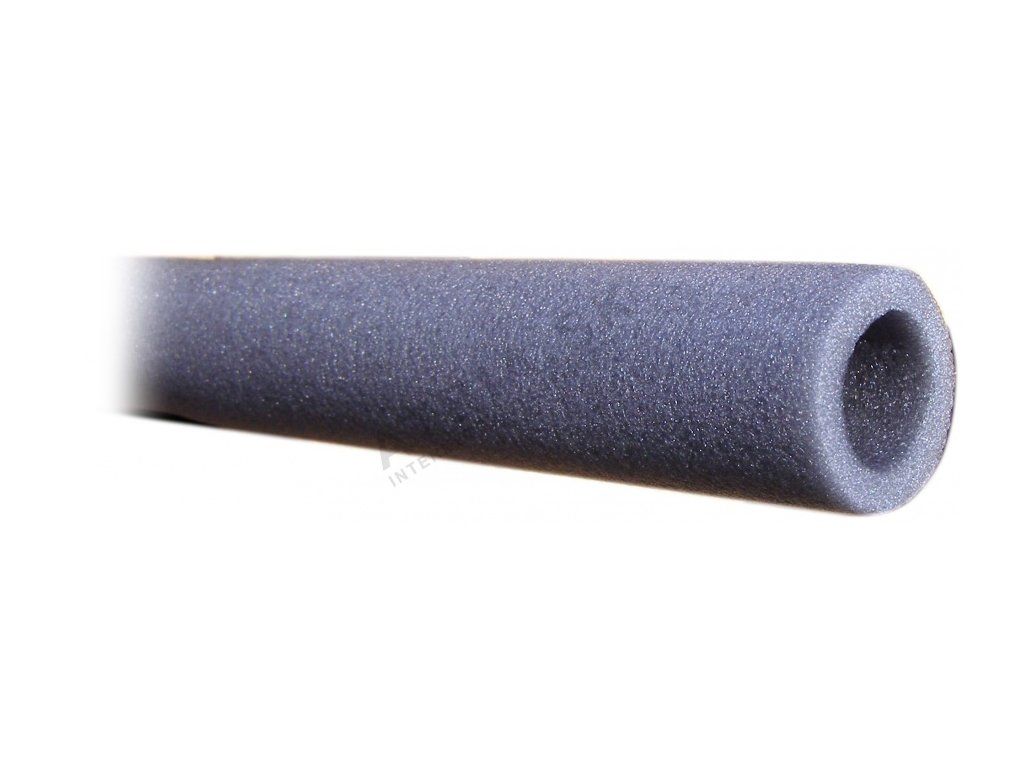
Insulation 22 mm (1/2") / 9 mm
Price: €0.86
Sleeve-type thermal insulation for pipe, 9 mm wall thickness, for pipe with a 22 mm diameter.
A more detailed guide on how to properly insulate distribution pipework depending on the type of space and the type of water flowing through the pipe can be found in the article Pipe insulation – why and how to insulate distribution pipework.
A practical six-step procedure for choosing and installing pipework.
How to proceed when choosing and installing pipework – a practical summary
If we sum up all the previous steps into one practical procedure, choosing pipe for water and heating should go roughly as follows. First, clarify the purpose of that section of the run – is it drinking water distribution, or a closed heating circuit (radiators, underfloor heating)? This answer immediately determines whether an oxygen barrier is essential (heating) or not so critical (drinking water distribution).
Next, choose the material – for a typical renovation or new build, plastic-aluminium PEX-AL-PEX pipe is in most cases the most practical choice thanks to its combination of price, easy installation, and shape memory; consider copper for higher durability requirements; steel is practically never specified for a new installation today. Then determine the diameter based on whether it is an individual circuit (16 mm) or a main run with higher flow (20–26 mm or more).
Then decide on the routing method – concealed in living spaces and bathrooms for aesthetic reasons, surface-mounted in the boiler room, cellar, or garage for easy servicing. Choose the jointing method based on whether you anticipate taking joints apart in the future (compression), it is a larger installation (press), or you are working with PP-R pipe (welding). Finally, do not forget insulation wherever the run passes through an unheated space, or where condensation could form on cold pipe.
After installation itself, a pressure test of the whole system is an essential step – that is, verifying that no joint leaks, before the pipe gets cast into a wall or screed and becomes inaccessible. The exact installation and pressure-testing procedure, step by step, can be found in the article Pipe installation – procedure and pressure test. If a problem appears later despite correct installation, an overview of the most common faults and the recommended way to deal with them can be found in the article Servicing and common pipework problems.
Real-world examples
Example 1 – new-build house with underfloor heating. When designing the distribution system for a new-build house with underfloor heating in all living rooms, two different levels of the system had to be resolved at once. For the individual underfloor heating circuits running from the manifold to specific rooms, plastic-aluminium pipe with a 16 mm diameter was chosen – this diameter easily covered the length and flow of individual loops in rooms of ordinary size. For the main run from the boiler room to the manifold, where the flow from all circuits combines, a larger-diameter pipe was chosen instead, so as not to create unnecessary pressure losses or flow noise. Since it was a closed heating circuit, pipe with an oxygen barrier was a given for both branches of the system. The section of the run passing from the boiler room through an unheated hallway to the manifold was additionally fitted with sleeve insulation, so that heat was not needlessly lost before reaching the individual rooms. The manifold and main runs were routed surface-mounted in the technical room, while in the living spaces the pipework remained hidden under the floor, or concealed in the bathroom walls where connecting to fittings.
Example 2 – apartment in a panel building, riser replacement during a bathroom renovation. During a complete bathroom renovation in an older panel building, the owner decided to replace the original steel water and heating risers with new material – the reason was visible corrosion on the old pipework, a typical sign of long-term operation of steel distribution without adequate water treatment. The new pipework in the bathroom was routed mostly concealed, so that no pipe would be visible once the tiling was finished – in an apartment where every centimetre of space counts and aesthetics play an important role, this choice was clear. In the technical shaft, where the risers are shared by several apartments stacked on top of each other and where future servicing by the building manager is anticipated, the routing remained surface-mounted, so that the joints stay easily accessible at any time without having to break open tiling. Given that a larger number of joints needed to be made quickly in one apartment, a press jointing method was chosen instead of compression – the faster installation was worth it for this scope of work despite the need to borrow pressing tongs. The heating water run to the radiator naturally got pipe with an oxygen barrier, while for the drinking water run to the sink and shower this property was not critical.
Frequently asked questions about pipework for water and heating
What is the main difference between PEX-AL-PEX, copper, and steel pipe?
PEX-AL-PEX combines plastic layers with an aluminium core that prevents oxygen penetration and gives the pipe shape memory. Copper pipe is more resistant to temperature and pressure, but more expensive and more demanding to install (soldering with an open flame). Steel pipe is used today only in exceptional cases, since it is prone to corrosion from the inside without proper water treatment.
What pipe diameter should I choose for a typical house?
For individual circuits, such as underfloor heating loops, a diameter of 16 mm is commonly used. For main riser distribution or longer sections with higher flow, where several circuits combine, a diameter of 20 to 26 mm or more is chosen.
Does pipe for underfloor heating need to have an oxygen barrier?
Yes. Underfloor heating is a closed heating circuit in which the same water circulates long-term. Without an oxygen barrier (aluminium layer in PEX-AL-PEX, EVOH layer in PE-RT), oxygen from the surroundings would gradually diffuse into the water and cause corrosion of the system's metal components – the boiler, the pump, and the radiators.
Is concealed or surface-mounted pipe routing better?
It depends on the space. Concealed routing is aesthetically clean, but requires breaking open the wall or floor in the event of a fault. Surface-mounted routing is visible, but installation and any repair are simpler – which is why it is used mainly in technical spaces such as the boiler room, cellar, or garage.
What is the difference between a compression and a press joint?
A compression joint can be taken apart and reassembled at any time without special tools, which is valued during servicing. A press joint is made with pressing tongs, is faster to install at scale, and is permanent (non-detachable), but requires investment in pressing tools.
How is plastic PP-R pipe joined?
Most often by welding – the pipe and fitting are fused together into a homogeneous, permanent whole. This method is common for both cold and hot water distribution.
Does cold water pipe need insulating too, or only hot water pipe?
Insulation makes sense for both. For hot water and heating water, it reduces heat loss, especially on runs passing through unheated spaces like a cellar or attic. For cold water, it prevents moisture condensation ("sweating") on the pipe surface.
Can PEX-AL-PEX pipe be bent without special tools?
Thanks to its aluminium middle layer, PEX-AL-PEX has so-called shape memory – once bent by hand into the required shape, for example around a room corner, it holds that shape on its own, without needing further fixing.
Related topics
- PEX-AL-PEX vs. copper vs. steel pipe
- What pipe diameter do I need
- Concealed vs. surface-mounted routing
- Oxygen barrier – why it matters for heating pipe
- Pipe jointing methods – compression, press, welding
- Pipe insulation – why and how to insulate distribution pipework
- Pipe installation – procedure and pressure test
- Servicing and common pipework problems
- Frequently asked questions about pipework for water and heating
Have a question about water or heating pipework?
Can't decide, or dealing with a specific situation in your home? Write to us – we're happy to help.