
Concealed vs. Surface-Mounted Routing
The decision between concealed and surface-mounted pipe routing is one of those that's very hard and expensive to fix later. While a choice of radiator colour or fitting type can be changed even after years without major work, the routing method for water and heating distribution is practically decided only once - at the shell-construction stage, during a bathroom renovation, or when replacing a boiler with new pipework. That's why it's worth spending time on this topic before the walls are closed up or the screed is poured.
Pipe for water and heating distributes hot or cold water between the source (boiler, water meter) and individual outlets - radiators, fittings, underfloor heating. The choice of material and diameter affects the lifespan of the run, pressure losses, and the overall cost of the installation, but equally important is the question of whether the run will be hidden within the structure or visible on the wall surface. This choice determines how easily (or, conversely, how awkwardly) the system can be inspected, extended, and repaired in the future.
In this article we'll cover both pipe routing methods - concealed and surface-mounted - including their advantages, disadvantages, and typical places of use. We'll also add related topics closely tied to this choice: what pipe material to choose, what pipe diameter is needed, why an oxygen barrier matters for heating circuits, what pipe jointing methods exist, and how to properly insulate the distribution system. If you're working on a specific project, these texts will help you complete the full picture - concealed and surface-mounted routing simply can't be assessed in isolation from material, diameter, or jointing method.
Concealed routing - when the pipe disappears into the wall
Overview of the main differences between concealed and surface-mounted pipe routing.
Concealed routing means the pipe is embedded in the wall or floor under plaster or screed. The biggest advantage is aesthetics - in living rooms (living room, bedroom, bathroom) no pipes, trunking, or clips are visible, and the wall stays smooth and ready for any interior finish. That's exactly why concealed routing is almost automatically used in the living areas of a house or apartment, where the appearance of the space is a priority and where visible pipework would look intrusive.
The flip side of the coin is accessibility in the event of a fault. If a leak appears somewhere along a hidden section - for example due to a joint ageing, or mechanical damage during other construction work - the repair requires breaking open the wall or floor, finding the exact location of the leak (often using a thermal camera or acoustic detection), chipping away the plaster or screed, carrying out the repair itself, and then bricking it back up and repainting or laying new tiles. This is therefore a job that is substantially more time-consuming and expensive than an ordinary repair of visible pipework. For this reason, with concealed routing it pays off far more to invest in quality joints, the right material with an oxygen barrier, and a thoroughly performed installation including a pressure test before covering it up - any saving made here can come back many times over in repair costs later.
In practical terms, this means that with concealed routing you shouldn't compromise on the choice of pipe or fittings. It's recommended to favour materials and joints with proven long-term reliability, and to avoid solutions where a joint risks losing its seal over time. If you're planning concealed routing, it's also worth thinking through the route in advance so it runs as straight as possible, with a minimum of unnecessary joints in the wall - every joint is, after all, a potential weak point.
Surface-mounted routing - visible, but practically low-maintenance to service
Surface-mounted routing, by contrast, is visible, run along the surface of the wall - either exposed, or hidden in mounting trunking or cable troughs that partially cover the pipe while still allowing access without demolition. The main advantage is simplicity of installation and any subsequent repair - if a leak appears or the run needs extending or adjusting (for example when adding another radiator), you just remove the cover trunking or simply access the pipe, without touching any masonry structures.
The downside is, logically, aesthetics - even the neatest trunking is visible in the space, which is why surface-mounted routing is used mainly in technical and utility spaces where appearance isn't a priority: the boiler room, utility room, cellar, garage, or attic. In these spaces, on the other hand, the accessibility of the pipe is a clear advantage - during a regular inspection of the boiler, pump, or manifold, it's far simpler to have the main runs in plain sight than to search for them behind plaster.
In practice, both approaches are commonly combined within a single house or apartment - main riser runs and technical distribution in the boiler room or cellar are routed surface-mounted (easy servicing, no need for aesthetics), while runs heading to individual outlets in living rooms are routed concealed. This combination usually represents the best balance between aesthetics and practicality - the areas most demanding to service (the technical room) remain accessible, while the living space stays visually clean.

PEX-AL-PEX pipe 16 x 2 for heating, underfloor heating and water
Price: €0.66/m
Multilayer plastic-aluminium pipe with an oxygen barrier, 16 mm diameter - universal use for water and heating, suitable both under plaster (thanks to the oxygen barrier and shape memory it holds its shape after bending without a fitting) and for visible distribution in technical spaces.
What pipe material to choose under plaster and on the surface
The choice of routing method (under plaster or on the surface) is closely linked to the choice of pipe material. Not every material is equally suited to concealed routing, where the pipe is expected to stay in place untouched for decades.
PEX-AL-PEX, meaning multilayer plastic-aluminium pipe, combines an inner and outer plastic layer with a middle aluminium layer. The aluminium prevents oxygen from diffusing into the water, which matters especially in closed heating circuits, and it also gives the pipe shape memory - once bent, the pipe holds its shape, which significantly simplifies routing around corners and obstacles without a lot of fittings. This property is exactly what makes it a very popular choice for concealed routing - fewer joints in the wall means fewer potential points of leakage.
Copper pipe is a traditional solution, very resistant to both temperature and pressure, used for decades especially in older installations and in more demanding technical applications. However, it's more expensive, and installation (soldering) requires more skill and working with an open flame, which lengthens the installation and makes workmanship quality more critical - with concealed copper routing, extra emphasis needs to be placed on the soldered joints precisely because subsequent inspection or repair of a joint in the wall is difficult.
Steel pipe is used today only in exceptional cases - typically in older installations gradually reaching the end of their service life, or in industrial applications. It's prone to corrosion from the inside without proper water treatment, which for a new installation (especially concealed, where a corroding run can't simply be checked visually) represents a real risk - which is why it's practically not used for new runs. A detailed comparison of all three materials, including their typical use, can be found in the separate article PEX-AL-PEX vs. Copper vs. Steel Pipe.
For underfloor heating, which by its very nature is always routed within the floor structure (so effectively "concealed" in the broader sense), besides PEX-AL-PEX, specialised PE-RT pipe with an oxygen barrier formed by an EVOH layer instead of aluminium is also used - this type is designed specifically for circuits laid long-term in screed with no possibility of servicing.

HEPWORTH pipe for underfloor heating, 16 mm
Price: €1.48/m
PE-RT pipe with an oxygen barrier, designed specifically for underfloor heating - meaning for a circuit permanently embedded in screed, where the pipe is not expected to be accessed again once it's cast in.
What pipe diameter to choose
Comparison of approximate prices for commonly used pipe diameters, per metre.
Regardless of whether you choose concealed or surface-mounted routing, pipe diameter needs to be chosen based on the required water flow and the length of the run. For underfloor heating and individual circuits, 16 mm is commonly used, while for main riser runs or longer sections with higher flow, 20-26 mm or more is used.
This choice also directly affects how demanding it will be to route the pipe in the wall or in trunking. Pipe that is too narrow causes high pressure losses and noise from flowing water - and with concealed routing, noise in the pipes is especially unpleasant, since the source of the noise can't be seen or easily located. Needlessly wide pipe, on the other hand, increases the cost of the installation and slows down the arrival of hot water, which shows up especially on longer runs to outlets.
For main riser runs, which in many cases are routed surface-mounted precisely in technical spaces (boiler room, shaft, cellar), it's worth choosing a larger diameter with some margin - here spatial constraints usually aren't as strict as with concealed routing to individual radiators, where the aim is to route the pipe as economically as possible because of the width of the chase in the wall. The exact calculation procedure and recommended diameters for individual situations can be found in the article What Pipe Diameter Do I Need.

PEX-AL-PEX pipe 26 x 3 for heating, underfloor heating and water
Price: €1.62/m
Larger 26 mm diameter, suitable for main riser distribution with higher flow - typically used for surface-mounted routing in the boiler room, utility room, or for the main riser pipe heading to individual floors.
Oxygen barrier - why it matters especially for concealed routing
The oxygen barrier - most often an aluminium layer in PEX-AL-PEX pipe, or a special EVOH layer in PE-RT pipe - prevents atmospheric oxygen from penetrating through the pipe wall into the closed heating circuit. Without this barrier, oxygen would gradually diffuse into the heating water and cause corrosion of the system's metal parts - the boiler, the pump, the radiators, and any steel sections of the distribution.
With surface-mounted routing, the consequences of a missing oxygen barrier will sooner or later show up visibly (for example in boiler performance or pump noise) and can be addressed later, since the run is accessible. With concealed routing the situation is different - the pipe itself in the wall isn't directly subject to corrosion, but if the oxygen barrier were missing, oxygen would reach the entire closed circuit and would damage the other system components for years without you ever detecting it on the hidden pipe. This is exactly why an oxygen barrier is practically essential for pipe intended for heating (not just for drinking water distribution) - and even more so for concealed routing, where any fix is no longer possible without breaking into the structure.
It's also important to distinguish the purpose of the pipe - the oxygen barrier matters for closed heating circuits, meaning runs to radiators and underfloor heating. For distribution of cold or hot domestic drinking water, which isn't part of a closed circuit, this property isn't treated with the same strictness, since the water in the run is continuously replaced and it isn't a circulating closed system. More on this topic, including how to recognise the barrier when choosing pipe, can be found in the article Oxygen barrier - why it matters for heating pipe.
Pipe jointing methods - what suits under plaster and what suits the surface
Just as important as the material is the choice of jointing method for the pipe and fittings, because the joint is exactly the most common place a leak can occur.
Compression joints are secured mechanically with a union nut and a sealing ring. The advantage is that the joint can be taken apart and reassembled at any time without special tools, which you'll appreciate especially during servicing. This very ability to be taken apart is the reason compression joints are often preferred for surface-mounted routing, where the joint is accessible at any time - for example when connecting radiators, manifolds, or fittings in the boiler room.
Press joints are created with special pressing tongs that permanently deform a metal sleeve around the pipe and fitting. The joint is faster to install at scale and is permanent, i.e. non-detachable, which does require investment in pressing tools. This very permanence and reliability is what makes press joints a typical choice for concealed routing - once a joint is properly pressed and tested with a pressure test, there's no reason to expect it will ever need to be taken apart, and the risk of a leak with a correctly made joint is low.
Welding, especially for plastic PP-R pipe, joins the pipe and fitting by fusing the material and creates a homogeneous, permanent joint. It's common for both cold and hot water distribution and, like press joints, suits concealed routing, since a properly welded joint has no mechanical parts that could loosen over time.
In summary: for concealed routing it makes sense to favour press joints or welding - joints that, once pressure-tested, require no further intervention. For surface-mounted routing, especially in technical spaces where occasional adjustments or servicing are expected, compression joints can be a more practical choice precisely because of their ability to be taken apart. A detailed overview of all three methods can be found in the article Pipe jointing methods - compression, press, welding.
Insulating pipework for both concealed and surface-mounted routing
Sleeve-type thermal insulation, usually made of foamed polyethylene, is fitted over the pipe and reduces heat loss along the run. It matters especially on longer hot water or heating circuit runs passing through unheated spaces, such as a cellar or attic, where without insulation the water would noticeably cool down on its way to the appliance.
With surface-mounted routing, insulation is a simple matter - the pipe is accessible, insulation is fitted during installation and can be added or replaced later if needed. With concealed routing, the situation is the opposite - insulation must be fitted before covering, since adding it later once the pipe is cast in or bricked over is no longer possible. If insulation is forgotten or its thickness is underestimated, the result can be needless heat losses for the entire lifespan of the run, which can no longer be simply fixed.
For cold water distribution, insulation serves a different purpose - it prevents moisture condensation on the pipe surface, so-called sweating. This is relevant especially for surface-mounted routing in environments with higher air humidity, where dripping moisture from uninsulated pipe could over time damage surrounding structures or cause corrosion of clips. Details on choosing insulation thickness and its correct installation can be found in the article Pipe insulation - why and how to insulate distribution pipework.
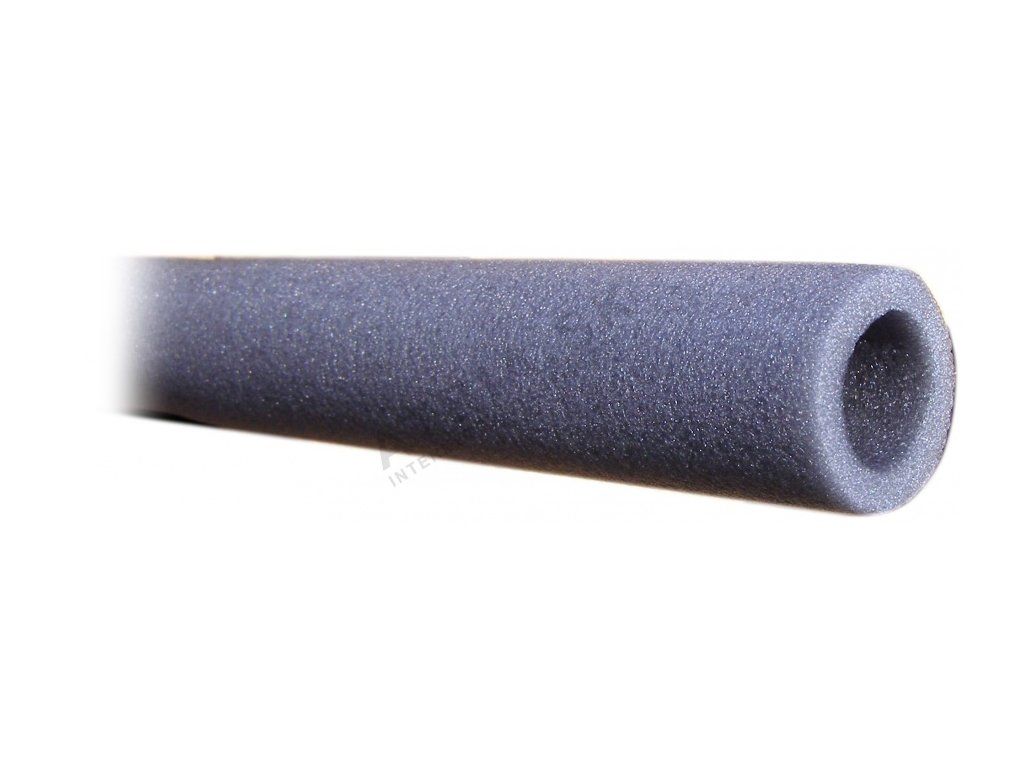
Insulation 22 mm (1/2") / 9 mm
Price: €0.86
Sleeve-type thermal insulation for pipe, 9 mm wall thickness, for pipe with a 22 mm diameter - suitable both for surface-mounted distribution in technical spaces and for sections before covering up concealed routing.
How to decide - summary by type of space
When deciding between concealed and surface-mounted routing, it's worth going space by space rather than settling the whole house with a single decision. In living rooms - the living room, bedrooms, children's rooms, hallways - concealed routing makes sense for aesthetic reasons, of course provided quality material with an oxygen barrier is used, a reliable jointing method (press or welding), and the installation is verified with a pressure test before covering it up.
In the bathroom the situation is a bit more specific - part of the distribution (to fittings, to a radiator) is typically routed concealed for appearance, but during renovations it's worth thinking through the routes so that a future repair wouldn't require ripping up the tiling in the most exposed spot. In technical spaces - the boiler room, utility room, cellar, garage, attic - surface-mounted routing is, on the other hand, practically always the better choice, because it delivers easy servicing and inspection without the appearance of the space losing anything, since these are spaces people don't normally relax in or receive visitors.
The universal rule, then, is: the less a space will be touched after completion and the greater the emphasis on appearance, the more concealed routing with an emphasis on material and joint quality makes sense. The more often inspection, adjustment, or servicing is expected, the more surface-mounted routing pays off, saving both time and money on every future intervention.
Real-world examples
Distribution routing process in a real house with the boiler in the basement.
House with the boiler in the basement and underfloor heating on the living floor. In a new-build house, the main riser runs from the boiler in the basement to the manifolds on individual floors were routed surface-mounted, fastened in a technical shaft alongside the staircase - thanks to this, during the annual inspection of the boiler and pumps, the condition of all the main joints can also be checked without touching any walls. The underfloor heating circuits themselves in the living rooms, on the other hand, were routed exclusively within the floor structure (so concealed in the broader sense) using pipe with an oxygen barrier, and were thoroughly tested with a pressure test before the screed was poured - since no access to the circuit is possible after pouring, the emphasis was placed precisely on the quality of the material and joints before covering it up.Apartment in a panel building with a bathroom renovation.
When concealed and when surface-mounted routing pays off, depending on the space.
Frequently asked questions (FAQ)
Can concealed routing be changed to surface-mounted later?
Technically yes, but in practice this means chipping the existing run out of the wall or disconnecting it and running new pipe along the surface. It's more of an exceptional solution for a major renovation than a routine step - in the vast majority of cases, repairing the specific damaged section is simpler and cheaper than a complete change of routing method.
Does concealed pipe have to be PEX-AL-PEX?
No, copper or other types of plastic pipe can also be routed under plaster, as long as they have suitable properties for the given application (for example an oxygen barrier for heating circuits). However, thanks to its shape memory and easier installation without an open flame, PEX-AL-PEX is one of the more practical choices specifically for concealed routing with a minimum of joints.
Is it worth insulating concealed pipe too?
Yes, especially if it runs through an unheated or cooler space (for example along an external wall or through an unheated floor). Insulation must be fitted before covering, since it can no longer be added afterwards, once the pipe is bricked in or cast over.
Why does a pressure test matter for concealed routing?
A pressure test is carried out before covering the run and verifies that all joints are truly leak-tight under operating pressure. With surface-mounted routing, any leak can also be detected after commissioning and repaired easily, but with concealed routing this check before covering is the only way to avoid demolition later. A detailed procedure can be found in the article Pipe installation - procedure and pressure test.
Can concealed and surface-mounted routing be combined in the same house?
Yes, and in practice this is common and usually the most sensible solution - main distribution in technical spaces is routed surface-mounted for easy servicing, while runs in living rooms are routed concealed for appearance.
What pipe diameter is most commonly routed concealed?
For underfloor heating and individual circuits to outlets, 16 mm is commonly used. Larger diameters (20-26 mm or more) tend to be associated with main riser runs, which are more often routed surface-mounted in technical spaces.
Which jointing method is most suitable for concealed routing?
For concealed routing, press joints or welding (for plastic PP-R pipe) are most often recommended, since these are permanent, non-detachable joints that, once pressure-tested, require no further intervention. Compression joints are detachable and practical for servicing, but that very ability to be taken apart isn't an advantage for concealed routing - on the contrary, the reliability of a permanent joint is more valuable inside a wall.
What should I do if I suspect a leak in concealed pipework?
The first step is to verify the symptoms - a damp patch on the wall, a pressure drop in the heating system, increased water consumption. Precisely locating the leak usually needs to be entrusted to a professional with detection equipment (thermal camera, acoustic detector), so that only the actually affected spot is broken open, not a blind guess. Common symptoms and the recommended procedure are described in the article Servicing and common pipework problems.
Related topics
- How to Choose Pipework for Water and Heating
- PEX-AL-PEX vs. Copper vs. Steel Pipe
- What Pipe Diameter Do I Need
- Oxygen barrier - why it matters for heating pipe
- Pipe jointing methods - compression, press, welding
- Pipe insulation - why and how to insulate distribution pipework
- Pipe installation - procedure and pressure test
- Servicing and common pipework problems
- Frequently asked questions about pipework for water and heating
Have a question about water or heating pipework?
Can't decide, or dealing with a specific situation in your home? Write to us – we're happy to help.