
What Pipe Diameter Do I Need
What Pipe Diameter Do I Need
The question "what pipe diameter do I need" is one of those technical decisions that most people only think about once they're standing in front of a shelf of pipes at a store, or when the installer on site is waiting for a decision on which way to route the distribution. Yet it's a choice that, once bricked into a wall or cast into a screed, is hard and costly to change. While project documentation typically covers the boiler's output, the type of radiators, or the location of the manifold, the pipe itself and its diameter often gets left until the last moment - even though it's exactly what determines whether the system will be quiet, deliver hot water quickly to where it's needed, and run without unnecessary pressure losses.
This article addresses exactly that topic - how the diameter of pipe for water and heating is chosen, why it's not the same whether you choose 16 mm or a larger profile, and how the diameter relates to the other decisions you have to make about water and heating distribution: what pipe material to use, whether to route the run under plaster or on the surface, how to make the joints, and whether to insulate the pipe. All of these topics are connected - a poor diameter choice can be partly compensated for with a different material or routing method, but the best results only come from an installation where each of these decisions is made deliberately and in line with the others.
If you're currently renovating an apartment, building a house, or just adding a run for a new radiator or sink, in the text you'll also find specific pipe products commonly used for each situation, including approximate prices. At the end of the article there's also a series of frequently asked questions and two real-world examples showing how theory translates into actual decisions on a specific project.
What pipe is and why the diameter matters
Pipe for water and heating distributes hot or cold water between the source (boiler, water meter) and individual outlets - radiators, fittings, underfloor heating circuits. It's essentially the "circulatory system" of the whole household: the boiler or water meter is the heart, the pipes are the blood vessels, and the radiators, fittings, or underfloor circuits are the places the water (heat) needs to reach. The choice of material and diameter affects several things at once - the lifespan of the system, pressure losses, ease of installation, and the overall cost of the installation.
Pipe diameter can be compared to the width of a road - too narrow a road causes traffic jams (in pipe this shows up as pressure losses and noise), while too wide a road is needlessly expensive and, in the case of water, also slower to "start up", because hot water has to travel through it first before reaching the appliance. That's exactly why pipe diameter isn't chosen at random or based on what happens to be on hand, but according to how much water needs to flow through that section and over what distance.
It's also important that a household's distribution system usually isn't made up of a single diameter from start to finish. The main run from the boiler or water meter, where flow for several rooms or circuits combines, needs a different diameter than the final section to a single radiator or a single underfloor heating circuit. The system therefore typically "steps down" in diameter as it moves from the source to the individual appliances.
What pipe diameter do I need - how the diameter is chosen
Pipe diameter varies depending on whether it's a single circuit or a main distribution run.
Pipe diameter is chosen based on the required water flow and the length of the run. For underfloor heating and individual circuits, 16 mm is commonly used - that's the diameter that loops around the whole floor area in separate circuits, and since these are shorter sections with lower flow per circuit, 16 mm is generally more than adequate. For main riser runs or longer sections with higher flow, on the other hand, 20-26 mm or more is used, because there the flow from several circuits or rooms combines, and the pipe must be able to carry a substantially larger volume of water without causing problems.
Two opposing effects are key here, and a balance has to be struck between them. Pipe that is too narrow causes high pressure losses and noise from flowing water - water moves faster through a narrow profile, which at higher flow leads to turbulence that's audible especially in quieter rooms (bedroom, living room at night). Conversely, unnecessarily wide pipe increases the cost of the installation (more material, more expensive fittings) and slows down the arrival of hot water - by the time hot water "works its way" through the whole volume of wider pipe to reach the fitting or radiator, more time passes and more water is needlessly wasted down the drain or cools in the circuit.
In practice, this means the correct answer to "what pipe diameter do I need" always depends on the specific section of the run, not on the whole installation at once. When planning, it therefore makes sense to break the distribution system down into individual sections - the main supply from the boiler or water meter, the manifold, and finally the individual circuits to the appliances - and consider the expected flow and length separately for each section. Where flow from multiple directions combines (for example right before the boiler or right after the water meter), a larger diameter is appropriate. Where it's already down to a single circuit or a single appliance (the last metre to a radiator, one underfloor heating circuit), a smaller, standard 16 mm diameter is usually sufficient.

PEX-AL-PEX pipe 16 x 2 for heating, underfloor heating and water
Multilayer plastic-aluminium pipe with an oxygen barrier, 16 mm diameter, universal for water and heating - the typical diameter for individual underfloor heating circuits and shorter runs to appliances.
Price: €0.66/m
For comparison, here's what the same type of pipe looks like in a larger diameter:

PEX-AL-PEX pipe 26 x 3 for heating, underfloor heating and water
Larger 26 mm diameter, same construction (plastic-aluminium pipe with an oxygen barrier), suitable for main riser distribution with higher flow, where several circuits or rooms combine.
Price: €1.62/m
If you need the answer to how the whole question of diameter fits into the broader decision-making about pipework (material, routing method, jointing), this is covered in detail in the article How to Choose Pipework for Water and Heating, which adds broader context to this topic.
What pipe material to choose - PEX-AL-PEX, copper, or steel
The three common pipe materials differ in properties, price, and installation complexity.
Pipe diameter isn't decided in isolation from material - both parameters are chosen together, because not every material is available equally commonly in every diameter, and not every material suits every type of run. On the market today you'll mainly find three basic solutions.
PEX-AL-PEX, meaning multilayer plastic-aluminium pipe, combines an inner and outer plastic layer with a middle aluminium layer. The aluminium here has two roles - it prevents oxygen from diffusing into the water, which matters especially in closed heating circuits, and it also gives the pipe shape memory, so once bent, the pipe holds its shape without needing to be mechanically fixed. This makes PEX-AL-PEX a popular choice for underfloor heating, where the pipe loops in regular patterns across the whole floor area, but it's equally used for ordinary hot and cold water distribution.
Copper pipe is a traditional solution, very resistant to both temperature and pressure - in installations where long lifespan and higher demands are expected, it's one of the proven choices. Its downside is a higher price and more demanding installation, since joining copper (soldering) requires more skill and an open flame, which isn't always practical or safe without an experienced tradesperson when renovating occupied spaces.
Steel pipe is used today only in exceptional cases - typically in older installations undergoing only partial renovation, or in industrial applications. The main reason for steel's decline is its susceptibility to corrosion from the inside unless proper water treatment is ensured - which is why designers and installation companies rarely choose steel pipe for a typical home installation today.
A detailed comparison of all three materials, including their advantages and disadvantages, can be found in the separate article PEX-AL-PEX vs. Copper vs. Steel Pipe.
When choosing between materials, it's also worth thinking about the type of run the pipe will be used for. For example, specifically for underfloor heating, besides classic PEX-AL-PEX pipe, PE-RT pipe with an oxygen barrier is also sold, designed directly for this purpose:

HEPWORTH pipe for underfloor heating, 16 mm
PE-RT pipe with an oxygen barrier designed specifically for underfloor heating, 16 mm diameter - the same standard diameter commonly used for individual underfloor heating circuits.
Price: €1.48/m
Oxygen barrier - why it matters when choosing diameter too
Once the decision on diameter and material has been made, you also need to think about whether the chosen pipe has an oxygen barrier. The oxygen barrier - most often in the form of an aluminium layer in PEX-AL-PEX pipe, or a special EVOH layer in PE-RT pipe - prevents atmospheric oxygen from penetrating through the pipe wall into the closed heating circuit.
Without this barrier, oxygen would gradually diffuse into the heating water and cause corrosion of the system's metal parts - the boiler, the pump, the radiators, and any steel pipework present in the system. This is exactly why an oxygen barrier is practically essential for pipe intended for heating - meaning not just for drinking water distribution, but for a closed circuit where the same water circulates repeatedly.
When choosing pipe diameter, it's therefore important to remember that the diameter itself only solves the flow side of things - pressure losses, noise, the speed at which hot water arrives. The question of long-term protection for the system's metal components is only addressed by the oxygen barrier, which is why for heating circuits these two properties (diameter and barrier) are assessed together, not separately. Both the PEX-AL-PEX product and the HEPWORTH pipe mentioned above contain an oxygen barrier, which makes them a suitable choice specifically for closed heating circuits, not just for drinking water distribution.
More on this topic, including exactly what oxygen diffusion in the system causes and how it can be prevented, can be found in the article Oxygen barrier - why it matters for heating pipe.
Concealed vs. surface-mounted routing - how it relates to diameter
Another decision usually made alongside pipe diameter is the routing method. Concealed routing means the pipe is embedded in the wall or floor under plaster or screed. It looks aesthetically clean - once the work is finished, no pipes are visible, only switches, fittings, and radiators. The downside is that in the event of a fault, meaning a leak, it requires breaking open the wall or floor just to reach the damaged spot and repair it.
Surface-mounted routing, on the other hand, is visible, run along the surface of the wall - often in trunking or completely exposed. The advantage is simpler installation and easier repair, since the pipe is directly accessible at any time without demolition. The downside is lower aesthetics, which is why this solution is mainly used in technical spaces such as the boiler room, cellar, or garage, where appearance isn't a priority and easy access for servicing is valued instead.
In relation to pipe diameter, it holds true that for concealed routing, choosing the right diameter matters even more than for surface-mounted routing - since any repair or replacement is far more costly and complicated, it pays to choose the diameter, material, and jointing method correctly from the start, to minimise the future likelihood of ever needing to access the bricked-in run at all. For surface-mounted routing in technical spaces, there is greater tolerance instead - if the chosen diameter turns out not to be optimal, adjusting it is easier since the pipe is freely accessible.
A more detailed comparison of both routing methods can be found in the article Concealed vs. surface-mounted routing.
How pipe is joined - compression, press, welding
The choice of pipe diameter and material ultimately also ties into how the individual sections and fittings are joined together. There are essentially three common jointing methods.
Compression joints are secured mechanically with a union nut and a sealing ring. The advantage of this solution is that the joint can be taken apart and reassembled at any time without special tools, which you'll appreciate especially during servicing - for example when a valve, filter, or other component in the system needs replacing without having to cut the pipe.
Press joints are created with special pressing tongs that permanently deform a metal sleeve around the pipe and fitting. The joint is faster to install at scale - with a larger number of joints on a project, this saves significant time - and is permanent, i.e. non-detachable. The downside is that this method requires investment in pressing tools, which pays off especially for professional installation companies that use this technique repeatedly across multiple jobs.
Welding, especially for plastic PP-R pipe, joins the pipe and fitting by fusing the material. The result is a homogeneous, permanent joint - essentially the two parts become a single piece of material. This method is common for both cold and hot water distribution, wherever PP-R pipe is used.
For PEX-AL-PEX pipe, mentioned in this article as the typical solution for both 16 mm and 26 mm diameters, in practice you'll most often come across compression or press joints - the choice between them mostly depends on whether the installation is done by a DIYer with ordinary tools (compression joints) or a professional company with pressing tongs (press joints). A detailed overview of all three jointing methods, including when each is best suited, can be found in the article Pipe jointing methods - compression, press, welding.
Pipe insulation - when it's necessary
The final decision usually made together with pipe diameter, material, and routing method is the question of insulation. Sleeve-type thermal insulation, usually made of foamed polyethylene, is fitted over the pipe and reduces heat loss along the run.
It matters especially on longer hot water or heating circuit runs passing through unheated spaces - typically a cellar or attic - where without insulation the water would noticeably cool down on its way to the appliance. This means the tap would have to run longer before genuinely hot water starts flowing, and for a heating circuit, some of the heat produced by the boiler would be lost before it even reaches the radiator or the underfloor circuit.
For cold water distribution, insulation has one more function - it prevents moisture condensation on the pipe surface, so-called sweating. This is a common occurrence especially in warmer, more humid spaces, where cold pipe "condenses" atmospheric moisture on its surface, which over time can cause damp patches on walls or corrosion of surrounding metal elements.
Pipe diameter directly affects what size of insulation you need to choose - insulation sleeves are made in diameters matching specific pipe diameters, so the larger the diameter of the run, the larger the inner diameter of the insulation sleeve must be too. An example of a specific product:
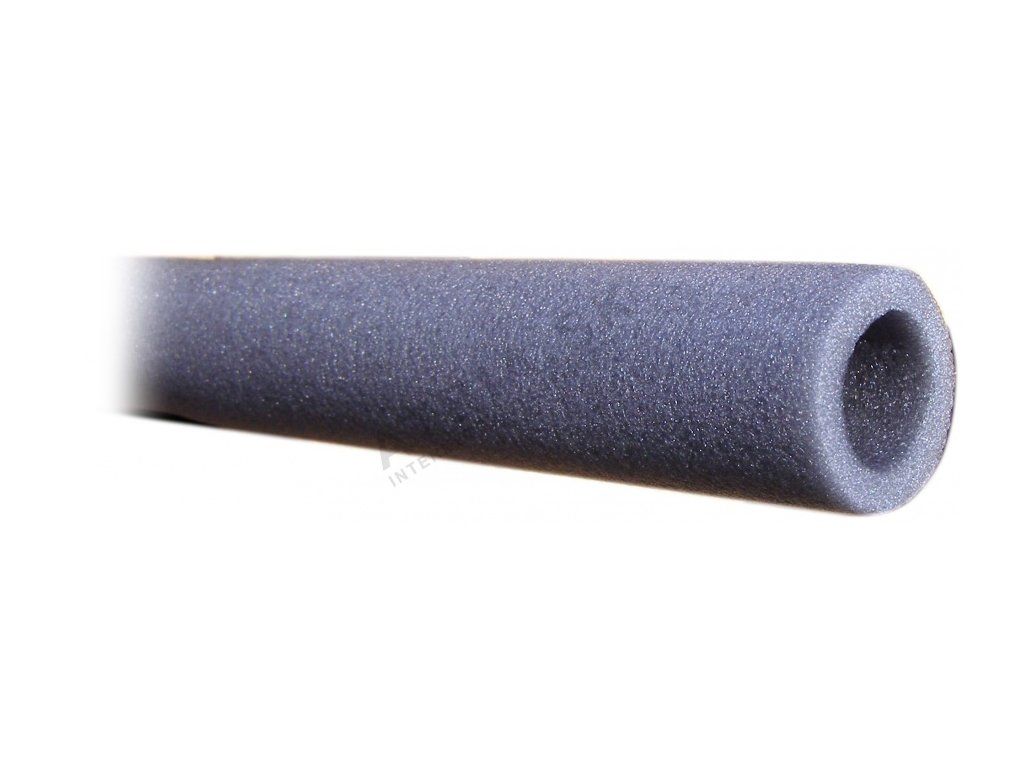
Insulation 22 mm (1/2") / 9 mm
Sleeve-type thermal insulation for pipe, 9 mm wall thickness, for pipe with a 22 mm diameter - especially suitable for longer runs passing through unheated spaces such as a cellar or attic.
Price: €0.86
A complete pipe installation procedure, including the recommended pressure test after the run is finished (which reveals any leaks before the pipe is bricked in or cast into a screed), can be found in the article Pipe installation - procedure and pressure test. If, on the other hand, an existing run is already behaving abnormally (pressure drop, noise, leakage), a useful overview is offered by the article Servicing and common pipework problems.
Real-world examples
Example 1: House with underfloor heating and a separate run for the bathroom
This real-world example shows a typical design process for underfloor heating distribution in a house.
In a new-build house, underfloor heating was planned for all living rooms, with classic radiators only in the utility room. The underfloor circuits were designed using PEX-AL-PEX pipe with a 16 mm diameter - the standard diameter for this type of run - distributed from a shared manifold to each room separately. The main supply to the manifold, where flow for all circuits combined, was handled with a larger 26 mm diameter, so it could manage the simultaneous flow of several circuits running at once without unnecessary pressure losses. Since part of the run passed through the unheated utility room, sleeve insulation matching the pipe diameter was added on this section, so heat wasn't lost before even reaching the living spaces. The run was routed concealed in the floor (a common solution for underfloor heating), and the joints at the manifold were made as compression joints, so that in the event of future servicing, individual circuits could be easily accessed without needing to permanently take anything apart.
Example 2: Apartment in a panel building - renovating water distribution in the bathroom and kitchen
During the renovation of an apartment in a panel building, the original, decades-old water distribution had to be replaced with new pipe. Since these were shorter sections from the riser to individual outlets - the sink, the shower, the kitchen sink - a smaller 16 mm diameter pipe was chosen, which was fully sufficient for this type of short run with limited flow. The run was routed concealed under new plaster in both the bathroom and the kitchen, since these were living spaces where aesthetics were a priority. Since no future modifications to the run were anticipated in this case (a complete renovation isn't done often), press joints were chosen - permanent and faster to install at scale, which, with multiple joints in the small space of the bathroom and kitchen, also meant a shorter time to complete the work. A short section of the run passing through a cooler installation shaft was additionally fitted with anti-sweating insulation, since increased humidity had previously been recorded in this apartment exactly at the location of the original, uninsulated pipe.
Frequently asked questions about pipe diameter
What pipe diameter do I need for underfloor heating?
For underfloor heating and individual circuits, a diameter of 16 mm is commonly used. This is the diameter that loops repeatedly across the floor area in separate loops, and since flow per circuit is limited, 16 mm is generally more than sufficient.
When do I need a larger diameter than 16 mm?
A larger diameter, 20 to 26 mm or more, is used for main riser runs or longer sections with higher flow - meaning wherever flow from multiple circuits or rooms combines at once, for example right before the manifold or right after the boiler.
The wrong pipe diameter shows up either as noise and losses, or as needless costs.
What happens if I choose pipe that's too narrow?Pipe that is too narrow causes high pressure losses and noise from flowing water. This is noticeable especially in quieter areas of the home, where the flow of water through a narrow profile can be heard.
What happens if I choose needlessly wide pipe?
Needlessly wide pipe increases the cost of the installation, since more material and more expensive fittings of the matching diameter are needed, and it also slows down the arrival of hot water, since it takes longer for hot water to travel through the wider profile to reach the appliance.
What's the difference between PEX-AL-PEX, copper, and steel pipe?
PEX-AL-PEX is multilayer plastic-aluminium pipe with an oxygen barrier and shape memory. Copper pipe is traditional, very resistant to both temperature and pressure, but more expensive and more demanding to install (soldering with an open flame). Steel pipe is used today only in exceptional cases, since without proper water treatment it is prone to corrosion from the inside.
Does pipe for heating need to have an oxygen barrier?
Yes, for closed heating circuits an oxygen barrier is practically essential. Without it, oxygen would gradually diffuse into the heating water and cause corrosion of the boiler, the pump, the radiators, and any steel pipework in the system.
Is it better to route pipe concealed or surface-mounted?
It depends on the space and the priorities. Concealed routing is aesthetically cleaner, but requires breaking open the wall or floor in the event of a fault. Surface-mounted routing is simpler to install and repair, but less attractive, which is why it suits technical spaces such as the boiler room, cellar, or garage best.
Which pipe jointing method should I choose?
Compression joints can be taken apart at any time without special tools, which is valued during servicing. Press joints are faster with a larger number of joints and are permanent, but require investment in pressing tools. Welding is used mainly for plastic PP-R pipe and creates a homogeneous, permanent joint.
When is it worth insulating pipe?
Insulation is worthwhile especially on longer hot water or heating circuit runs passing through unheated spaces, such as a cellar or attic, where without insulation the water would noticeably cool down on its way to the appliance. For cold water, insulation additionally prevents sweating on the pipe surface.
Related topics
- How to Choose Pipework for Water and Heating
- PEX-AL-PEX vs. Copper vs. Steel Pipe
- Concealed vs. surface-mounted routing
- Oxygen barrier - why it matters for heating pipe
- Pipe jointing methods - compression, press, welding
- Pipe insulation - why and how to insulate distribution pipework
- Pipe installation - procedure and pressure test
- Servicing and common pipework problems
- Frequently asked questions about pipework for water and heating
Have a question about water or heating pipework?
Can't decide, or dealing with a specific situation in your home? Write to us – we're happy to help.