
Servicing and common problems with pipe
Pipe is one of those parts of a heating and water system that most households only think about once something stops working – a damp stain appears on the ceiling, a radiator stops heating properly, or water starts dripping from a fitting. Yet it is precisely the pipe that carries hot or cold water between the source (boiler, water meter) and the individual points of use – radiators, taps, underfloor heating circuits – and its condition directly affects how reliably and for how long the whole system will work without needing servicing.
The order of key factors that, according to this article, most determine pipe lifespan.
In this article we look at pipe from a servicing and maintenance perspective: what faults occur most often, why they arise, and what a household or an installation company can do to prevent them. We'll go through the influence of material choice, diameter, routing method (concealed or surface-mounted), joint type, and thermal insulation – exactly the parameters that, in practice, determine most whether the pipe will be a trouble-free part of the installation for decades, or a source of repeated service call-outs.
The article is intended both for households dealing with a specific problem or planning a renovation of their piping, and for installation companies wanting to organise their arguments for material and installation choices with a client. At the end you'll find two real-world examples and answers to the most frequently asked questions about servicing piping systems.
Why pipe is one of the most common causes of servicing work
Pipe itself is a passive element – it has no moving parts, doesn't consume energy, doesn't require regular servicing in the sense of replacing components the way, for example, a circulation pump or boiler burner does. That's exactly why it's often not given enough attention already at the design and installation stage. The problem is that mistakes made when choosing the material, diameter or routing method of the pipe only show up months to years later – and by then the fix is generally far more expensive and complicated than if the matter had been handled correctly from the start.
Typical situations leading to servicing work on pipe include a leaking joint, cracks caused by frost or mechanical stress, corrosion of the system's metal parts caused by oxygen penetrating through the pipe wall, insufficient water flow caused by an undersized diameter, or heat loss on long runs routed through unheated spaces. Each of these situations has its own specific cause and generally also a specific, proven solution – which we'll go through in the following sections.
It's also important to realise that the accessibility of pipe (that is, whether it's routed under plaster, or visibly on the surface) fundamentally changes the difficulty and cost of any repair. The decision on the routing method should therefore be made knowing that access to the pipe may be needed from time to time – and in technical spaces where more frequent servicing is anticipated (boiler room, utility room, cellar), surface-mounted routing clearly pays off from this perspective.
Pipe material and its effect on failure rate: PEX-AL-PEX, copper, steel
Comparison of the three most used pipe materials according to the article.
Choosing the pipe material is probably the most important decision in terms of future failure rate. On the market today, we commonly encounter three main types.
PEX-AL-PEX (multilayer plastic-aluminium pipe) combines an inner and outer plastic layer with a middle aluminium layer. The aluminium layer serves two important functions: it prevents oxygen diffusion into the water, which is key especially in closed heating circuits (more in a separate section on the oxygen barrier below), and it also gives the pipe shape memory – that is, once bent into the required shape, the pipe holds that shape, which greatly simplifies installation especially on runs with several bends.
Copper pipe is a traditional, proven material, very durable against both temperature and pressure. Its disadvantage is a higher price compared to plastic-aluminium alternatives and more demanding installation – joining copper is done by soldering, which requires skill and work with an open flame, and therefore also extra caution when installing in enclosed spaces or near flammable materials.
Steel pipe is used today in new installations only exceptionally – you'll find it more in older buildings or industrial applications. Its main weakness from a servicing perspective is a susceptibility to corrosion from the inside, unless proper water treatment in the system is ensured. Corrosion of steel piping is precisely one of the most common causes of servicing work in older installations – it shows up as gradual narrowing of the diameter (rust deposits), worsened flow, and eventually perforation of the pipe wall.
For a typical renovation of water and heating piping in a family house or flat, the vast majority of installation companies today therefore recommend plastic-aluminium PEX-AL-PEX pipe – it combines good value, easy installation and sufficient durability for normal operation. Our atria.sk range includes, for example, PEX-AL-PEX pipe 16 x 2 for heating, underfloor heating and water, which has an oxygen barrier and is suitable universally for water and heating.

PEX-AL-PEX pipe 16 x 2 for heating, underfloor heating and water
Price: €0.66/m
Multilayer plastic-aluminium pipe with an oxygen barrier, 16 mm diameter. Universal use for water and heating, a common choice for individual underfloor heating circuits.
Wrong pipe diameter as a hidden cause of problems
Pipe diameter is chosen according to the required water flow and the length of the run. For underfloor heating and individual circuits, a diameter of 16 mm is commonly used, while for main riser lines or longer sections with higher flow, a diameter of 20 to 26 mm and above is used. This decision might at first glance seem purely technical and insignificant for the average user, but from a servicing perspective, pipe diameter has a direct impact on two very specific manifestations of trouble.
Pipe that's too narrow causes high pressure losses and noise as the water flows – in practice this is one of the most common reasons customers complain about "humming" or "hissing" in the pipes, especially with a larger draw-off of hot water at once or with the circulation pump running at higher output. This noise can only be eliminated by replacing the undersized section of pipe with a wider diameter – additionally adjusting the flow rate will generally only reduce the problem, not eliminate it.
Conversely, unnecessarily wide pipe increases installation cost and slows the arrival of hot water – that is, the time until you get hot water instead of the cold water that was standing in the pipe until then, after opening the tap. On longer runs (for example between a boiler room in the basement and an upstairs bathroom), this can mean noticeable water wastage every time it's drawn off.
For main riser lines or sections with higher flow, a suitable solution is PEX-AL-PEX pipe 26 x 3 for heating, underfloor heating and water – the same proven material as the smaller diameter, just in a size suited to higher flow. We recommend consulting the right diameter choice for your specific project with an installation company, or reviewing more detailed recommendations in the article What pipe diameter do I need.

PEX-AL-PEX pipe 26 x 3 for heating, underfloor heating and water
Price: €1.62/m
Larger 26 mm diameter, suitable for main riser lines with higher water flow – where 16 mm pipe would cause pressure losses and noise.
Concealed vs. surface-mounted routing – where most servicing complications arise
The pipe routing method is a decision that directly shows up on the day the pipe needs servicing – and that's exactly why we devote a separate section to it.
Concealed routing is pipe embedded in a wall or floor under plaster or screed. From an aesthetic standpoint, it's a clean solution – no runs are visible in living spaces, walls and floors look visually finished. The catch is that in case of a fault, that is a leaking joint or a burst pipe, repair requires breaking open the wall or floor just to reach the damaged spot at all. In practice, this means costs not only for the pipe repair itself, but also for demolition work, debris removal and restoring the surfaces afterwards (plaster, tiling, painting).
Surface-mounted routing, by contrast, is visible, run along the surface of the wall – often in trunking or completely openly. Installation and any repair are clearly simpler and cheaper, since the pipe is freely accessible at any time without needing to break anything open. The disadvantage is lower aesthetic value, so this solution is used mainly in technical spaces – the boiler room, cellar, garage – where aesthetics take a back seat to practicality.
From a servicing perspective, a sensible compromise is therefore to combine both approaches: in living rooms (living room, bedrooms, hallway) we choose concealed routing for appearance, but in technical spaces, and especially in places with an increased likelihood of future intervention (for example at underfloor heating manifolds, shut-off valves, or where it passes through structures), it's better to leave the pipe accessible on the surface, or behind an inspection hatch. You'll find a more detailed comparison of both approaches in the article Concealed vs. surface-mounted routing.
Oxygen barrier and corrosion – the silent enemy of a heating system
One of the most common, yet also least visible problems in heating systems is corrosion caused by atmospheric oxygen penetrating into the heating water. It's a problem that doesn't show up immediately as a leak or a crack, but gradually, over months to years – and by the time it finally shows up, it's generally already too late for a simple fix.
The oxygen barrier – most often an aluminium layer in PEX-AL-PEX type pipe, or a special EVOH layer in PE-RT type pipes – prevents atmospheric oxygen from penetrating through the pipe wall into a closed heating circuit. Without this barrier, oxygen would gradually diffuse into the heating water and cause corrosion of all the system's metal parts – that is, the boiler, circulation pump, radiators and any steel sections of the run.
In practice, this means that an oxygen barrier is practically essential for pipe intended for heating (unlike pipe intended solely for drinking water distribution, where this problem doesn't threaten to the same degree). If pipe without an oxygen barrier is used when renovating or extending a heating circuit, the risk of corrosion problems in the system increases significantly – and the cost of replacing a damaged circulation pump or the heat exchanger in the boiler is generally far higher than the price difference between pipe with and without a barrier.
From a servicing point of view, the oxygen barrier is therefore one of those pipe properties that really isn't worth skimping on for heating circuits. Both PEX-AL-PEX pipes in our range – the smaller 16 mm diameter and the larger 26 mm one – automatically have an oxygen barrier thanks to the middle aluminium layer. So does HEPWORTH pipe for underfloor heating, 16 mm, which uses PE-RT technology with an EVOH layer and is specifically designed for underfloor heating circuits. You'll find more technical detail in the article Oxygen barrier – why it matters in heating pipe.

HEPWORTH pipe for underfloor heating, 16 mm
Price: €1.48/m
PE-RT pipe with an oxygen barrier (EVOH layer), specifically designed for underfloor heating circuits.
Ways of joining pipe – which joints cause servicing the most trouble
Besides the material and diameter of the pipe itself, the method by which individual sections and fittings are joined also determines how trouble-free the run will be in the future. In practice, we encounter three main techniques.
Screwed (compression) joints are secured mechanically with a union nut and a sealing ring. Their big advantage from a servicing perspective is that the joint can be taken apart and reassembled at any time without special tools – which you will especially appreciate during servicing, when you need to reach a part of the system, replace a component, or add a branch. That's exactly why screwed joints are commonly used at shut-off valves, at fitting connections, and anywhere future disassembly is anticipated.
Press joints are created with special pressing pliers that permanently deform a metal sleeve around the pipe and fitting. The advantage is speed of installation on a larger scale (when installing an entire run, pressing is considerably faster than screwing), and joint permanence – the disadvantage is that the joint can't be taken apart without cutting, and installation requires investing in pressing tools. From a servicing perspective, this means a press joint is generally not taken apart – in case of a fault, the damaged section is simply cut out and replaced with a new one, again either pressed or with a transitional screwed fitting.
Welding, used mainly with plastic PP-R pipes, joins the pipe and fitting by melting the material. It creates a homogeneous, permanent joint and is common for both cold and hot water distribution. Similarly to pressing, a welded joint is essentially non-detachable too – in case of a fault, the damaged section is cut out and replaced.
From a servicing standpoint, then, it's a practical recommendation to combine both approaches depending on location: for elements that may need changing in the future or need to be accessible (shut-off valves, manifolds, appliance connections), choose screwed joints for their detachability; for continuous runs where no future intervention is anticipated, pressing or welding is faster and cheaper to install. You'll find a detailed overview of the advantages and disadvantages of each joining method in the article Ways of joining pipe – screwed, press, welded.
Thermal insulation of pipe – prevention instead of repair
The last, but equally important element from a servicing and long-term trouble-free operation perspective is the pipe's thermal insulation. Sleeve-type thermal insulation, usually made of foamed polyethylene, is simply slipped over the pipe and reduces the heat loss of the run.
Its importance is greatest on longer runs of hot water or heating circuit routed through unheated spaces – typically a cellar or attic. Without insulation, water would noticeably cool down on its way to the fixture, which in practice means higher energy consumption to reheat it and a longer wait for hot water at the tap. For cold water runs, insulation has yet another important function – it prevents condensation of moisture on the pipe surface, that is, so-called "sweating". This sweating isn't just an aesthetic problem (dripping water on the pipe), but in the long run also a risk of dampness in surrounding structures, mould growth, or damage to surface finishes.
From a servicing perspective, pipe insulation is clearly cheaper prevention than dealing with condensation or heat loss afterwards. Our atria.sk range includes, for example, Insulation 22 mm (1/2") / 9 mm – sleeve-type thermal insulation suitable for pipe with a diameter of 22 mm, with a wall thickness of 9 mm. You'll find more practical recommendations on insulating different types of runs in the article Pipe insulation – why and how to insulate piping.
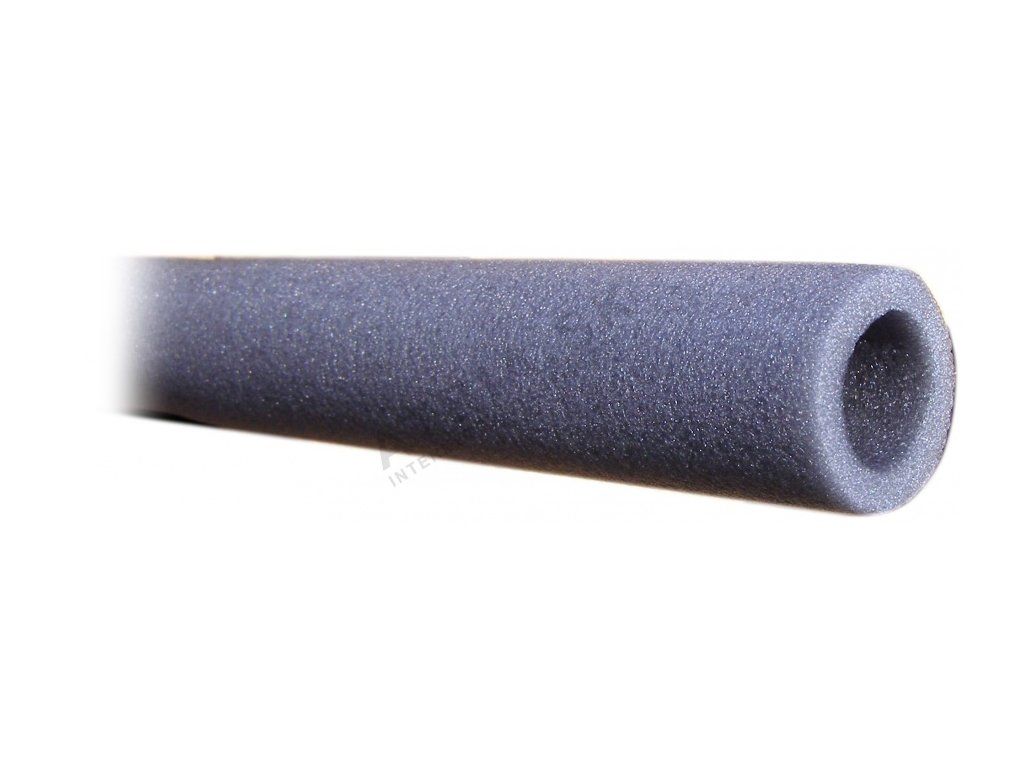
Insulation 22 mm (1/2") / 9 mm
Price: €0.86
Sleeve-type thermal insulation for pipe, wall thickness 9 mm, for pipe with a diameter of 22 mm. Reduces heat loss and prevents condensation of moisture on the pipe surface.
When installing a new run or renovating one, it also makes sense to go through the entire installation procedure including the mandatory pressure test, which reveals any leaks before the pipe is covered with plaster or screed – you'll find the detailed procedure in the article Pipe installation – procedure and pressure test.
Real-world examples
Switching to wider pipe (26 mm instead of 16 mm) eliminated the flow noise.
Example 1: Family house with noisy pipes after a boiler replacementIn a family house, the original boiler was replaced with a new, more powerful model, but the heating runs stayed the original ones, sized for the older, less powerful boiler. After the replacement, noticeable noise appeared in the main riser run as the water flowed, especially when the circulation pump was working at higher output. On inspection it turned out that the main run had too small a diameter for the new, higher flow needed by the more powerful boiler. The solution was to replace a section of the main riser run with wider-diameter pipe (26 mm instead of the original 16 mm), which handled the higher flow without pressure losses or noise. This case shows why it's important, when replacing a heat source, to always check the sizing of the existing runs too, not just the boiler itself.
Example 2: Panel-building flat with repeated corrosion of the circulation pump
In a panel-building flat, over the course of several years there were repeated seizures and failures of the circulation pump in the heating circuit, even though the pump had been replaced with a new unit several times. Only on closer inspection of the system was it discovered that part of the heating circuit had been extended, during a previous partial renovation, with pipe without an oxygen barrier, originally intended only for cold water distribution. Oxygen penetrating through the wall of this pipe was gradually causing corrosion inside the system, which showed up precisely as repeated pump failures and deposits in the system. The fix consisted of replacing the incorrectly used section of pipe with pipe that has an oxygen barrier, and cleaning out the entire heating circuit. This case, in turn, shows why it never pays to reach for cheaper pipe without an oxygen barrier for any intervention in a closed heating circuit, even if it's "only" a short supplementary section.
Frequently asked questions about pipe servicing and faults (FAQ)
Typical signals of a fault directly on the pipe, according to the article's FAQ.
How do I recognise I have a pipe problem, and not, say, a boiler or pump problem?Typical signals of a problem directly on the pipe are damp patches on walls or the ceiling, dripping or a wet spot around a joint or fitting, noise (humming, hissing) as water flows in the run, or a drop in system pressure with no obvious cause on the boiler or pump side. If the fault shows up only in one place or section of the system, it's more likely to be the pipe or a joint than the heat source itself.
Is it worth replacing old steel pipe with new during a renovation?
Steel pipe is used in new installations today only exceptionally, precisely because of its susceptibility to corrosion from the inside without proper water treatment. When renovating an older run where signs of corrosion are already showing (worsened flow, rusty water when draining the system), replacing it with modern plastic-aluminium pipe with an oxygen barrier is generally a sensible investment that reduces the likelihood of further servicing work.
Does pipe for drinking water distribution need an oxygen barrier too?
The oxygen barrier mainly addresses protecting the metal parts of a closed heating circuit (boiler, pump, radiators) against corrosion caused by atmospheric oxygen penetration. For drinking water distribution, which isn't part of a closed heating circuit, this problem isn't a threat to the same degree, since the water in the run is continuously replaced and doesn't circulate in a closed loop through metal parts prone to corrosion.
What's the difference between a press and a screwed joint in terms of future servicing?
A screwed joint can be taken apart and reassembled at any time without special tools, which is advantageous in places where future intervention is anticipated (valves, manifolds, appliance connections). A press joint is permanent and non-detachable – in case of a fault, the damaged section is simply cut out and replaced with a new one. The choice between them should take into account whether that spot in the system is likely to need future access.
Why does my pipe hum when I turn the hot water on full?
The most common cause of noise as water flows is pipe that's too narrow relative to the required flow, causing high pressure losses. The solution is generally to replace the section in question with wider-diameter pipe – additionally adjusting the flow rate will generally only reduce the problem, not eliminate it fully.
Is it better to route new pipe under plaster, or on the surface?
It depends on the space and the likelihood of future servicing. In living rooms, concealed routing is commonly chosen for aesthetic reasons, even though any repair then requires breaking open the wall or floor. In technical spaces (boiler room, cellar, garage) and for elements with a higher likelihood of future intervention (manifolds, valves), it pays to leave the pipe accessible on the surface, even at the cost of lower aesthetics.
How do I know if my underfloor heating pipe has an oxygen barrier?
PEX-AL-PEX type pipe (thanks to the middle aluminium layer) and PE-RT type pipe with an EVOH layer, which are specifically designed for heating circuits including underfloor heating, have an oxygen barrier as standard. When buying pipe intended for heating, it's worth checking for the presence of an oxygen barrier directly in the product's technical description.
Why is it important to insulate pipe routed through a cellar or attic?
On longer runs routed through unheated spaces without insulation, water noticeably cools down on its way to the fixture, meaning higher energy consumption to reheat it and a longer wait for hot water. For cold water runs, insulation also prevents condensation of moisture (sweating) on the pipe surface, which can damage surrounding structures over the long term.
Related topics
- How to choose pipe for water and heating
- PEX-AL-PEX vs. copper vs. steel pipe
- What pipe diameter do I need
- Concealed vs. surface-mounted routing
- Oxygen barrier – why it matters in heating pipe
- Ways of joining pipe – screwed, press, welded
- Pipe insulation – why and how to insulate piping
- Pipe installation – procedure and pressure test
- Frequently asked questions about pipe for water and heating
Have a question about pipe for water or heating?
Not sure what to choose, or dealing with a specific situation in your home? Write to us – we're happy to help.