
Oxygen barrier – why it matters in heating pipe
When choosing pipes for heating, most people focus mainly on diameter, material and price per metre. A less obvious property that matters just as much in the long run is the oxygen barrier – a layer within the pipe wall that prevents atmospheric oxygen from entering the closed heating circuit. While this property plays no role at all in a drinking water pipe, in a heating pipe it determines how long the boiler, circulation pump, radiators and the piping itself last without corrosion problems.
This article explains exactly what an oxygen barrier is, how it works, why it is practically essential in closed heating circuits, and how its absence shows up. Along the way we'll look at how the oxygen barrier relates to the choice of pipe material (PEX-AL-PEX vs. copper vs. steel pipe), to the pipe diameter, to how the pipe is routed in the building, and to how individual sections are joined and insulated. The goal is that after reading it you can judge for yourself whether the pipe you are planning to use (or already have in your house) is suitable for a heating circuit, or whether you risk problems that will only fully show up years later.
If you are dealing with a complete overhaul of your piping, we also recommend the general overview How to choose pipes for water and heating – this article instead goes deep specifically into the topic of the oxygen barrier, which in practice is often underestimated or not even recognised by installers or customers as a separate selection criterion.
What is pipe for water and heating, and why does the choice matter
Pipe for water and heating carries hot or cold water between the source (boiler, water meter) and the individual points of use – radiators, taps, underfloor heating circuits. At first glance it looks like a simple installation component, but in reality the choice of material and diameter affects several important parameters at once: the lifespan of the whole system, pressure losses during water flow, ease and speed of installation, and, not least, the overall cost of the installation.
For cold or hot tap water distribution, the main concerns are hygiene, resistance to water pressure and lifespan. For heating pipe – that is, pipe that is part of a closed circuit between the boiler and the heat emitters – there is an additional, critically important requirement: protection against atmospheric oxygen entering water that circulates in the system long-term without being replaced. This requirement is exactly why pipe intended solely for drinking water distribution cannot automatically be used for a heating circuit as well, even if it has the same diameter and a similar price.
Oxygen as the silent enemy of a heating system
A closed heating circuit works on the principle that water filled in once (or a mixture of water and antifreeze) circulates in the system long-term – ideally for years without needing significant topping up. This is a fundamental difference compared to drinking water distribution, where water constantly flows through and is continuously replaced with fresh water. That is precisely why it is a much more sensitive question, in a heating circuit, what gradually gets into the water in the system from outside.
Atmospheric oxygen is one of the main triggers of corrosion in the metal materials that water in the system comes into contact with – the steel parts of the boiler, the circulation pump, steel radiators, and older steel piping. If oxygen continuously penetrates into the water through the pipe wall (even when the pipe looks perfectly fine on the outside, with no visible leak), it gradually accumulates in the closed circuit and triggers a long-term corrosion process on all the metal parts that the water comes into contact with. This process is in no way dramatic or immediately visible – it takes place slowly, over months to years, which is exactly why the consequences are often attributed to other causes (an ageing boiler, a worn pump) instead of the real cause, which is pipe without an oxygen barrier.
The oxygen barrier is therefore a property that does not show up at all on the pipe during a normal inspection or during installation – the difference between pipe with a barrier and without one is invisible to the naked eye, and only shows up years later in the condition of the whole system. This is the main reason why it is important to know and verify this property before purchase, not only once the first signs of corrosion appear.
How the oxygen barrier works in practice
The oxygen barrier is a layer within the construction of the pipe wall that prevents diffusion (gradual penetration) of atmospheric oxygen through the pipe material into the water flowing through it. You will most commonly encounter it in two forms, depending on the base material the pipe is made from.
In multilayer plastic-aluminium PEX-AL-PEX pipe, the oxygen barrier is formed by the aluminium layer itself, which is part of the pipe wall's construction – located between the inner and outer plastic layers. Aluminium is inherently impermeable to gases, so if this middle layer is present in the pipe and undamaged (for example, not damaged during bending or cutting), it reliably stops oxygen diffusion into the water inside the pipe. The same aluminium layer also has a second useful property – it gives the pipe shape memory, thanks to which the pipe holds its shape after being bent, without needing further fixing along its whole length.
In PE-RT pipe (heat-resistant polyethylene, without an aluminium layer), the oxygen barrier is solved differently – a special EVOH layer (ethylene vinyl alcohol) is added, which has the same function as aluminium in PEX-AL-PEX pipe, i.e. it prevents oxygen penetration, but without a metal layer in the wall construction. This type of pipe is commonly used precisely for underfloor heating, where long runs of pipe are laid in loops in the screed and flexibility without an aluminium layer is an advantage.
The common denominator of both solutions is the principle – somewhere in the cross-section of the pipe wall there must be a layer (metal or a special plastic) that acts as a barrier to gases. Without such a layer, the pipe wall (for example in ordinary, cheaper PEX pipe without an additional layer) is partially permeable to oxygen, even though it looks the same from the outside as pipe with a barrier.
The oxygen barrier in the pipe wall stops atmospheric oxygen from entering the water in the circuit.
PEX-AL-PEX, copper and steel pipe – which one has an oxygen barrier
When deciding between pipe materials, the oxygen barrier is just one of several criteria, but for a heating circuit it is one of the most important. You'll find a detailed comparison of all properties in the separate article PEX-AL-PEX vs. copper vs. steel pipe; here we'll look specifically at how each material fares in terms of oxygen protection.
PEX-AL-PEX (multilayer plastic-aluminium pipe) has the oxygen barrier built directly into its construction thanks to the middle aluminium layer, as described above. It is therefore a material that is reliably protected against oxygen diffusion across its entire surface, and this is also one of the main reasons why it is so often used today precisely for heating circuits and underfloor heating.
Copper pipe is a traditional, very durable material – it handles high temperatures and high pressure better than plastic alternatives and has a long history of use in heating systems. Copper itself is not prone to corrosion in the way that, for example, steel pipe is when in contact with oxygen, but other metal components in the same circuit (the boiler's steel body, the circulation pump, or possibly steel radiators) are still exposed to oxygen-induced corrosion even when the pipe itself is copper. Copper pipe is also more expensive than plastic alternatives, and its installation (soldering) requires more skill and work with an open flame, which makes installation longer and more expensive compared to pressed or screwed plastic solutions.
Steel pipe is used in new heating installations today only exceptionally – you'll find it more in older systems or industrial applications. Its main disadvantage is that it is itself prone to corrosion from the inside if the water in the system is not properly treated (chemically conditioned) – combined with the presence of oxygen in the circuit (for example due to a missing barrier on another part of the system made of a different material), the corrosion process is further accelerated. When renovating an older heating system with original steel pipe, choosing new pipe with an oxygen barrier is therefore even more important – it protects the remaining steel elements of the system that stay in the installation.
Comparison of the three most commonly used pipe materials in terms of the oxygen barrier.
For a typical modern heating circuit installation (radiators as well as underfloor heating), the most common and recommended choice is therefore plastic-aluminium PEX-AL-PEX pipe with an oxygen barrier – it combines easy and fast installation, shape memory after bending, and reliable protection of the water in the circuit against oxygen.
 |
PEX-AL-PEX pipe 16 x 2 for heating, underfloor heating and water Multilayer plastic-aluminium pipe with an oxygen barrier, 16 mm diameter – universal use for water and heating, a common choice for individual underfloor heating circuits. Price: €0.66/m |
 |
PEX-AL-PEX pipe 26 x 3 for heating, underfloor heating and water Same construction with an oxygen barrier, larger 26 mm diameter – suitable for main riser lines and sections with higher water flow. Price: €1.62/m |
What diameter of pipe to choose when dealing with the oxygen barrier
Price rises with pipe diameter – both sizes have the same oxygen barrier.
Pipe diameter is a separate topic from the oxygen barrier – the barrier protects the water against oxygen ingress regardless of what diameter the pipe has, but in practice, when choosing a specific pipe, both parameters are addressed together. Pipe diameter is chosen according to the required water flow and the length of the run. For underfloor heating and individual circuits, 16 mm is commonly used; for main riser lines or longer sections with higher flow, 20 to 26 mm and above is used.
Pipe that is too narrow for the required flow causes high pressure losses and noise as the water flows – the circulation pump has to work against greater resistance, which also affects its lifespan and energy consumption. Unnecessarily wide pipe, on the other hand, needlessly increases the cost of the installation (more material, larger fittings) and slows down the arrival of hot water in the run, since the volume of water that needs to be heated on every start of circulation is larger.
In practice, this means that designing a heating circuit combines a smaller diameter (16 mm) for individual underfloor heating circuits or short runs to radiators with a larger diameter (26 mm and above) for the main lines, through which water flows towards several circuits at once. Both diameters can (and, for a heating circuit, should) have the same oxygen barrier – it is not a case of "either diameter or barrier", but two parameters that are addressed at the same time. You'll find a detailed guide on calculating and choosing the right diameter in the article What pipe diameter do I need.
Concealed vs. surface-mounted routing, and why the oxygen barrier matters equally for both
How the pipe is routed in the building is another decision that is made independently of the oxygen barrier choice, but combined with it, it strongly affects how noticeable any missing barrier becomes when it comes to fixing a problem. Concealed routing is pipe embedded in a wall or floor under plaster or screed – it looks aesthetically clean, since after the building work is finished no pipe or joints are visible, but in case of a fault (for example a leak) it requires breaking open the wall or floor to repair it.
It is precisely with concealed routing that the oxygen barrier matters even more – if pipe without a barrier were to gradually cause corrosion of the boiler, pump or radiators, the fix would take place on these visible and easily accessible components, but the concealed pipe itself stays built into the structure for years without the possibility of easy inspection. Investing in pipe with an oxygen barrier is therefore, for concealed routing, essentially a one-time opportunity to make the right decision – replacing embedded pipe afterwards is far more costly and complicated than with surface-mounted routing.
Surface-mounted routing, by contrast, is visible, run along the surface of the wall, often in trunking or completely openly. Installation and any repair are simpler, since the pipe is directly accessible at any time, but visually this solution is less attractive, so it is used mainly in technical spaces such as the boiler room, cellar or garage. Even with surface-mounted routing, the oxygen barrier protects the rest of the system in the same way – better pipe accessibility only solves the question of convenience of any repair to the pipe itself, not protection of the boiler, pump and radiators from oxygen-induced corrosion. You'll find more on choosing between the two routing methods in the article Concealed vs. surface-mounted routing.
Ways of joining pipe with an oxygen barrier
How individual sections of pipe are joined is another practical decision made during installation, one that is directly connected to how the system will be worked on during future servicing. In practice, you'll most often encounter three joining methods.
Screwed (compression) joints are secured mechanically with a union nut and a sealing ring. The advantage of this solution is that the joint can be taken apart and reassembled at any time without special tools, which you will especially appreciate during servicing – for example when replacing a fitting or when a particular section of the run needs to be temporarily disconnected.
Press joints are made with special pressing pliers that permanently deform a metal sleeve around the pipe and fitting. The joint is faster to install over a larger scope (advantageous for example in a more extensive installation with many joints) and is permanent, i.e. non-detachable, which in turn requires the installation company to invest in pressing tools.
Welding is used mainly with PP-R plastic pipe and joins the pipe and fitting by melting the material – it creates a homogeneous, permanent joint and is common for both cold and hot water distribution.
The joining method itself has no direct effect on whether the pipe has an oxygen barrier or not – that is determined by the construction of the pipe wall itself (the material and its layers), not by the type of fitting or joining method. When choosing a joining method, it therefore makes sense to decide mainly based on how often you expect to need servicing (in favour of screwed joints) or based on speed and cost of installation for a larger project (in favour of press joints). You'll find a more detailed comparison of all three methods in the article Ways of joining pipe – screwed, press, welded.
Thermal insulation of pipe and its connection to the heating circuit
Pipe insulation is a topic that doesn't directly concern the oxygen barrier, but in a comprehensive approach to heating installation it is addressed in the same project phase, so it's worth mentioning here too. Sleeve-type thermal insulation, usually made of foamed polyethylene, is slipped over the pipe and reduces the heat loss of the run.
Insulation matters especially for longer runs of hot water or heating circuit routed through unheated spaces, such as a cellar or attic – without insulation, the water would noticeably cool down on its way to the fixture (radiator, hot water outlet), meaning energy loss and a slower rise to the required temperature. For cold water distribution, insulation has a different, but equally practical function – it prevents condensation of moisture on the pipe surface, i.e. so-called sweating, which can damage surrounding structures over the long term.
Just like with the joining method, pipe insulation is not directly related to the presence or absence of an oxygen barrier in the pipe wall either – these are two separate properties of the piping system that are, however, addressed together when designing a complete installation. Quality pipe with an oxygen barrier routed through an unheated space without insulation will still lose part of its heat along the way, even though the corrosion protection remains functional. You'll find more on choosing the thickness and type of insulation in the article Pipe insulation – why and how to insulate piping.
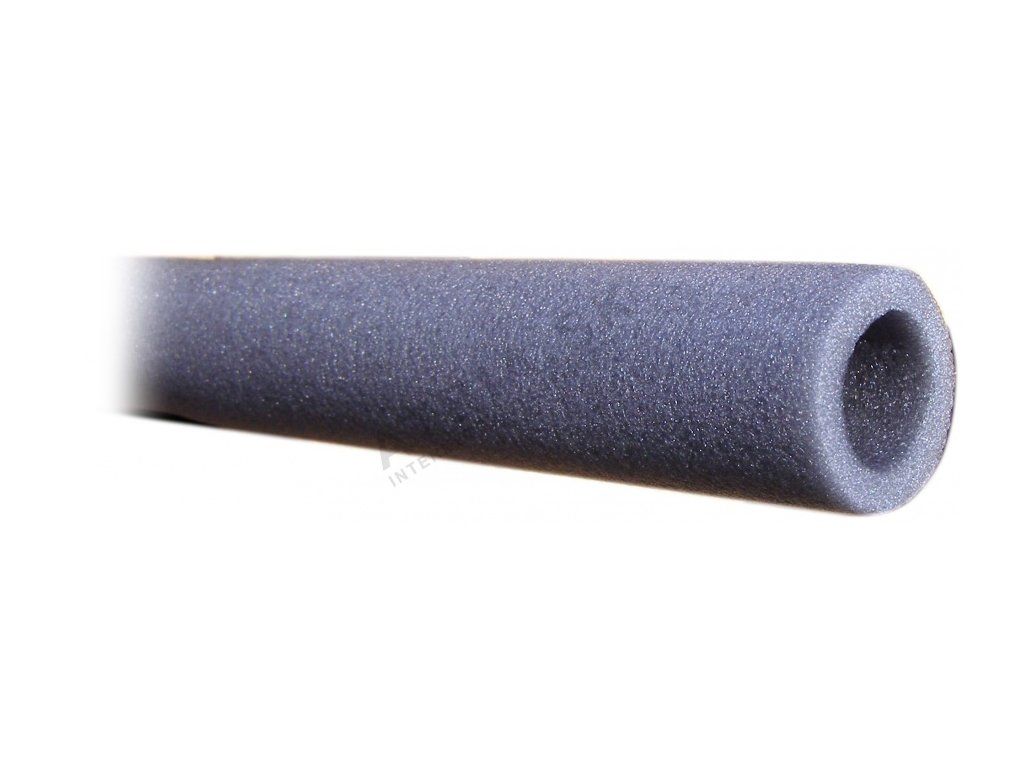 |
Insulation 22 mm (1/2") / 9 mm Sleeve-type thermal insulation for pipe, wall thickness 9 mm, for pipe with a diameter of 22 mm – reduces the heat loss of runs routed through unheated spaces. Price: €0.86 |
Underfloor heating and the oxygen barrier – why it is especially important here
Underfloor heating is a typical example of an installation where tens to hundreds of metres of pipe are laid directly in the floor screed during construction or renovation – it is therefore an extreme case of concealed (or rather "under-screed") routing, where subsequent access to the pipe is practically impossible without extensive intervention in the entire floor. That is exactly why the oxygen barrier is handled especially carefully for underfloor heating – the pipe is not bought for one season, but for the entire lifespan of the floor.
Two types of pipe with an oxygen barrier are commonly used on the market for underfloor heating – plastic-aluminium PEX-AL-PEX (with a middle aluminium layer) or PE-RT pipe with a special EVOH layer, which is more flexible and suited precisely to the dense loops laid in the floor. Both types perform the same function of protecting the water in the circuit against oxygen, differing mainly in flexibility, shape memory and the installation habits of the particular contractor.
 |
HEPWORTH pipe for underfloor heating, 16 mm PE-RT pipe with an oxygen barrier (EVOH layer), specifically designed for underfloor heating – 16 mm diameter corresponds to the common standard for individual circuits in the floor. Price: €1.48/m |
What is the risk if pipe has no oxygen barrier
If pipe without an oxygen barrier is used in a closed heating circuit, oxygen from the air gradually diffuses through the pipe wall into the water in the system. This water then circulates through the entire circuit and comes into contact with all the metal components – the internal parts of the boiler, the circulation pump, the radiator bodies, and possibly older steel sections of the run, if present in the system.
The result is gradual corrosion of these metal parts. In the circulation pump, corrosion can show up as wear of the moving parts and a shortened pump lifespan. In the boiler, it is a more sensitive matter, since the heat exchanger and other internal components are key to the safe and efficient operation of the entire heat source. In steel radiators or older steel piping, corrosion can gradually show up even with visible symptoms from the inside, such as worsening water circulation or deposits in the system.
Since this process takes place slowly and is not directly visible during normal operation, it is often only discovered once a specific problem appears – a pump failure, uneven radiator heating, or during a boiler service call. By that point, the original pipe without an oxygen barrier has long been built into the structure (especially with underfloor heating or concealed routing), and replacing it is far more difficult than it would have been with the right choice of barrier-equipped material from the start.
Real-world examples
The oxygen barrier must be handled at the level of the whole circuit, not just its largest part.
Family house with underfloor heating and supplementary radiators in the bathroomsIn a new-build family house, the main heating area is handled by underfloor heating, but classic radiators are also added in the bathrooms and utility room, connected to the same closed circuit as the underfloor heating. In such a case it is essential that not only the pipe laid in the floor has an oxygen barrier (which is usually automatically remembered when choosing, since it's the standard for underfloor heating), but also the pipe leading to the radiators, which is part of the same circuit. If part of the run to the radiators were handled with cheaper pipe without a barrier (for example to save money on a smaller section), oxygen penetrating through that part of the run would put the boiler and circulation pump at risk regardless of the rest of the system (the underfloor heating) having an intact barrier. The oxygen barrier must be handled at the level of the entire closed circuit, not just at the level of its largest or most visible part.
Panel-building flat renovating the original radiator piping
When renovating a flat with original steel piping to the radiators several decades old, part of the pipe (for example a section routed in a new partition wall or when moving a radiator to a different spot) is replaced with new material, while the rest of the original steel piping in the flat remains, since replacing it completely would mean extensive work in every room. In this scenario, choosing new pipe with an oxygen barrier is especially important – the new pipe doesn't just protect itself, its barrier also helps limit the total amount of oxygen that gets into the shared circuit (common to the whole building or its branch). Since the remaining steel sections of the run are already more prone to corrosion, consistently maintaining the oxygen barrier at least on the newly added sections helps slow down further deterioration of the whole shared system.
Frequently asked questions about the oxygen barrier in pipes
What exactly does an oxygen barrier in pipe mean?
It is a layer within the pipe wall (most often an aluminium layer in PEX-AL-PEX, or a special EVOH layer in PE-RT pipes) that prevents atmospheric oxygen from penetrating through the pipe wall into the water inside a closed heating circuit.
Why is the oxygen barrier important specifically for heating, and not for drinking water distribution?
In drinking water distribution, water constantly flows through and is replaced with fresh water, so oxygen does not accumulate in it. In a closed heating circuit, by contrast, the same water circulates long-term without being replaced, so even gradually penetrating oxygen accumulates in the system and causes corrosion of metal parts – the boiler, pump, radiators and steel piping.
How do I know whether a specific pipe has an oxygen barrier?
In PEX-AL-PEX pipe, the barrier is the middle aluminium layer, which is part of the standard construction of this type of pipe. In PE-RT pipe, it's an added EVOH layer. This property should be stated directly in the product description – when buying pipe intended for a heating circuit, it's worth checking for the presence of a barrier in the description, since visually, to the naked eye, pipe with a barrier and without one cannot be reliably distinguished.
Can an oxygen barrier be added afterwards to pipe that doesn't have one?
No, the oxygen barrier is part of the construction of the pipe wall and is created directly during manufacturing (the aluminium layer in PEX-AL-PEX, the EVOH layer in PE-RT). It cannot be added afterwards to pipe already built in without a barrier – the only remedy is to replace that section of pipe with a type that has a barrier.
Does it make sense to address the oxygen barrier with copper pipe too?
Copper itself is not prone to corrosion the way, for example, steel pipe is when in contact with oxygen, but other metal components in the same closed circuit (for example the boiler's steel body, the circulation pump, or steel radiators) are exposed to oxygen-induced corrosion even when the pipe itself is copper. The oxygen barrier is therefore addressed at the level of the whole circuit, not just one material used in part of it.
Does even a short section of pipe to a single radiator need an oxygen barrier?
Yes. The oxygen barrier must be handled at the level of the entire closed circuit – if even a short section of the run lacked a barrier, oxygen penetrating through that section would spread throughout the closed system and put more distant components, such as the boiler or circulation pump, at risk, not just that local section.
Is the oxygen barrier related to the diameter or the joining method of the pipe?
No, the oxygen barrier is determined by the construction of the pipe wall (the material and its layers), while the diameter is chosen according to the required flow and the length of the run, and the joining method (screwed, press, welded) according to installation preferences and the need for future servicing. These are three separate, mutually independent decisions that are addressed together when designing an installation.
Does a missing oxygen barrier show up immediately, or only over time?
It only shows up over time – it is a gradual corrosion process that takes place over months to years. That's exactly why the consequences (pump wear, boiler problems, worsened circulation in radiators) are often mistakenly attributed to another cause instead of the real source of the problem, which is pipe without an oxygen barrier.
Where can I find more information about installing and pressure-testing pipe with an oxygen barrier?
The installation procedure as well as verifying tightness of the run before it is finally covered (for example before being embedded in screed for underfloor heating) is described in the separate article Pipe installation – procedure and pressure test. If you're already operating the system and dealing with a specific problem, also check out the article Servicing and common problems with pipe.
Related topics
- How to choose pipe for water and heating
- PEX-AL-PEX vs. copper vs. steel pipe
- What pipe diameter do I need
- Concealed vs. surface-mounted routing
- Ways of joining pipe – screwed, press, welded
- Pipe insulation – why and how to insulate piping
- Pipe installation – procedure and pressure test
- Servicing and common problems with pipe
- Frequently asked questions about pipe for water and heating
Have a question about pipe for water or heating?
Not sure what to choose, or dealing with a specific situation in your home? Write to us – we're happy to help.