
Most Common Backup Power Source Failures
Most households buy a backup source with a clear goal - so that the boiler, circulation pump or control electronics survive a power outage without the house getting cold or the pipes freezing. The problem arises the moment the source is finally "tested" by a real outage, after months or years of quiet operation - and it fails exactly when it's needed most. Across dozens of service jobs and questions from atria.sk customers, a handful of causes keep repeating, making up the vast majority of failures. In this article we go through them one by one, show how they show up, why they happen, and what to do about them - including when it's worth repairing the source and when it's more sensible to replace it.
Why backup sources fail exactly when you need them most
A backup source (UPS) is, in essence, a simple device - a rectifier/charger, a battery, and an inverter that turns the battery's DC voltage into the 230 V AC the boiler or pump needs. Precisely because it's simple, it can appear to work flawlessly for a long time - the indicator light is on, the fan isn't spinning, everything looks fine. The real test only comes during a mains outage, when the source has to switch the load onto the battery within a fraction of a second. If even one link in the chain (battery, charging circuit, inverter, fuse, connector) is weakened, the whole system fails - and the owner only finds out the moment the boiler goes dark in the middle of a freezing night.
From a service perspective, it makes sense to split failures into two groups: battery failures (the most common, dictated by the physics of lead-acid batteries) and electronics/sizing failures (less common, but causing bigger problems since they show up right at first use). Below is an overview of what we encounter most often in practice - the percentages are based on typical experience with service claims for backup sources for boilers and circulation pumps.
Failure #1: A discharged or worn-out battery
This is clearly the most common cause of failure - by our estimate it's behind almost half (45%) of all claims and service calls. Lead-acid batteries (AGM or gel type), the ones most commonly used in backup sources, have a physically limited lifespan. It's not really a "fault" in the strict sense, more natural wear that most users don't notice until it's too late.
Typical lifespan varies by technology:
- AGM battery - usually 3 to 5 years with correct charging and room-temperature surroundings.
- Gel battery - somewhat more resistant to deep discharge, usually 5 to 7 years.
- Lithium (LiFePO4) battery - the longest lifespan, 8 to 10 years even with more frequent cycling, but a higher purchase price.
The problem is that a battery doesn't fail "all at once" after 3-4 years of operation - its capacity gradually declines, so a source that was rated to last 90 minutes when new might only last 20 minutes after three years, and nobody finds out until a real outage longer than a few minutes occurs. High temperature in the boiler room (above 25 °C) accelerates this process further - as a general rule, every +10 °C above the recommended operating temperature roughly halves a lead-acid battery's lifespan.
The solution depends on the source's age. If the device as a whole (inverter, electronics) is fine and it's just the battery that's worn out, replacing the battery alone is usually enough - it works out considerably cheaper than a whole new source and extends the device's life by several more years. But if the source is older than 6-7 years and the battery isn't the only problem (for example a worn inverter or a noisy fan on top of it), investing in a new device makes much more economic sense.
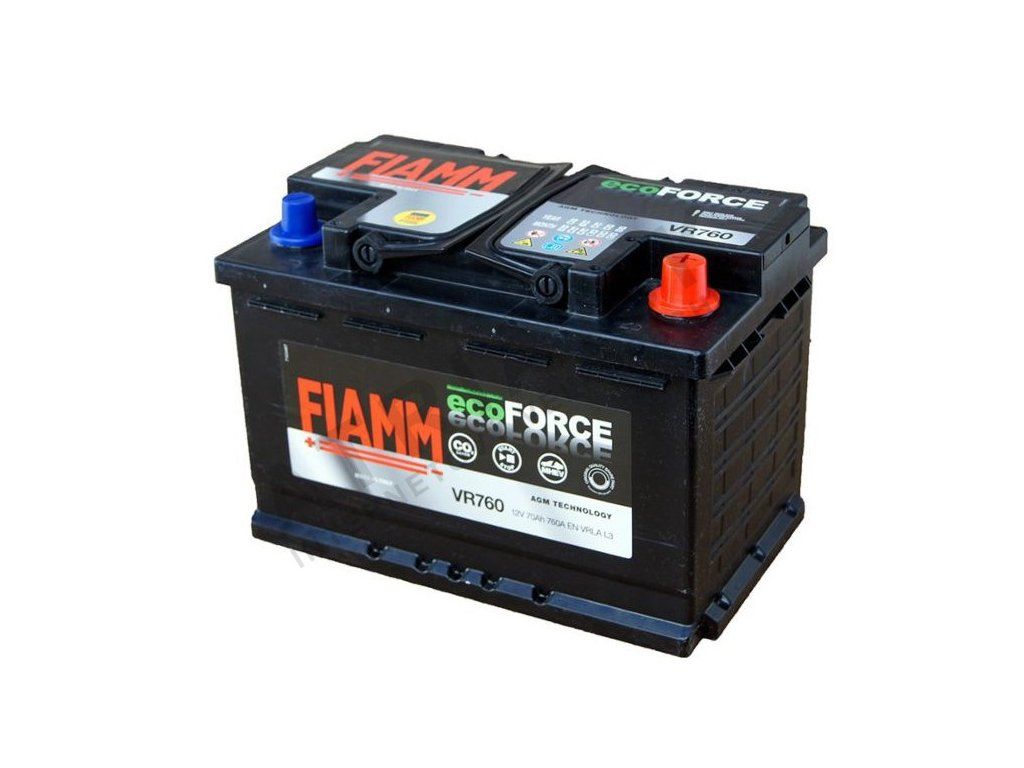 |
FIAMM ECOFORCE AGM VR 760 - a quality AGM replacement battery from a proven manufacturer, suitable as a direct replacement in most common backup sources for boilers. If your original battery is already 3-4 years old and the source holds less than half its original runtime, this is usually the cheapest and fastest fix. Price from 178.56 EUR. |
Failure #2: Incorrectly sized power output
The second most common cause (an estimated 20% of cases) has nothing to do with wear - it's a mistake made right at the selection stage. The customer buys a backup source based on price or a rough guess, without calculating the actual draw of the boiler and all connected components (circulation pump, weather-compensation controller, burner fan). Result: the source does start up during an outage, but immediately overloads or shuts down shortly after starting, because the pump's or fan's inrush current exceeds its capacity.
A typical scenario from practice: a condensing boiler with a circulation pump has a rated draw of around 100-150 W, but the pump's inrush (startup) current can briefly require 2-3 times its steady-state consumption. If the backup source's reserve is right at the edge, every pump restart causes an overload and the source shuts down protectively - the user then mistakenly thinks it's a "battery fault", when it's actually purely a matter of undersizing.
The solution is simple, but requires a bit of calculation at the buying stage: add up the rated draw of everything the source needs to power (boiler, circulation pump, possibly a weather-compensation controller too), add the pump's inrush current, and finally add a reserve of at least 30%. For an ordinary family house with a condensing boiler and one circulation pump, sources with an output of 300-500 W are most often recommended in practice; for larger houses with several pumps or zone control, 1000 W and above.
 |
Avansa 300 W - suitable for a smaller condensing boiler with one circulation pump and the control electronics, where higher outputs aren't needed and would only make the investment more expensive. Price from 177.64 EUR. |
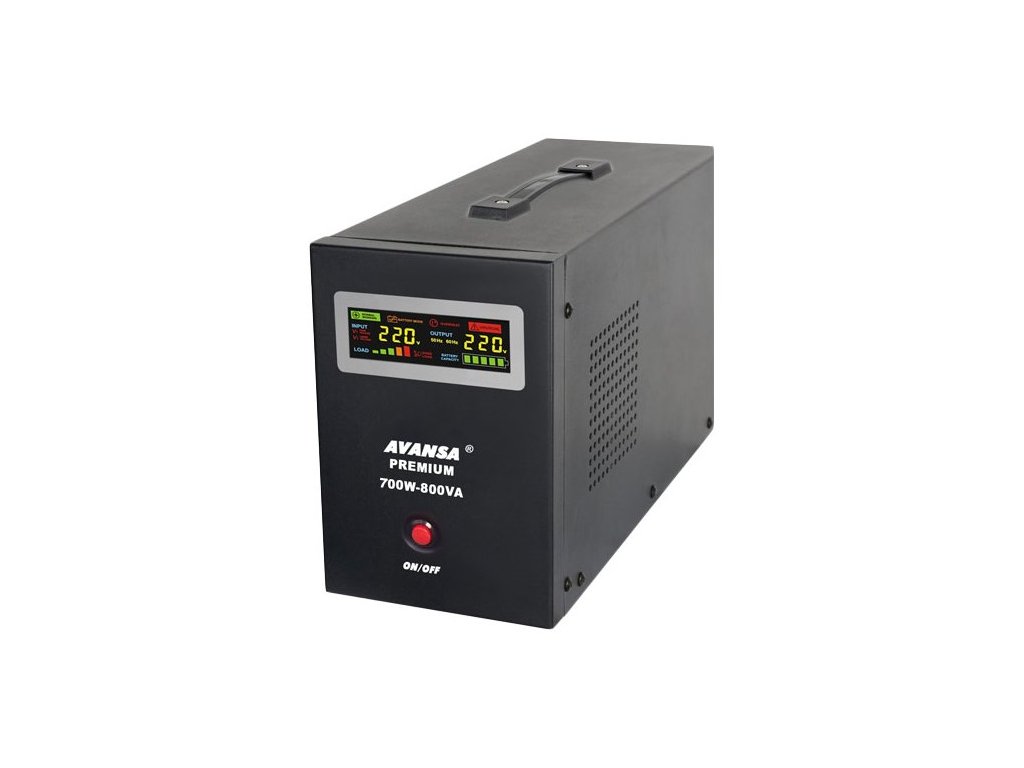 |
Avansa 1050 W - a sufficient reserve for houses with several circulation pumps, zone control, or a boiler with a higher-draw burner fan, where lower outputs regularly run into overload. Price from 385.33 EUR. |
Failure #3: Overheating and clogged ventilation
The third most common cause (an estimated 15% of cases) relates to where the source is installed. Backup sources are, in the vast majority of households, installed in a boiler room or utility room - exactly where humidity is high, dust accumulates, and the temperature is often elevated by the boiler itself. Both the battery and the source's electronics are sensitive to heat: the higher the ambient temperature, the faster the battery ages, and the higher the risk of the electronics overheating under load and shutting down protectively.
In practice we most often see these installation mistakes:
- The source is built into a closed cabinet with no ventilation openings, even though the manufacturer requires at least 10-15 cm of free space around the vents.
- After years of operation the device's ventilation grilles are clogged with dust and cobwebs, significantly restricting airflow through the cooling.
- The source is placed directly above the boiler or right next to the chimney/flue pipe, where the ambient temperature is permanently higher than in the rest of the room.
- The room has no ventilation at all, and in summer the boiler room temperature routinely exceeds 30 °C.
The fix usually doesn't require buying anything - just place the source so it has free space on all sides around the vents, blow out or vacuum the grilles regularly (at least once a year), and ideally choose an installation spot where the temperature doesn't fluctuate significantly over the year. For a new installation it's also sensible to choose a room with at least minimal natural ventilation instead of a completely sealed space.
Failure #4: A faulty or worn-out inverter
The inverter is the "brain" of the whole source - it converts the battery's DC voltage into the 230 V AC the boiler needs. In cheaper or older devices, after years of operation the inverter can start producing a distorted voltage waveform (a so-called modified sine wave instead of a pure sine wave), which, with more sensitive boiler electronics, causes odd behaviour - a flickering display, error messages, or even the burner refusing to start, even though the power supply is "technically" working.
Another typical symptom of a worn-out inverter is a loud buzzing or humming sound during battery operation, or a burning smell from inside the unit - that's already a sign not to delay replacement, since permanent damage or, in a worse case, even fire risk is possible. Unlike the battery, the inverter can't be replaced on its own (it isn't a common consumable part), so in most cases when it fails it's more economical to get a whole new source, especially if the original device is older than 5 years.
 |
FIAMM ECOFORCE AFB TR 720 - if you decide on a complete replacement instead of repairing the inverter, this is a proven replacement battery, also suitable as part of a planned overhaul of the whole backup system together with a new source. Price from 146.58 EUR. |
Failure #5: Frequent "false" switching to battery
Some customers complain that the source switches to battery operation even when no real power outage has occurred - the boiler "blips" for a couple of seconds (you hear a relay click, or a short beep from the source), yet the lights in the house never went out at all. This isn't a fault of the source itself, but a reaction to a brief dip or fluctuation in the mains voltage (for example when a large appliance starts up elsewhere in the house, or fluctuations from the utility), which the human eye can't detect through a light bulb but the backup source's sensitive electronics can.
If this happens repeatedly (several times a day), it's worth checking two things: first, whether the switching threshold is set too sensitively in the source's own settings (some models allow this to be adjusted), and second, whether the problem lies in the house's electrical wiring itself (a loose connection, an overloaded protected circuit). Frequent unnecessary switching also wears out the battery and the source's relay faster than normal operation would, so it shouldn't be dismissed as a "harmless quirk".
Failure #6: Battery sulfation after long inactivity
The last common cause (also an estimated 10% of cases, partially overlapping with failure #1) mainly concerns cottages, holiday homes or households where the heating is switched off completely over summer and the backup source goes months without any charge/discharge cycle. Lead-acid batteries that remain partially or fully discharged for a long time are subject to a phenomenon called sulfation - crystals of lead sulfate form on the electrodes, reducing the battery's capacity and, in extreme cases, damaging it irreversibly.
The fix is simple and costs nothing extra: even if you're not using the source directly over summer, leave it plugged into the mains so the battery is kept charged by the trickle/float current that almost every modern backup source has built in. If you disconnect the device completely from the mains (for example when shutting a cottage down for winter), it's recommended to manually recharge the battery at least once every 2-3 months, otherwise you risk finding significantly reduced capacity, or a completely dead battery, come spring.
How to spot an approaching failure before an outage happens
Most of the failures described above can be avoided if you know what signals to watch for before a real power outage occurs. The most reliable warning signs include:
- Shorter test runtime. Most sources have a button or automatic battery test - if the time the source lasts during the test has noticeably shortened compared to last year, the battery is losing capacity.
- Change of colour or flickering of the LED indicator. A shift from green to orange/yellow, or flickering during normal operation (not just during an outage), usually signals a charging or battery problem.
- Sounds. Unusual beeping, relay clicking for no apparent reason, or buzzing/humming from inside the device.
- Smell. A burning smell or a "sour" smell (typical of a damaged lead-acid battery) is always a reason for immediate inspection, not for putting it off.
- Age of the device. If the battery has been in service for 4 or more years and has never been replaced, the probability of an impending failure rises exponentially regardless of whether any of the signals above have already appeared.
We recommend a simple test once a quarter: disconnect the source from the mains (simulating an outage) and check whether it really does take over the load and how long it lasts compared to the manual's figure. This simple step will reveal the vast majority of impending battery failures before a real outage happens on a freezing night.
Prevention: regular maintenance can add years to its lifespan
As with most household appliances, with backup sources too, regular, simple maintenance can extend the device's lifespan by several years and drastically reduce the risk of failure at a critical moment. The recommended minimum schedule looks like this:
This simple routine - a monthly visual check, a quarterly real test, an annual cleaning, and a planned battery replacement after 3-5 years - can eliminate almost all the causes of failure described above before they show up during a real outage. The quarterly test by disconnecting from the mains is especially important - it's the only way to actually verify that the source will work exactly when you need it, rather than just theoretically "showing a green light".
When repair is worth it and when a new source is
Deciding between repair and replacement is, in practice, simpler than it looks, if you set yourself a clear rule based on age and type of failure. For a battery failure on a device up to roughly 5-6 years old, simply replacing the battery is almost always worth it - it's the cheapest possible fix and restores the source's full original runtime. For an inverter failure, repeated overloading, or an age above 6-7 years, buying a new device is usually the better option - partly because the inverter itself typically can't be bought as a standalone part, and partly because newer models usually have better efficiency, quieter operation and a longer warranty.
When choosing a new device, we recommend not buying a source sized exactly to your current consumption, but also allowing for possible future expansion (for example adding a second circulation pump or zone control) - a power reserve pays off and saves future headaches with overloading, as described in the section on failure #2.
Frequently asked questions
How long does a backup source last during a power outage?
It depends on the battery capacity and the total draw of the connected devices. An ordinary source with a smaller battery for a boiler and one circulation pump lasts roughly 60-120 minutes; larger setups with higher battery capacity can reach 3-6 hours. The exact figure can always be found in the specific model's technical specification, but the real runtime gradually shortens as the battery ages, so it's worth testing it occasionally.
Can the battery in a backup source be replaced myself?
In most common models, yes - the battery is usually accessible after unscrewing the cover and is connected via simple connectors (not permanently soldered in). It's important to use a battery of the same type and capacity as the source originally had, and to observe the correct polarity when connecting it. If in doubt, it's always safer to leave the replacement to a service technician.
Why does the source beep even though the power hasn't gone out?
Most often it's either a brief mains voltage dip that the source interprets as a reason to switch (described in the section on false switching above), or a signal that the battery's end of life is approaching. If this happens often, we recommend checking the battery with a test, and possibly also the state of the electrical wiring on that circuit.
Do I need to store the backup source in any special way when I'm not using it over summer?
Ideally leave it permanently plugged into the mains so the trickle charge keeps the battery in optimal condition. If you disconnect it completely (for example at a cottage over winter), we recommend manually recharging the battery at least once every 2-3 months to prevent permanent damage from sulfation.
Is it worth investing in a lithium battery instead of a lead-acid AGM one?
For a higher purchase price, a lithium (LiFePO4) battery offers roughly double the lifespan of an ordinary AGM battery, lower weight and more stable performance even at lower charge levels. For more intensive use, or in cases where replacing the battery is difficult (for example a hard-to-reach location), this higher investment usually pays off in the long run.
How do I tell the problem isn't the source but the boiler itself?
The most reliable way is to temporarily connect the boiler directly to the mains (without the backup source) and check whether it works without any problems. If it does, the problem is almost certainly in the source or in the connection between the source and the boiler, not in the boiler itself.
Related topics
- How to choose a backup source for a boiler
- How much backup power do I need
- Maintenance and replacement of a backup source battery
- How long does a backup source last during a power outage
You can find the complete range in the main category Backup power sources for boilers, pumps.
Do you have a question on this topic?
Can't decide, or dealing with a specific situation in your household? Write to us - we're happy to help.