
How Much Backup Power Do I Need
We get this question on our customer line practically every week, usually phrased as "what backup source should I buy for my boiler?". There's no single universal number to answer it, but you can work it out with a simple calculation in a few minutes - you just need to know the draw of the devices the source is meant to power, and add a sensible reserve for startup peaks. In this article we'll walk through the exact procedure, real draw values for common heating system components, and specific recommendations by power class.
One warning up front, which many people mix up: a backup source (UPS) for a boiler isn't meant to "heat" for you during a power outage - heating water or burning fuel without electricity simply isn't physically possible. Its job is to keep the electronics, fan, circulation pump and possibly the ignition alive, so the boiler can work exactly as if the power had never gone out at all. That's exactly why it's important to know the real electrical draw of these components, not the boiler's output in kW, which is stated for heat, not electricity.
Why the output matters more than it seems
An undersized backup source is one of the most common reasons for complaints we see in practice. A customer buys the cheapest model, then at home finds that the source "trips" into overload or restarts when the circulation pump starts up, and is disappointed. Yet the problem isn't with the product, but with the fact that the real peak load was higher than the source's rated output. On the other hand, a needlessly oversized source costs more money and, in the case of a UPS with a lead-acid battery, also takes up more space, without bringing any practical benefit.
Correct sizing therefore isn't just a matter of convenience - it directly affects whether the backup source does exactly what you expect of it during a real power outage, i.e. keeps the boiler running without overloading and without unnecessary restarts.
What exactly a backup source powers
For a gas or electronically controlled boiler, a backup source usually powers these components:
- Control electronics and the display - the smallest consumer in the system, running continuously as long as the boiler is powered.
- The flue gas extraction fan - on condensing and turbo boilers this runs practically the whole time the burner is operating, and its draw is noticeably higher than the electronics' draw.
- The heating circulation pump - has the highest average draw of all three components, and additionally draws significantly more current than its rated value for a brief moment every time it starts up.
- The ignition electrode - only draws current in short pulses when igniting the burner, has minimal impact on the overall calculation, but is mentioned for completeness.
If you also have underfloor heating with separate zone pumps, a well circulation pump, or a smart thermostat with its own power supply at home, these appliances need to be added too - more on that below in the section on reserves.
Indicative draw values (real ranges from everyday practice)
| Component | Typical draw in operation | Note |
| Control electronics and display | approx. 25 W | constant, steady draw |
| Flue gas extraction fan | approx. 100 W | while the burner runs |
| Circulation pump (running) | approx. 60 W | for a standard wet-rotor pump |
| Circulation pump (startup peak) | up to approx. 150 W | only for a fraction of a second at startup |
The sum of the ordinary, average draw (electronics + fan + running pump) for most household boilers comes out at roughly 185 W. But if the pump is starting up at the exact moment the fan and electronics are also running, the brief peak can reach roughly 275 W (25 W + 100 W + 150 W). This exact moment - the pump's startup coinciding with the fan running - is the typical situation where an undersized source "trips up".
Step-by-step calculation procedure
Instead of complicated formulas, four simple steps are enough, based exactly on the figures above:
- Add up the rated draw of all the appliances you want to power from the backup source (electronics, fan, pump, and any other zones).
- Add a 25-30% reserve to cover the motors' startup current peaks (pump, fan) - these are brief, but the source has to safely "survive" them without overloading.
- Compare the result with the source's rated output (W, or VA) stated in the product description - the model you choose should have a reserve, not be right at the edge.
- Consider the planned runtime and future expansion (for example adding underfloor heating or a second pump), and choose a higher power class accordingly, even if a lower one would suffice right now.
For an ordinary household boiler with a standard circulation pump, the total recommended reserve comes out at roughly 240-280 W. This means the lowest commonly sold class of backup source, with a rated output of around 300 W, is only just enough for a simple setup (electronics + fan + one pump) - suitable mainly where you're not planning any future expansion at all.
Power classes and who they suit
In our range you'll find backup sources divided into several power classes. Let's go through the three most common and exactly what type of household and setup they suit.
300 W - the basic class for a simple boiler
This class covers the electronics, the fan and one ordinary circulation pump without much reserve. It's suitable for smaller flats and households with a standard condensing boiler, where you don't plan to connect anything else to the source. Keep in mind there's practically no reserve here for future expansion (for example adding a second pump for underfloor heating).
 |
Avansa 300 W - suitable as an entry-level class for a boiler with one circulation pump and no planned expansion, covers the ordinary sum of the electronics', fan's and one pump's draw. Price from 177.64 EUR. |
500 W - the recommended class for an ordinary household
The 500 W model already gives a real reserve above the calculated 275 W peak - in practice this is the class we recommend as the "gold standard" for an ordinary family house with one boiler and one pump, where you want room for a small future addition too (for example a smart thermostat or a hot water circulation pump).
 |
Avansa 500 W - the most commonly recommended choice for an ordinary household with one boiler and pump, leaves a sensible reserve above the calculated peak and room for a small addition too. Price from 199.51 EUR. |
1050 W - for several zones or a bigger reserve
If you have underfloor heating with separate zone pumps at home, a combination of radiators and underfloor heating with two circulation pumps, or simply want a substantial reserve for the future, reach for the class around 1050 W. This class comfortably covers several pumps running at once too, which can be a problem for the lower classes.
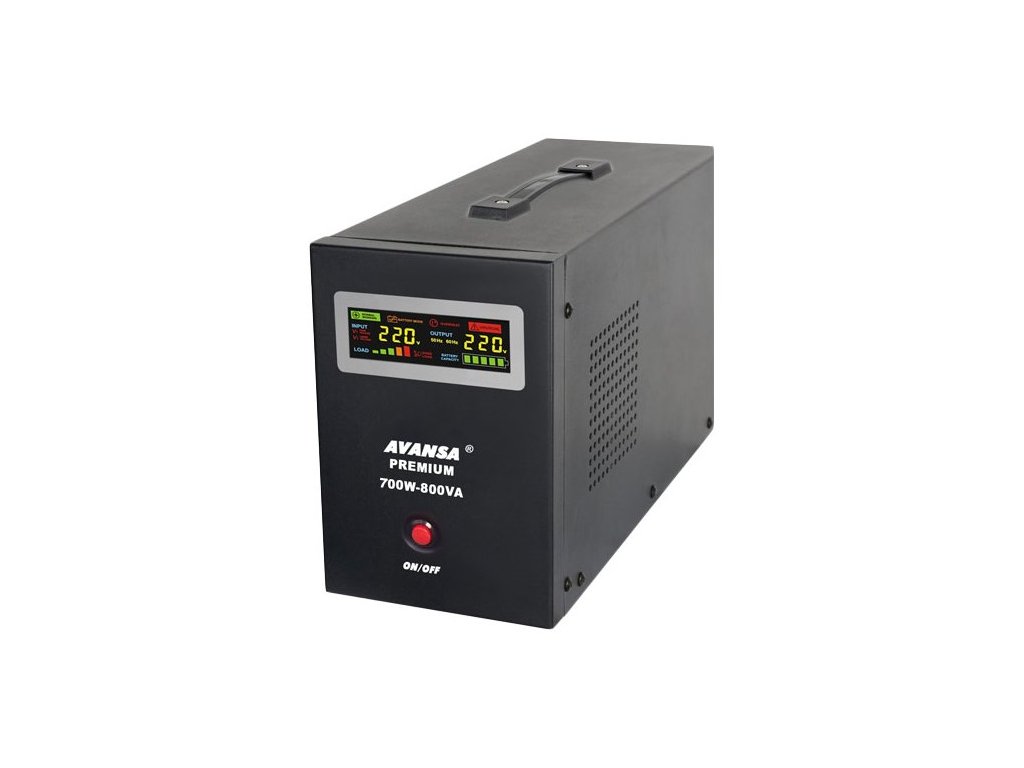 |
Avansa 1050 W - suitable for multi-zone systems with several circulation pumps (e.g. radiators + underfloor heating), or if you want a substantial reserve for the future. Price from 385.33 EUR. |
How the calculated load shows up across the different classes
Another angle on choosing is the source's percentage load - i.e. what share of its rated output you actually use during normal operation (185 W average draw). A lower load percentage means a bigger reserve for peaks, quieter operation (lower load = less heat, less wear) and usually a longer battery lifespan too, since it isn't subjected to repeated deep draws close to its limit.
The chart shows why we recommend the 300 W class only for a simple setup with no expansion - at 62% load there's not much room left for the 275 W startup peak we calculated above (275 W would already be 92% of the source's 300 W rated output, which is just below the limit, but with no reserve at all for battery ageing or slight variations in your specific pump's real draw). At the 500 W and 1050 W classes, on the other hand, there's comfortably enough room for the peak and for future additions.
A standalone battery - when it makes sense
If you already have a backup source at home and just want to extend its runtime, or conversely need to replace a worn-out battery, a standalone replacement battery without an inverter can also be bought. Here it's no longer about the draw of the connected appliances, but about the battery's capacity (Ah) - higher capacity means a longer runtime at the same draw. When choosing a replacement battery, it's important to check that the type (AGM or AFB), size and voltage level match your original source - you'll find this information in your UPS's manual, or ask us via the form below.
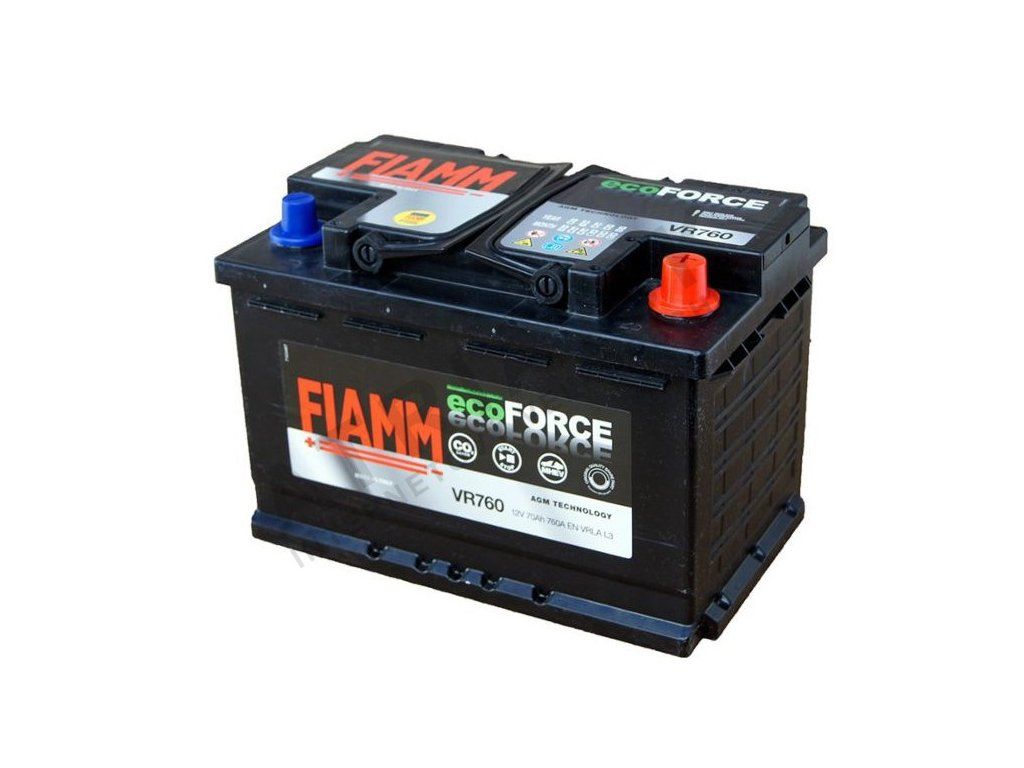 |
FIAMM ECOFORCE AGM VR 760 - a replacement AGM battery suitable for replacing a worn-out one in a backup source or extending its runtime, check compatibility with your model before buying. Price from 178.56 EUR. |
Common mistakes when choosing the output
Over the years we've been dealing with this topic, the same mistakes keep repeating. Here's a list of the most common ones so you can avoid them:
- Only counting the boiler's output in kW, not the real electrical draw. A boiler with a 24 kW heat output might have an electrical draw of only around 150-200 W - it's a completely different quantity and unit.
- Ignoring the pump's startup peak. The pump's rated (average) draw is only part of the story - the brief inrush draw at startup is typically 2-3 times higher, and it's exactly this that most often causes an undersized source to overload.
- Forgetting other zones or future expansion. If you buy a source right at the limit of your needs today and add underfloor heating with its own pump next year, you'll have to buy a new source instead of allowing for a reserve now.
- Overlooking the battery type and its effect on runtime under high draw. Not all batteries tolerate repeated high draws equally well - if in doubt, it's better to ask in advance than to deal with a complaint after the fact.
- Choosing the cheapest model regardless of the real load. The price difference between the 300 W and 500 W classes is usually smaller than it's worth saving, once you factor in the risk of overload and boiler restarts during an outage.
How to find your own boiler's real draw
The values given in this article are real, common ranges from practice, but every boiler and every pump is slightly different. If you want to be sure your specific setup comes out exactly right, we recommend the following approach:
- Check the boiler's rating plate - usually on the inside of the front cover, or in the technical data sheet you get from the installer. Look for a figure labelled "electrical draw" or "el. output", usually in watts (W), not kW.
- Find the circulation pump's rating plate - if the pump is standalone (not built directly into the boiler), it has its own plate with a draw figure, often with a range too (for example "speed-controlled pump 20-90 W").
- Measure the real draw with a wattmeter - if you can, a cheap mains wattmeter (commonly available at electronics shops) will show you the boiler's exact, current draw, including startup peaks, directly from the socket. This is the most reliable way to verify the theoretical values in practice.
- If in doubt, ask your installer or the boiler manufacturer - the boiler's technical data sheet always has this figure, and the installer who fitted the boiler usually has it on hand.
If the measured or found value differs significantly from the indicative figures in this article (for example if you have a large circulation pump without speed control, drawing above 100 W), recalculate the recommended power class using the same procedure - add up the real draw, add a 25-30% reserve, and compare it with the source's rated output.
What type of backup source is commonly used with boilers
Besides the output itself, it's worth knowing that backup sources also differ by the technology used to switch to the backup battery. With sensitive boiler electronics (control board, frequency-controlled circulation pump), it matters that the switch to battery is fast enough and the voltage waveform good enough quality - otherwise there's a risk the boiler will briefly restart during a mains outage before the switch to backup completes. That's exactly why line-interactive type sources, or ones with a sufficiently short switching time, are recommended for boilers, rather than the cheapest purely offline solutions with a long switching delay. The specific technology type and switching time can always be found in the technical description of the given product.
A practical example from an ordinary household
Let's imagine a typical family house with a gas condensing boiler, one circulation pump for radiators, and no further expansion planned. The sum of the electronics' draw (25 W), the fan's (100 W) and the running pump's (60 W) gives 185 W. When the pump starts up while the fan is also running, the brief peak can reach 275 W. After adding the recommended 25-30% reserve, we arrive at a value the 500 W class safely covers - the source's load comes out at 37%, leaving a comfortable reserve as well as room for possibly adding a smart thermostat or a second pump in the future.
If the same household planned to add underfloor heating with its own zone pump in the future (adding roughly another 40-70 W to the draw), it would be worth considering the 1050 W class right away, so the investment in a backup source doesn't need repeating a year later.
Frequently asked questions
Is a 300 W backup source enough for an ordinary boiler?
For a simple setup with one circulation pump and no planned expansion, yes, it usually covers normal operation as well as the startup peak. But if you plan to add anything (a second pump, underfloor heating, a smart thermostat), we recommend going straight for the higher 500 W class, which leaves a bigger reserve.
Why does my backup source restart exactly when the pump starts up?
This is typically an overload caused by the startup peak, which for motors (pumps and fans alike) is several times higher than their normal, average draw. If this happens repeatedly, it means the source's rated output is tight or insufficient for your setup, and you should consider a higher class.
Does the boiler's output in kW factor into the calculation?
No, the boiler's output in kW relates to heat (energy burned from gas or another fuel), not the electrical draw. When choosing a backup source you only care about the electrical draw of the individual components (electronics, fan, pump), which is an entirely different, much lower figure.
Can I connect a router or a home alarm control panel to the same backup source?
Yes, as long as the source has enough output reserve and battery capacity. In that case we recommend adding these devices' draw to the total sum right at the first step of the calculation, and choosing the power class accordingly, or asking us via the form below.
Is there a difference between W and VA when choosing a backup source?
Yes, these are different quantities (real and apparent power), which for real appliances with a motor (pumps, fans) differ depending on the device's power factor. When comparing products we recommend going by the figure in watts (W), which is closer to the real consumption, and if in doubt, always check the exact figure in the product description or ask us.
How long does a backup source last during a power outage?
Runtime depends on the battery's capacity and the real draw of the connected appliances - the higher the source's load percentage, the shorter the runtime. Exact runtime figures for a specific model can be found in the product description, or read the separate article dedicated to this topic (link below).
Related topics
- How to choose a backup source for a boiler
- Backup power for a circulation pump
- How long does a backup source last during a power outage
- Maintenance and replacement of a backup source battery
You can find the whole range of backup sources for boilers and pumps in the category Backup power sources for boilers, pumps.
Do you have a question on this topic?
Can't decide, or dealing with a specific situation in your household? Write to us - we're happy to help.